
Garis besar topik
-
-
Siswa harusTandai selesai
1. Students are able to analyze data
2. Students are able to interpret the results of data processing
-
Siswa harusTandai selesaiHari: RabuTanggal: 23 Desember 2020Waktu : 16.00 - 15.30 WIBLink :
-
-
Siswa harusTandai selesai
In research, the data analysis section may consist of a number of components. However, the overall data analysis process involves interpreting data in the form of text or images. For this reason, a researcher needs to prepare the data for analysis, carry out different analyzes, deepen understanding of the data, present the data, and make a broader interpretation of the meaning of the data. The following is a description of some of the general processes researchers could explain in their research to illustrate the overall data analysis activity.
Analysis
Data analysis is the process of systematically compiling data obtained from observation through organizing data into categories, describing them into units, conducting hypotheses to making conclusions that can be understood by observers themselves and others.
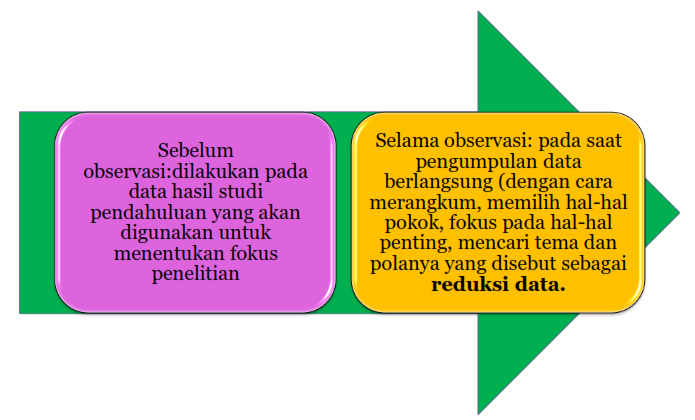
The data analysis process according to Sugiyono (2011) is as follows:
Interpretation of Data
Interpretation of research data is a form of activity to combine the results of an analysis with various kinds of questions, criteria, and to a certain standard in order to be able to create a meaning from the existence of data that someone has collected in order to find an answer to problems that exist in a study are currently being corrected.
The stages in data interpretation according to Poerwandari (2008) are:
1. Data organization
2. Coding / analysis
3. Creating a hypothesis and testing the hypothesis
4. Make conclusions
For more details, please open the link as follows:
-
Siswa harusTandai selesai
Quantitative data analysis methods are methods that depend on the ability to calculate data accurately. In addition, this method also requires the ability to interpret complex data. Some examples of quantitative analysis methods, such as descriptive analysis, regression, and factors. Quantitative data analysis methods have various types of analysis such as correlational techniques, regression, comparison, descriptive and the like.
Quantitative Research Assumptions
Quantitative research is based on the following assumptions (Nana Sudjana and Ibrahim, 2001; Del Siegle, 2005, and Johnson, 2005).
This method is an approach to data processing through statistical or mathematical methods which are collected from secondary data. The advantage of this method is a more measured and comprehensive conclusion. Other methods that can be used in the data analysis process are text analysis, statistical, diagnostic, predictive, prescriptive.
a. That the reality that is the target of research is single-dimensional, fragmental, and tends to be fixed so that it can be predicted.
b. Variables can be identified and measured by means of objective and standard.
Characteristics of Quantitative Research
The characteristics of quantitative research are as follows (Nana Sudjana and Ibrahim, 2001: 6-7; Suharsimi Arikunto, 2002: 11; Johnson, 2005; and Kasiram 2008: 149-150):
a. Using deductive thinking patterns (rational - empirical or top-down), which tries to understand a phenomenon by using general concepts to explain specific phenomena.
b. The logic used is positivistic logic and avoids things that are subjective.
c. The research process followed a planned procedure.
d. The purpose of quantitative research is to construct nomothetic science, namely science that seeks to make laws from its generalizations.
e. The subject under study, the data collected, and the source of the data needed, as well as the data collection tools used in accordance with what was planned beforehand.
f. Data collection is done through measurement using objective and standard tools.
g. Involves tallying numbers or quantifying data.
h. Researchers place themselves separately from the object of research, in the sense that they are not emotionally involved with the research subject.
i. Data analysis was performed after all data were collected.
j. In data analysis, researchers are required to understand statistical techniques.
k. The results of the study are in the form of generalizations and predictions, regardless of the context of time and situation.
l. Quantitative research is called scientific research
Quantitative Research Procedures
In practice, this research is based on a previously planned procedure. The quantitative research procedure consists of the following activity stages.
a. Identify the problem
b. Study of literature.
c. Development of a conceptual framework
d. Identification and definition of variables, hypotheses, and research questions.
e. Research design development.
f. Sampling technique.
g. Data collection and quantification.
h. Data analysis.
i. Interpretation and communication of research results.
Types of Quantitative Research
In conducting research, researchers can use certain methods and designs by considering the research objectives and the nature of the problems at hand. Based on the nature of the problem, quantitative research can be divided into several types as follows (Suryabrata, 2000: 15 and Sudarwan Danim and Darwis, 2003: 69 - 78).
a. Descriptive research
b. Correlational research
c. Comparative causal research
d. Action research
e. Developmental research
f. Experimental research
Quantitative Research Methods
The method used in quantitative research, especially quantitative analytic, is the deductive method. In this method a scientific theory that has been accepted as a truth is used as a reference in finding further truth.
Jujun S. Suriasumantri in his book Science in a Moral, Social, and Political Perspective (2000: 6) states that basically the scientific method is a way for science to acquire and organize its body of knowledge based on: a) a logical framework of thought with arguments that are consistent with knowledge previously compiled; b) describe the hypothesis which is the deduction of the said framework; and c) verify the hypothesis in question to test the truth of the statement factually.
Furthermore, Jujun stated that the scientific framework which is based on the logico-hypothetico-verification process basically consists of the following steps (Suriasumantri, 2005: 127-128).
a) The formulation of the problem, which is a question about an empirical object that has clear boundaries and can be identified the factors involved in it.
b) The preparation of a frame of mind in the formulation of hypotheses which is an argument that explains the possible relationships between various interrelated factors and forms a constellation of problems. This thinking framework is arranged rationally based on scientific premises that have been verified by taking into account the empirical factors that are relevant to the problem.
c) Formulation of hypotheses which are temporary or presumptive answers to the questions posed whose material is the conclusion of the developed frame of mind.
d) Hypothesis testing, which is the collection of facts relevant to the proposed hypothesis to show whether there are facts that support the hypothesis or not.
e) Drawing conclusions which is an assessment of whether the proposed hypothesis is rejected or accepted.
The steps or research procedures were then visualized by Jujun S. Suriasumantri in chart form as follows:

For more details, please see the following shows:
-
Siswa harusTandai selesai
This data analysis method is a method using interviews and observations by answering questions like what, why or how. The data analyzed by this method is in the form of text or narrative. Furthermore, from the overall data, a classification process is carried out based on the needs with a coding process. The last stage in this method is data interpretation. The actual data interpretation process is carried out simultaneously during coding. Interpretation attempts were made simultaneously in classifying the data. Interpretation step to analyze data to produce the required information.
This method requires a more subjective approach to data. Qualitative data analysis method is a method of in-depth data processing with data from observations, interviews, and literature. The advantage of this method is the depth of the analysis results. On the other hand, this is the added value of the qualitative analysis method, in which the analyst plays an important role in the analysis process as part of the research tool.
What is meant by qualitative analysis is a job that aims to investigate and determine the content of the compounds contained in a test sample. This qualitative analysis is carried out using standard testing techniques in the laboratory.
The method used in conducting this qualitative analysis test can be in the form of classical methods or using sophisticated instruments. The most important classical test method is color analysis or color reaction.
By burning the test compound and then seeing the specific flame color produced, it can be seen the compounds contained therein. Both methods are preliminary tests.
This method can be used for inorganic compounds both cations, anions, or also for organic compounds such as phytochemical screening techniques in the selection of plant secondary metabolites. Another qualitative analysis method that can be used to determine the substance content is the flame color test.
Using Instrument
In the use of analytical instruments, it is usually known that in today's times, it can perform various qualitative analyzes depending on the specifications of the instrument.
For example: Variable Consumer Behavior, which measures consumer behavior (based on theory) consists of: cultural, social, personal, psychological factors, and purchase decisions
Qualitative Research Characteristics
1. The data collected is in the original condition or natural (natural setting).
2. The researcher acts as a research tool, meaning that the researcher is the main tool for collecting data / as an observer of the interview.
3. As much data as possible were collected descriptively, which was then written in the form of a report.
4. Qualitative research is more concerned with process than results.
5. The background of behavior or actions is searched for meaning.
6. Using the method triangulation method or data triangulation.
7. Concerned with contextual details.
Types of Qualitative Data Analysis
In general, data analysis methods include reduction, data display and data conclusions or verification. However, because there are so many caulitative data, the data analysis model also varies according to the object of research. In general, the data analysis model is divided into three groups: first, the text and language analysis methods group; second, the analysis method group for cultural themes; third, group analysis of performance, individual behavior and institutional behavior [11].
The parts of the three groups of qualitative data analysis models above are as follows [12]:
1. Group of text and language analysis methods
a) Content analysis (this analysis)
b) Framing analysis (Frame analysis)
c) Semiotic analysis
d) Analysis of mass social media construction
e) Hermeneutic
f) Discourse analysis and text interpretation
g) Critical discourse analysis
2. Group analysis of cultural themes
a) Structural analysis
b) Domain analysis
c) Taxonomy analysis
d) Componential analysis
e) Discovering cultural theme analysis
f) Constant comparative analysis
g) Grounded analysis
h) Ethnology
3. Group performance analysis and individual experiences and institutional behavior
a) Focus group discussion (FGD)
b) Case studies
c) Biographical techniques
d) Life's history
e) SWOT analysis
f) Use of documentary materials
g) Use of visual materials
Source:(1) William J. Goode dan Paul K. Hatt, Methods in social research, Kogakusa: McGraw-Hill Book Company, 1981
(2) Sugiyono, Metode Penelitian Kuantitatif dan Kualitatif Dan R & D, (Bandung : Alfabeta, 2009), hlm. 338.
http://
http:// -
Siswa harusTandai selesai
The difference between qualitative and quantitative research can be seen from several aspects. Not always contradicting each other, there are also those who have similarities or similarities between the two.
1. Qualitative is general, flexible, and dynamic.
2. Quantitative has a specific, detailed and static nature. The flow of quantitative research itself was planned from the start and cannot be changed.
Data analysis
- Qualitative can be analyzed during the research process.
- Quantitative can be analyzed at a final stage prior to reporting.
Research Subject Terms
- Qualitative research subjects are usually referred to as sources.
- Quantitative has research subjects who are commonly referred to as respondents.
- Look at the Facts
- Qualitative: Qualitative research views "Facts / Truth" depending on how the researcher interprets the data. This is because there are complex things that cannot be explained simply by numbers, such as human feelings.
- Quantitative: Quantitative research views "Facts / Truth" as being the object of research out there. Researchers must be neutral and impartial.
Data collection
- Qualitative: Qualitative research focuses more on something that cannot be measured by black and white truth, so that in qualitative research the researcher digs deep into the data on certain things.
- Quantitative: Data collection was carried out using a series of research instruments in the form of tests / questionnaires.
Data Representation
- Qualitative: The results of qualitative research are in the form of the researcher 's interpretation of a phenomenon, so that the research report will contain more descriptions.
- Quantitative: The results of quantitative research are presented in the form of mathematical calculation results. The results of the calculation are considered as confirmed facts.
Implications of Research Results
- Qualitative: The results of qualitative research have a limited impact or effect on a particular situation. So that the results of this study cannot be concluded in different settings.
- Quantitative: The results of quantitative research are generalized facts / theories. Whenever and wherever, this fact applies.
Kinds of Methods
- Qualitative: Phenomenology, ethnography, case studies, historical, grounded theory.
- Quantitative: Experiment, survey, correlation, regression, path analysis, ex post facto.
Research purposes
- Qualitative: gain deep understanding, develop theory, describe reality and social complexity.
- Quantitative: Explaining the relationship between variables, testing the theory, generalizing the social phenomena under study.
Type of Data
- Qualitative: qualitative research is in the form of descriptive or describes the phenomenon or research facts as they are.
- Quantitative: data types that are numeric or numeric. In addition, it is also in the form of statistics, namely data that has been grouped so that it can provide information about a problem or symptom.
Some summaries of the differences between quantitative and qualitative research are as follows:

- Qualitative Research
Purpose: subject approach, sample, data source, flexible research steps can change and develop as you go along.- Quantitative Research
Purpose: subject approach, sample, research steps, data sources are clear.
- Qualitative Research:
- Watching participates in trying to find meaning. Must go directly to make participants active in the respondent's life.
- Do it objectively
- Record data and with facts.
- Recording must be done in a formal and thorough and consistent with the objectives of the researcher.
- The existing phenomena must be seen from the context, both in terms of function and structure.
- More to case studies in the field, for example ethnographic issues, and so on.
Quantitative Research:
- The quantitative approach emphasizes the results of the existing diversity averages
- The way of thinking in analyzing with a qualitative approach emphasizes logic, which looks for mistakes.
- Quantitative:
- Is viewed as exploratory and inductive.
- Measuring facts. The focus on reliability / reliability is key
- Separate theory and data
- In a free context
- The case of many subjects
- Not involved- Qualitative Research:
Is a collection of data in a natural setting with the intention of interpreting the phenomena that occur where research is a key instrument, sampling of data sources is done purposively and snowball.- Quantitative Research:
Retrieval of data is available because it has experienced continuous previous treatment. Thus the sample was taken through a questionnaire, which then the data was processed statistically in accordance with the research objectives.
- Qualitative Research:
- Build social reality, cultural meaning
- Focus on Interactive process activities
- Intensity is key
- Present and explicit values
- Theory and data converge
- Restricted situation
- Few subject cases
- Related systematic analysis
- Researchers are involved.
- Quantitative Research:
- Make generalizations in making conclusions for a population whose samples have been homogenized through the appropriate sampling method.
- Researchers collect data that is already available so that the involvement of researchers is not really needed in the field.
- Qualitative Research:
- An effective thing
- Reality variables can be identified and measured
- Research is independent from the object of observation
- Quantitative Research
- Reality is a social form
- variables are relatively difficult to measure, complex and interconnected - the researcher relates directly to the object or participant being observed.
- Qualitative Research:
- Hypotheses are developed in line with research or research momentary.
- Definition according to the context or when the researcher is ongoing
- Narrative descriptions or words of phrases or statements
- Prefer to assume sufficient reliability of collection
- The validity assessment corresponds to cross-checking of information sources
- Use descriptions narrative
- Quantitative research:
- Using a hypothesis determined from the beginning of the researcher
- A clear definition was stated from the start
- Reduce data to numbers
- Pay more attention to the reliability of the scores obtained through the research instrument
- assessment of validity using various procedures relying on statistical counts
- use a clear (current) procedure description
-