Garis besar topik
-
-
Pengantar Perkuliahan
Assalamu'alaikum Wr. Wb
Tabik Pun...
Selamat bergabung rekan rekan Mahasiswa yang saya banggakan, semoga kita selalu dalam kondisi sehat walafiat dan dalam Lindungan Allah SWT.
Pada kesempatan ini, kita akan mempelajari Perkuliahan dengan materi Wireless Sensor Network (SKO20428) online/daring SPADA (Sistem Pembelajaran Daring) Jurusan Sistem Komputer Fakultas Ilmu Komputer IIB Darmajaya. Mata kuliah Wireless Sensor Network ini memiliki beban 4 SKS terdiri dari 2SKS teori dan 2 SKS praktek. Detail pembelajaran selama 1 semester dapat dilihat pada Rencana Pembelajaran Semester (RPS) yang dapat diunduh melalui http://rps.darmajaya.ac.id/.Pada era modern saat ini teknologi wireless memegang peran sangat penting, hampir semua aktivitas kita sehari hari tidak lepas dari fungsi wireless dan sensor pada peralatan yang kita digunakan. Oleh sebab itu, perlunya kita mempelajari dan memahami secara sistematis dan terstruktur keilmuan di bidang tersebut.Selamat mengikuti perkuliahan ini dengan baik, Salam hangat dan tetap semangat !!!
Wassalamu'alaikum Wr. Wb
Rabbi zidnii ilman Warzuqnii fahmaa, Waj alni minash sholihin
Ya Allah, tambahkan ilmu ku dan berikan aku kemampuan untuk memahaminya, dan jadikanlah aku termasuk golongan orang yang sholeh.
-
Siswa harusTandai selesai
Deskripsi Matakuliah:
Mata kuliah ini mempelajari Jaringan Sensor Nirkabel atau disebut Wireless Sensor Network (WSN) yang merupakan sebuah jaringan yang menghubungkan perangkat-perangkat seperti sensor node, router dan sink node yang terhubung secara ad-hoc dan mendukung komunikasi multi-hop.Capaian Pembelajaran Matakuliah:
Mampu menganalisis sistem jaringan WSN (pengetahuan), dan menentukan perangkat (input/output) dan sensor dalam sistem WSN (sikap), serta dapat merancang sistem melalui simulasi dan pembuatan program aplikasi sederhana (keterampilan).Peta Pembelajaran:
Struktur Pelaksanaan:
Struktur Pelaksanaan Perkuliahan mata kuliah ini, diharapkan seluruh peserta didik dapat menyelesaikan mata kuliah ini dalam kurun waktu satu semester Adapun struktur pelaksanannya adalah sebagai berikut:
- Peserta didik diwajibkan membaca setiap materi dan konten yang diberikan per pokok bahasan.
- Peserta didik wajib mengisi presensi kehadiran sesuai jadwal pada menu atttendace setiap kali melaksanakan perkuliahan online.
- Peserta didik secara aktif berpartisipasi dalam diskusi baik secara sinkron (zoom) maupun asinkron (diskusi di LMS).
- Peserta didik wajib mengerjakan tugas, kuis, maupun aktifitas lain yang telah disediakan.
- Setelah peserta didik mempelajari seluruh pokok bahasan pada pertemuan 1 sampai dengan 7, maka peserta didik dapat mengikuti UTS.
- Pada saat seluruh pokok bahasan telah dipahami dan dipelajari oleh peserta didik, maka yang bersangkutan dapat mengikuti UAS.
- Seluruh bentuk aktivitas selama perkuliahan online harus terdata di LMS ini.
Model Asesmen dan Bobot Penilaian:
Asesmen dan bobot penilaian pada matakuliah ini adalah sebagai berikut:
Dosen Pengampu Mata Kuliah:
Nama : Bayu Nugroho, S.Kom., M.Eng NIK : 00200700 NIDN : 0218037701 Ruang : Ruang Dosen Jurusan SK (Gd F lt 1) email : bayu@darmajaya.ac.id 
Panduan Penggunaan Tools Virtual dan Piranti Komunikasi
Mata kuliah ini menggunakan metode pembelajaran asinkronus dan sinkronus. Metode pembelajaran asinkronus menggunakan materi yang sudah diunggah pada modul LMS. Referensi utama telah disiapkan pada laman ini, namun mahasiswa dapat menggunakan berbagai macam sumber lain (buku, jurnal, sumber online) untuk menambah wawasan. Sedangkan metode pembelajaran sinkronus akan menggunakan aplikasi Zoom. Aplikasi lainnya yang digunakan adalah software simulator Proteus. Berikut panduan penggunaan Zoom dan software simulator Proteus untuk pembelajaran.Tools Virtrual (Aplikasi Zoom) tutorial:Tools Simulator Software (NS2 Simulator) tutorial:How to Download and install NS2 in Windows 7 (Explained in Tamil) Step by Step Tutorial Download link:http://www.mediafire.com/file/grznu18m0728ds8/NS_2.35_for_Windows_7.rar/filehttps://www.youtube.com/watch?v=NkS8T5EtSWcBuku Ajar
Materi buku ajar:


Link Download:
http://www.tfb.edu.mk/amarkoski/WSN/Kniga-w02
https://www.google.com/url?sa=t&rct=j&q=&esrc=s&source=web&cd=&ved=2ahUKEwjTvZv4tLHvAhWjILcAHW8VDZQQFjAAegQIAhAD&url=http%3A%2F%2Fwww.tfb.edu.mk%2Famarkoski%2FWSN%2FKniga-w03.pdf&usg=AOvVaw1SwfB8cQLwxjYEc3Y_2iAJ
Jurnal dan Video Inspirasi
Pretest
Pretest akan dilaksanakan dengan ketentuan sebagai berikut :
- Pretest dilaksanakan secara online pada pertemuan pertama melalui Attemp1 Pretest.
- Pretest akan terbuka dan otomatis tertutup sesuai dengan jadwal yang telah ditentukan.
-
Siswa harusTandai selesai
Presensi elearning
Matakuliah : WSNKelas : 6SK-P1NO NPM NAMA PRESENSI KEHADIRAN 1 2 3 4 5 6 7 UTS 9 10 11 12 13 14 15 UAS 1 1911068021P AGUSTINA CINDY AMELIA √ √ √ √ √ √ √ √ √ √ √ 2 1911068015P AHMAD YUDI FIRMANSYAH √ √ √ √ √ √ √ √ √ √ 3 1911068012P BRAMASTAJI √ √ √ √ √ √ 4 1811060013 DIMAS SETIA PUTRA √ √ √ √ √ √ √ 5 1811060037 EFAN ULFADA √ √ √ √ √ √ √ √ √ 6 1811060001 Galang Tirtoaji Pratama √ √ √ √ √ √ √ √ √ √ √ 7 1911068013P HERI SETIAWAN √ √ √ √ √ √ √ √ √ √ 8 1911068019P MELINA √ √ √ √ √ √ √ √ √ √ 9 1911068014P NASRIL AHMAD √ √ √ √ √ √ √ √ √ √ 10 1911068022P QORRI INDAH SAPUTRI √ √ √ √ √ √ √ √ √ √ 11 1911068017P RIA SILVIANA √ √ √ √ √ √ √ √ √ √ √ 12 1911068029P RICKY ANJASMARA √ √ √ √ √ √ 13 1911068018P SEKAR PATMADANI √ √ √ √ √ √ √ √ √ √ √ 14 1811060040 SUHENDRO √ √ √ √ √ √ √ √ √ √ √ 15 1911060047 WAHYU PRASTIO WIBOWO √ √ √ √ √ √ √ √ √ √ Pelaksanaan Perkuliahan:
Seluruh mahasiswa wajib menyelesaikan materi kuliah ini dalam kurun waktu satu semester. Adapun pelaksanannya adalah sebagai berikut:- Perkuliahan dilaksanakan secara DARING/Online (via Zoom) dan LURING/Offline (tatap muka).
- Mahasiswa dibagi dalam 2 kelompok berdasarkan NOMOR URUT PRESENSI Ganjil dan Genap (BUKAN NOMOR NPM !!!).
- Mahasiswa dalam kelompok nomor urut presensi GANJIL masuk (tatap muka) pada minggu pertama dengan perkuliahan LURING/Offline, sedangkan Mahasiswa dalam kelompok nomor urut presensi GENAP pada minggu pertama mengikuti perkuliahan secara DARING/Online.
- Pada minggu ke dua dan seterusnya,Mahasiswa masuk secara bergantian secara DARING/Online (via Zoom) dan LURING/Offline (tatap muka) hingga minggu terakhir perkuliahan.
- Seluruh presensi kehadiran selama perkuliahan WAJIB harus online di LMS ini.
-
-
Attemp1 Pretest
Pretest ini merupakan uji pengetahuan tentang sejauh mana materi yang telah didapat sebelumnya yang akan dilanjutkan ke materi Wireless Sensor Network. Jawab berdasarkan pengetahuan anda apa adanya (tidak membuka buku ataupun searching di Google) karena TIDAK ADA PENILAIAN dalam tugas ini.-
-
Siswa harusTandai selesai
A sensor network1 is an infrastructure comprised of sensing (measuring), computing, and communication elements that gives an administrator the ability to instrument, observe, and react to events and phenomena in a specified environment. The administrator typically is a civil, governmental, commercial, or industrial entity. The environment can be the physical world, a biological system, or an information technology (IT) framework. Network(ed) sensor systems are seen by observers as an important technology that will experience major deployment in the next few years for a plethora of applications, not the least being national security [1.1ΓÇô1.3]. Typical applications include, but are not limited to, data collection, monitoring, surveillance, and medical telemetry. In addition to sensing, one is often also interested in control and activation.


-
-
-
-
-
APPLICATIONS OF WIRELESS SENSOR NETWORKS
WSN s are collections of compact -size, relat ively inexpensive computational nodes that measure local environment al conditions or other parameters and forward such information to a central point for appropriate processing. WSNs nodes (WNs) can sense the environment, can communicate with neighboring nodes, and can, in many cases, perform basic computations on the data being collected. WSN s suppor t a wide range of useful applications . In this chapter we identify some of these applications ; the chapter is not intended to beexhaustive , simply illustrative.-
Siswa harusTandai selesai
silahkan bergabung dengan kelas.
https://meet.google.com/fgn-dvxz-hob
-
-
-
-
-
-
BASIC WIRELESS SENSOR TECHNOLOGY
In this chapter we look at basic sensor node systems technology at several levels. First, we focus on the sensor node technology itself (Section 3.2), providing a survey of sensor technology, including a taxonomy that classifies devices in families, such as large sensors (e.g., radar sensors), microsensors (tiny sensors), nanosensors, tag-reading sensors, and other sensors (Section 3.3). As already noted, WSNs are characterized by the fact that they need to operate in resource-constrained environments; in turn, this fact imposes strict design guidelines and limitations on the WNs; to this end, we address sensor functionality and components, including the sensing and actuation unit, processing unit, communication unit, power unit, and other application-dependent units. Second, we look at fundamental networking and topological issues (Section 3.4). Building on the introduction provided herein, these issues are revisited in more detail in subsequent chapters. Finally, we look at some current research trends in sensor technology.
-
-
WIRELESS TRANSMISSION TECHNOLOGY AND SYSTEMS
In this chapter we look at radio-channel-related issues. It should immediately be noted that to maximize the opportunity for widespread and cost-effective deployment of WSN , one needs to make use of existing and/or emerging commercial off-the-she lf (COTS) wireless communications and inf rastructures rath er than having to develop an entirely new, specially designed apparatus. WSNs can use a number of wireless COTS technologies, such as Bluetooth/Persona l Area Networks (PANs), ZigBee , wireless LANs (WLAN)/hotspots, broadband wireless access (BWA)/WiMax, and 3G.
-
Siswa harusTandai selesai
The electromagnetic spectrum provides an unguided medium (channel) for point-to- point and/or broad cast radio transmission. Radio transmissi on is usually (frequency)-bandlimited by design. The analog bandwidth of the channel (the slice of electromagnetic frequency domain used) determines how much information (analog or digital) can be transmitted over the channel.


-
-
-
MEDIUM ACCESS CONTROL WSN
WSNs are typically composed of a large numb er of low-cost , low- power, multi functional wireless devices deployed over a geographical area in an ad hoc fashion and without careful planning . Individually, sensing devices are resource constrained and therefore are only capable of a limited amount of processing and communication. It is the coordinated effort of these sensing devices, however, that bears promise for a significant impact on a wide range of applications in several fields , including science and engineering, military settings, critical infrastructure protection, and environmental monitoring.
-
Siswa harusTandai selesai
Communication among wireless sensor nodes is usually achieved by means of a unique channel. It is the characteristic of this channel that only a single node can transmit a message at any given time. There fore, shared access of the channel requires the establishment of a MAC protocol among the sensor nodes.


-
-
Siswa harusTandai selesai
INSTALLASI NETWORK SIMULATOR
Lakukan installasi NETWORK SIMULATOR (NS Versi 2.35)
Mulai pertemuan 5 dst, menggunakan Software Network Simulator. Silahkan di Install di Laptop masing-masing.
-
-
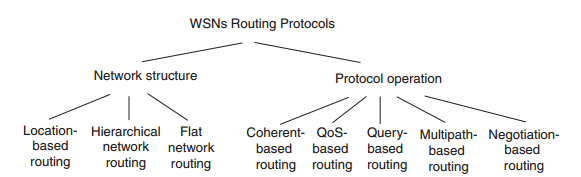
ROUTING PROTOCOLS FOR WSN
WSNs are extremely versatile and can be deployed to support a wide variety of applications in many different situations, whether they are composed of stationary or mobile sensor nodes. The way these sensors are deployed depends on the nature of the application.
-
Siswa harusTandai selesai
The way that data and queries are forwarded between the base station and the location where the target phenomena are observed is an important aspect and a basic feature of WSNs. A simple approach to accomplishing this task is for each sensor node to exchange data directly with the base station.


-
-
-
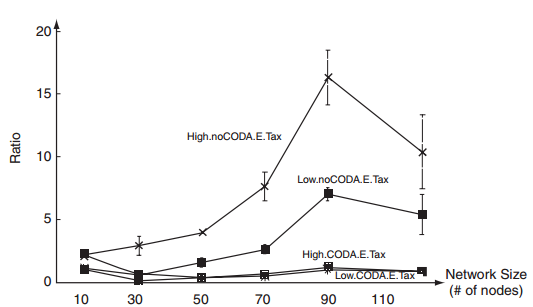
TRANSPORT CONTROL PROTOCOLS WSN
The architecture of computer and communication networks is often structured in layers: physical, data link, network (or internetworking), transport, and other higher layers, including session, presentation, and application. Each lower layer act s as a service provider to its immediate upper layer, which is a service user.-
Siswa harusTandai selesai
The question we deal with in this section is how to recover lost packets. Generally, two methods are available for this purpose: cache and non cache recovery. Non cache recovery is an end-to-end ARQ (automatic repeat request) similar to the traditional TCP.

-
-
-
UJIAN TENGAH SEMESTER (UTS)
Pelaksanaan UTS TeoriHari : SELASATanggal : 25 Mei 2021, 08.50 wibUTS TEORI : RABU, 26 Mei 2021. 23.59 wib.UTS PRAKTIKUM : SABTU, 29 Mei 2021, 23.59 wib -
-
MIDDLEWARE FOR WIRELESS SENSOR NETWORKS
WSNs are constrained in resource s such as bandwidth, computation and communication capabilities, and energy. WSN topology is variable due to node mobility, depletion of energy, switching between sleep and active states , radio range, and routing possibilities. A WSN may also need to support several applications simultaneously. There fore, a WSN is a wireless/mobile and resource-constrained network with diverse applications. The problem in this resource-constrained environment is how to design middle ware that is capable of adaptation between applications and network protocols.
-
-
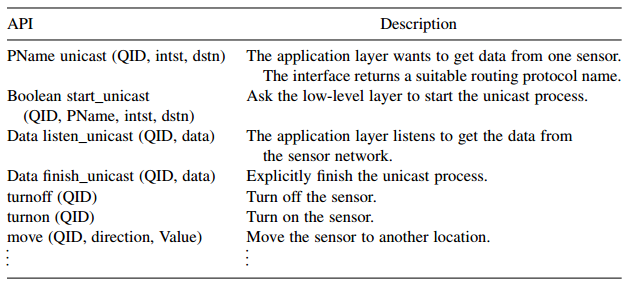
NETWORK MANAGEMENT FOR WSN
In this chapter we first briefly introduce traditional network management models, then identify issues and requirements of a network management system for WSN s and present an existing network management architecture. Issues of naming and localization as they relate to WSN management are also discussed.
-
-
OPERATING SYSTEMS FOR WSN
WSNs can be used to monitor and/or control physical environmentin space where it is difficult or impossible to do so manually. A W S N is generally composed of a centralized station (sink) and tens, hundreds, or perhaps thousands of tiny sensor nodes such as Mote [10.1] and Mica2 [10.1]. With the integration of information sensing, computation, and wireless communication, these devices can sense the physical phenomenon, (pre-)process the raw information, and share the processed information with their neighboring nodes. The sensor nodes can form a WSN either ad hoc or with, for example, a cluster-based architecture.
-
Siswa harusTandai selesai
The traditional OS is system software that operates between application soft ware and hardware and is oft en designed for workstations and PCs with plenty of resource s. This is usually not the case with sensor nodes in WSNs. There are also embedded operating systems such as VxWorks [10.21 ] and WinCE [10.22], none of which is specially designed for data-centric WSNs with constrained resource s. Sensors usually have a slow processor and small memory, different from mos t current systems. In this chapter, parameters that should be kept in mind in the process of OS design for WSN nodes are considered.
-
-
-
-
PERFORMANCE AND TRAFFIC MANAGEMENT
WSNs usually consist of hundreds or thousands of sensor nodes scattered in a geographical area and one or multiple sink(s) collecting information and transmitting it through wireless channels (Figure 11.1). The special design and character of sensors and their applications make WSNs different from traditional networks.
-
-
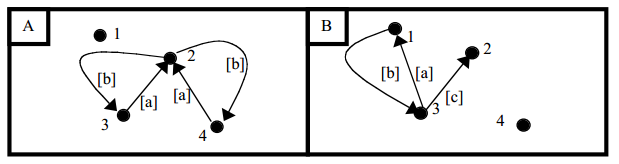
Structured Proactive and Reactive Routing
On-demand routing schemes suffer from the initial route setup latency, introduced by their discovery phase. This degrades the performance of interactive and/or multimedia applications. Table-driven routing, on the other hand, responds more quickly to call/route requests, but it wastes a large portion of the scarce wireless bandwidth on routing table broadcasts. Structured routing can be utilized to reduce the route setup time and increase throughput.
-
-
Hybrid Routing
Advances in ad hoc network research have opened the door to an assortment of promising military and commercial applications for ad hoc networks. However, because each application has unique characteristics (such as traffic behavior, device capabilities, mobility patterns, operating environments, etc.), routing in such a versatile environment is a challenging task, and numerous protocols have been developed to address it. While many protocols excel for certain types of ad hoc networks, it is clear that a single basic protocol cannot perform well over the entire space of ad hoc networks. To conform to any arbitrary ad hoc network, the basic protocols designed for the edges of the ad hoc network design space need to be integrated into a tunable framework.
-
-
TUGAS BESAR
-
Siswa harusTandai selesai
Rancang sebuah skema WSN. Tuliskan komponen yang digunakan, fungsi dan cara kerjanya pada skema yang anda buat.
-
-
-