Garis besar topik
-
-
Siswa harusTandai selesai
In this topic, we will explain the scale of data measurement using a questionnaire from techniques, types to examples.
A questionnaire is an information gathering technique that enables the analyst to study the attitudes, beliefs, behaviors, and characteristics of key people in an organization who may be affected by a proposed system or by an existing system. By using a questionnaire, the analyst attempts to measure what is found in the interviews, in addition to determining how broad or limited the sentiments expressed in an interview are.
The use of the questionnaire is appropriate when:
1. Respondents (people who respond or answer questions) are far from each other.
2. Involve a number of people in the system project, and it is useful to know what proportion of a certain group agrees or disapproves of a particular feature of the proposed system.
3. Conducting studies to find out something and want to seek all opinions before the system project is given certain instructions.
4. Want to be sure that problems in the existing system can be identified and discussed in follow-up interviews.
TYPES OF QUESTIONS IN THE QUESTIONNAIRE
The difference between the questions in the interview and the questions in the questionnaire is that in the interview, there is an interaction between the questions and their meaning. In interviewing the analyst has the opportunity to filter a question, define terms that are not clear, change the flow of questions, respond to complex views and generally control to fit the context. Some of the above opportunities are also possible in the questionnaire. So for the analyzer the questions must be absolutely clear, the flow of questions makes sense, the questions from the respondents are anticipated and the order of the questions is planned in detail.
The types of questions in the questionnaire, as follows:
1. Open Questions
Questions that provide respondents with open response options. In an open-ended question, anticipate the type of response that will arise. The response received must still be able to translate correctly.
2. Closed Questions
Questions that limit or close the response options available to the respondent.
The guidelines to follow when selecting the language for the questionnaire are as follows:
* Use the respondent's language whenever possible. Try to keep the words simple.
* Working with more specifics is better than being vague in the choice of words. Avoid using specific questions.
* Questions should be short.
* Don't side with the respondent by speaking to them in their lower level language choices.
* Avoid bias in the choice of words. Also avoid bias in difficult questions.
* Ask questions to the right respondents (meaning people who are able to respond). Don't assume they know much.
* Make sure that the questions are technically accurate enough before using them.
* Use software to check if the reading level is correct for the respondent
SCALE IN THE QUESTIONNAIRE
Scaling is the process of assigning numbers or symbols to an attribute or characteristic that aims to measure that attribute or characteristic. The reasons the systems analyst designs the scale are as follows:
1. To measure the attitudes or characteristics of the people who answered the questionnaire.
2. In order for respondents to choose the subject of the questionnaire.
DESIGNING QUESTIONNAIRE
Designing forms for data input is very important, as well as designing a questionnaire format is also very important in order to collect information about attitudes, beliefs, behaviors and characteristics.
The best questionnaire format is:
* Give sufficient free space,
* Points to empty space around page or screen text. To increase the response rate use white or slightly darker colored paper, for web survey designs use an easy-to-follow view, and if the form continues on several other screens it is easy to scroll to other parts.
* Give enough room for response,
* Ask respondents to mark answers more clearly.
* Using objectives to help determine format.
* Consistent with style.
2. Order of Questions
In answering the questions, it is necessary to think about the purpose of using the questionnaire and determine the function of each question in helping to achieve the goal.
* Questions regarding the importance for the respondent to continue, the questions must be related to the subject that the respondent considers important.
* Cluster items of the same content.
* Using the tendencies of association of respondents.
* Put forward less controversial items first.
CONTENTS OF THE QUESTIONNAIRE
The questionnaire must have a center of attention, namely the problem to be solved. Each question must be part of the hypothesis to be tested. In obtaining information that revolves around the problem to be solved, in general the contents of the questionnaire can be in the form of:
a. questions about facts
b. opinion question,
c. questions about self-perception.
HOW TO SAY A QUESTION
Although it is difficult to determine a general rule for how to ask questions, some important pointers regarding the above are worth knowing, including:
a. don't use difficult words
b. Don't use questions that are too general
c. avoid ambiguous questions (ambiguous),
d. do not use vague words,
e. Avoid suggestive questions
f. avoid presumptive questions
g. do not create questions that do respondents,
h. avoid questions that require memory,
i. use easy language (words and sentences should be simple)
j. use terms that are familiar to the respondent,
k. questions arranged systematically (simple to complex)
To support this question, there are several things that need to be considered, including:
a. State the request prioritizing the need for an answer from the respondent and the importance of the respondent in answering the problem. In this case :
* State who conducted the research (name & agency)
* State why the study should be carried out (objectives)
* State that without the participation of the respondent, the research could not be carried out.
b. Explain how to fill out the questionnaire as clearly as possible.
-
Siswa harusTandai selesai
The measurement scale is a measuring tool used to quantify the information provided by consumers if they are required to answer questions that have been formulated in a questionnaire. There are four measurement scales, namely nominal, ordinal, interval, and ratio scales.
Nominal Scale
Nominal scales are used to classify objects, individuals or groups. For example, classifying gender, religion, occupation or location. In carrying out this classification, numbers are used as symbols or labels. In our example, classifying gender, the number 1 is generally used for male and 2 for female. We cannot perform arithmetic operations with these numbers because they only indicate the presence or absence of certain characteristics. Another example that can be used in applications regarding marketing research, as follows:
Do you agree with marketing imported rice in the free market at this time?
Answer: a agree b. don't agree
Answers that agree are given a value of 1 and answers that do not agree are given a value of 0 or 2
Ordinal Scale
The ordinal measurement scale provides information regarding the relative number of different characteristics possessed by a particular object or individual. This level of measurement has nominal scale information coupled with certain relative rating tools which provide information on whether an object has more or less characteristics but not to find out how many advantages and disadvantages there are.
Example :
Answers to questions in the form of ratings, for example strongly disagree, disagree, agree, and strongly agree can be given the numbers 1, 2, 3, 4, and 5. These numbers are only ratings symbols and do not express amounts. Usually the answers to the questionnaire use a Likert scale that is used to measure attitudes, for example to agree or disagree with a statement or question.
Examples of applications in marketing research:
What do you think about airline X's ticket sales service?
Answer: a. very slow b. slow c. fast d. very fast
Very slow answers are given a value of 1 and so on.
An example of an ordinal scale is as follows:
1. Education level:
- Kindergarten (TK) = 1
- Elementary School (SD) = 2
- Junior High School (SMP) = 3
- High School (SMA) = 4
- Diplomas = 5
- Undergraduate = 6
2. Female beauty level:
- So pretty = 4
- Beautiful = 3
- Pretty Pretty = 2
- Less Beautiful = 1
Ratio Scale
Instrumen penelitian yang menggunakan skala likert dapat dibuat dalam bentuk checklist ataupun pilihan ganda. Contoh item pertanyaan dan pembobotan dalam skala Likert dengan bentuk checklist adalah sebagai berikut:

Research instruments that use a Likert scale can be made in the form of a checklist or multiple choice. Examples of question items and weighting on a Likert scale with a checklist are as follows:

Description of Weighting:
SS (Strongly Agree) = score 5
ST (Agree) = score 4
RG (Undecided) = score 3
TS (Disagree) = score 2
STS (Strongly Disagree) = score 1
b. Guttman Scale
The Guttman scale is a cumulative scale which is also known as a scalogram scale which is very good for convincing researchers about the unity of dimensions and attitudes or traits being studied, which are often called universal attributes. A measurement scale with this type will get a firm answer, namely "yes or no", "true or wrong", "ever or never", "positive or negative", "agree or disagree", and others.
The data obtained can be in the form of interval data or dichotomous ratios (two alternatives). So if on the Likert scale there are 3,4,5,6,7 intervals, from the words "strongly agree" to "strongly disagree", then on the Guttman scale there are only two intervals, namely "agree" and "disagree". Research using the Guttman scale is carried out if you want to get a firm answer to a problem that is asked.
The Guttman scale can be made not only in the form of multiple choices, but also in the form of a checklist. Answers can be made with the highest score of one and the lowest of zero. For example, agreeing answers are given a score of 1 and disagreeing is given a score of 0. Examples of instruments that use the Guttman scale can be seen in the table below:

c. Semantic Defferential Scale
The Differential Semantic Scale is developed by Osgood. This scale is also used to measure attitude, only the form is not multiple choice or checklist, but is arranged in a continuum line where the answer "very positive" is located on the right side of the line, and the answer that is "very negative" is located on the left side of the line, or vice versa. The data obtained is interval data, and usually this scale is used to measure certain attitudes/characteristics possessed by a person.
This scale is different from the Likert scale which uses a checklist or multiple choice, on this scale the respondent is directly given a choice of the weight of the thing in question from positive to negative. Respondents can provide answers by ticking or giving levels of answers. Respondents' answers lie in the range of positive to negative answers. This depends on the respondent's perception of the one being assessed. The image below is an example of an instrument that uses the Differential Semantic scale.

d. Rating Scale
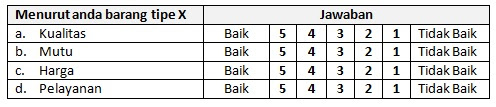
Rating scale model scale, respondents will not answer one of the provided qualitative answers, but answer one of the available quantitative answers. Thus the rating scale is more flexible, flexible and not limited to measuring attitudes, but to measuring respondents' perceptions or judgments of another phenomenon. Such as a scale to measure socio-economic status, institutions, knowledge, abilities, process activities and others.
With a rating scale, the raw data obtained is in the form of numbers, then interpreted in a qualitative sense. Respondents' answers were happy or unhappy, agreed or disagreed, ever or never. What is important for constructors of instruments with rating scales is that they must be able to interpret each number given to the alternative answers for each instrument item. Certain people choose the answer number 2, but the number 2 by certain people is not necessarily the same as other people who also choose the answer with number 2. An example of an instrument using a rating scale can be seen in the image below.

-