
Garis besar topik
-
Theories of Motivations
1. A Motivating Place to Work : The case of Zappos
2. Need-Based Theories of Motivation
3. Process-Based Theories
4. The Role of Ethics and National Culture
5. Motivation in Action : The case of Trade JoeΓÇÖs
6. Conclusion
7. Exercise
-
Siswa harusTandai selesai
A Motivating Place to Work: The Case of Zappos
It is unique to hear about a CEO who studies happiness and motivation and builds those principles into the companyΓÇÖs core values or about a company with a 5-week training course and an offer of $2,000 to quit anytime during that 5 weeks if you feel the company is not a good fit. Top that off with an on-site life coach who also happens to be a chiropractor, and you are really talking about something you donΓÇÖt hear about every day. Zappos is known as much for its 365-day return policy and free shipping as it is for its innovative corporate culture. Although acquired in 2009 by Amazon (NASDAQ: AMZN), Zappos managed to move from number 23 in 2009 on Fortune magazineΓÇÖs ΓÇ£100 Best Companies to Work ForΓÇ¥ list to 15 in 2010.Performance is a function of motivation, ability, and the environment in which you work. Zappos seems to be creating an environment that encourages motivation and builds inclusiveness. The company delivers above and beyond basic workplace needs and addresses the self-actualization needs that most individuals desire from their work experience. CEO Tony Hsieh believes that the secret to customer loyalty is to make a corporate culture of caring a priority. This is reflected in the companyΓÇÖs 10 core values and its emphasis on building a team and a family. During the interview process, applicants are asked questions relating to the companyΓÇÖs values, such as gauging their own weirdness, open-mindedness, and sense of family. Although the offer to be paid to quit during the training process has increased from its original number of $400, only 1% of trainees take the offer. Work is structured differently at Zappos as well. For example, there is no limit to the time customer service representatives spend on a phone call, and they are encouraged to make personal connections with the individuals on the other end rather than try to get rid of them.
Although Zappos has over 1,300 employees, the company has been able to maintain a relatively flat organizational structure and prides itself on its extreme transparency. In an exceptionally detailed and lengthy letter to employees, Hsieh spelled out what the new partnership with Amazon would mean for the company, what would change, and more important, what would remain the same. As a result of this type of company structure, individuals have more freedom, which can lead to greater satisfaction.
Although Zappos pays its employees well and offers attractive benefits such as employees receiving full health-care coverage and a compressed workweek, the desire to work at Zappos seems to go beyond that. As Hsieh would say, happiness is the driving force behind almost any action an individual takes. Whether your goals are for achievement, affiliation, or simply to find an enjoyable environment in which to work, Zappos strives to address these needs.

-
Siswa harusTandai selesai
1. How does Zappos motivate its employees?.
2. What is motivation to work at a place?
3. How does Zappos test the motivation of its new hires?
4. How does Zappos empower its employees?
-
Siswa harusTandai selesai
Theories of Motivation
Learning Objectives
After reading this chapter, you should be able to do the following:
- Understand the role of motivation in determining employee performance.
- Classify the basic needs of employees.
- Describe how fairness perceptions are determined and consequences of these perceptions.
- Understand the importance of rewards and punishments.
- Apply motivation theories to analyze performance problems
What inspires employees to provide excellent service, market a companyΓÇÖs products effectively, or achieve the goals set for them? Answering this question is of utmost importance if we are to understand and manage the work behavior of our peers, subordinates, and even supervisors. Put a different way, if someone is not performing well, what could be the reason?
Job performance is viewed as a function of three factors and is expressed with the equation below (Mitchell, 1982; Porter & Lawler, 1968).According to this equation, motivation, ability, and environment are the major influences over employee performance.
Figure 5.1
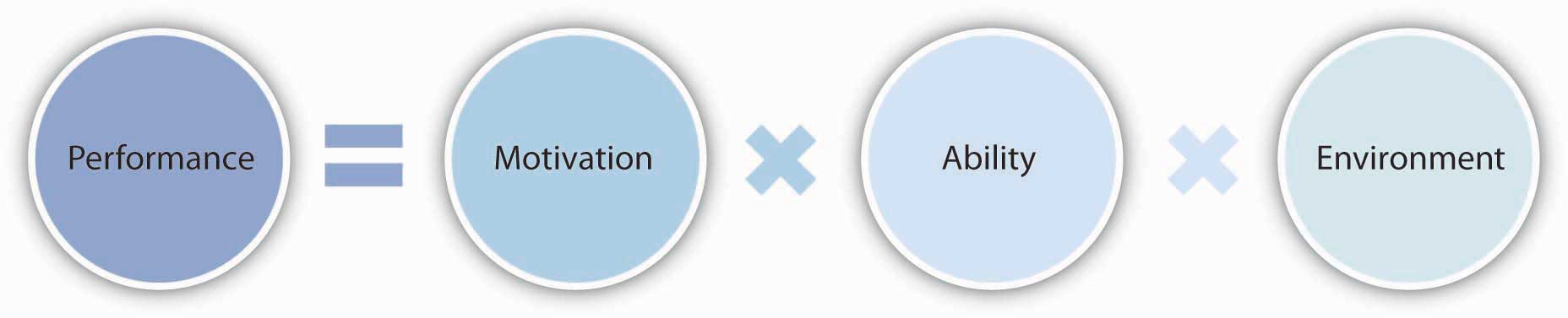
Performance is a function of the interaction between an individualΓÇÖs motivation, ability, and environment.
Motivation is one of the forces that lead to performance. Motivation is defined as the desire to achieve a goal or a certain performance level, leading to goal-directed behavior. When we refer to someone as being motivated, we mean that the person is trying hard to accomplish a certain task. Motivation is clearly important if someone is to perform well; however, it is not sufficient. AbilityΓÇöor having the skills and knowledge required to perform the jobΓÇöis also important and is sometimes the key determinant of effectiveness. Finally, environmental factors such as having the resources, information, and support one needs to perform well are critical to determine performance. At different times, one of these three factors may be the key to high performance. For example, for an employee sweeping the floor, motivation may be the most important factor that determines performance. In contrast, even the most motivated individual would not be able to successfully design a house without the necessary talent involved in building quality homes. Being motivated is not the same as being a high performer and is not the sole reason why people perform well, but it is nevertheless a key influence over our performance level.
So what motivates people? Why do some employees try to reach their targets and pursue excellence while others merely show up at work and count the hours? As with many questions involving human beings, the answer is anything but simple. Instead, there are several theories explaining the concept of motivation. We will discuss motivation theories under two categories: need-based theories and process theories.
-