Pelajaran ini belum siap untuk diambil.
The explanation of Curriculum Vitae
You are not enrolled in this course.
Syarat penyelesaian
The Ultimate Guide to Writing a Curriculum Vitae (Example Included!)
Whether you need to update an existing CV, want to build a new curriculum vitae from scratch, or maybe are still asking ΓÇ£what is a curriculum vitae?ΓÇ¥, weΓÇÖve got the answers for you. Read on for a curriculum vitae example, how to write your own curriculum vitae, how to format your CV, and how to make sure youΓÇÖre never scrambling when asked for your CV again.
What Is a Curriculum Vitae?
A curriculum vitae is an exhaustive listing of all of the significant achievements in your career. This includes education, research, work experience, publications, presentations, and anything else youΓÇÖve done in your professional life. Think of a CV as a complete account of everything that qualifies you as an expert in your field, Goodfellow says.
If youΓÇÖve only ever made a resume, youΓÇÖre probably used to cutting down your skills, experience, and education to one pageΓÇöor in rare cases two pages. ThatΓÇÖs because youΓÇÖre trying to focus on only the things that are most relevant to the job youΓÇÖre applying to.
With a CV, on the other hand, you donΓÇÖt take off and add details as you go along. You always include everything in a curriculum vitae; for folks later in their careers, that can add up to over 10 pages.
In the U.S., a curriculum vitae is primarily used in fields where research, publications, and presentations are of great importanceΓÇöfor example, academia. But take note: Outside the U.S., the term CV refers to something closer to a resume (I know, itΓÇÖs confusing!). So youΓÇÖll want to follow the guidelines for making a resume instead. (But be sure to research what is normally included in a CV in the country where youΓÇÖre job hunting, as it can vary widely.)
Despite the differences, the primary question both a resume and CV should answer is the same: What value will you bring to your new workplace?
Who Really Needs a Curriculum Vitae?
If youΓÇÖre in academia or a physician (particularly one who does research) you probably do need a curriculum vitae. If youΓÇÖre a researcher outside of academia or a mid-to-late-career lawyer, you might need one as well.
HereΓÇÖs a list of fields where you might need a CV:
- Academia: If youΓÇÖre a researcher, professor, or student who does research in academia, you definitely need a CV (and weΓÇÖve included a sample for you at the end of this article!). ThatΓÇÖs because so much of what makes you qualified depends on your research, where youΓÇÖve presented it, and whether youΓÇÖve kept up to date as an expert in your field. Note that college librarians often also need a curriculum vitae. However, if youΓÇÖre applying to a job at a university that doesnΓÇÖt involve research or teaching, you likely need a resume.
- Medicine: If youΓÇÖre a physician, then you also need a curriculum vitae. Even if youΓÇÖre early in your career or not actively researching, CV is still the preferred terminology and formatting for doctors. If youΓÇÖre a nurse or medical assistant, the term curriculum vitae or CV may still be used in job listings, but is likely there because the same organizations often hire physicians. You probably need a resume instead.
- Law: If youΓÇÖre a lawyer who is working in academiaΓÇöand therefore publishing, doing presentations, or teachingΓÇöyou will also need a curriculum vitae.
- Research Outside of Academia: If you have a PhD or masterΓÇÖs degree and do research, but outside of academia, youΓÇÖre still likely to need a CV and should keep one up-to-date. In this situation, listing all of your research in one place is likely to add to your value as a potential hire, especially if the person reading your application is a fellow researcher in your field.
If you are not in academia or medicine, your career is mostly judged by your performance on the job, and youΓÇÖre not expected to publish or present research at conferences, then you probably need a resume. (Quick rule of thumb: If you donΓÇÖt have the information for a curriculum vitae, then itΓÇÖs not for you, Goodfellow says.)
Not sure if you need a curriculum vitae or a resume for a particular job application? Ask! Reach out to the job contact or HR department and ask which document they prefer. If you canΓÇÖt get in touch with anyone and canΓÇÖt tell from context, uploading both documents (and clearly labeling them) works in a pinch.
That said, thereΓÇÖs no advantage to submitting a curriculum vitae when the hiring manager is looking for a resume. Consider that the average resume gets looked at for only six seconds. If you submit a longer curriculum vitae, that window likely wonΓÇÖt grow. So now a recruiter will have to glean the same information about you, in the same amount of time, from a longer document.
How Do I Write a CV?
So youΓÇÖre sure that you need a curriculum vitae, but how do you write one? Start by making a comprehensive list of all of your professional and educational accomplishments that fall under the following categories:
- Contact Information: This section will be similar to what youΓÇÖd include on a resume and include your name, address, phone number, and email address.
- Education: For each school you attended, include the name, location, what degree you received, and the dates you were there. If you donΓÇÖt have a separate research experience section, you can add details about the research that led to each degree here. If you have more than one school or degree, list them in reverse chronological order. (Same goes for all sections of your CVΓÇöthe most recent experience or information in each section goes first.)
- Teaching Experience/Work Experience/Research Experience: This could be three separate sections, or you could decide to combine them or leave one or more off. Just as you would on a resume, you should describe your past and current work, research, and teaching experience with strong, well-written bullet points that explain your duties and achievements. This is also a place where you can tailor your curriculum vitae for an ATSΓÇöthat is, an applicant tracking system that often scans your application materials and compares them to a job description before a human lays eyes on them. To do so, youΓÇÖll want to add in keywords from the job description, and your experience sections are a prime place to do this since you have the most flexibility.
- Conference Presentations: Include the title of your presentation, what event it was given at, where the event was, and whether it was an oral or poster presentation. When it comes to describing the conference itself, take into account who will be reading your CV. If itΓÇÖs an expert in your field, you donΓÇÖt need to describe a major conference to them because they already know. However, if your curriculum vitae is going to be read by a recruiter or hiring manager first, you might want to consider giving a bit of description to the conference itself. This is also true if youΓÇÖre looking to switch fields.
- Conference Attendance: This includes conferences where you attended but did not present and serves to show potential employers what youΓÇÖre doing to stay up-to-date in your field outside of your own research.
- Honors and Awards: Include the name of the recognition and date.
- Grants or Funding: Make sure you include the name of the grant and the period it was awarded for.
- Publications: If youΓÇÖre in academia, youΓÇÖre familiar with the adage ΓÇ£publish or perish,ΓÇ¥ and your CV is where you can show how good you are at staying alive. For this section list out any of your publications the same way that you would cite them, regardless of what number author you were. Underline or bold your name so it stands out as part of the list of authors.
- Professional Affiliations/Memberships: Note dates and if you held any positions within these organizations. Depending on the job youΓÇÖre applying for, this might be another place to expand on what your duties were.
- Community Outreach (optional): List dates and describe what you did in the same way you would describe a past job on a resume.
- Key (or Research) Skills (optional): This is another section where you can think about the ATS. If a job description is looking for a certain set of skills, and you have them, but itΓÇÖs not immediately clear from the rest of your CV, a skills section can help you get past the ATS and on your way to your next job.
- Language Skills (optional): If you speak a number of languages or a language that is especially useful in your field (for example, a doctor who speaks fluent Spanish in the U.S.), you might want to add a language skills section.
- References (personal choice): A Google search may leave you questioning whether or not you should include a references section on a curriculum vitae. Goodfellow notes that once upon a time, references were always included, and thatΓÇÖs why you often see the section on CV examples or in advice on how to write a curriculum vitae. However, the practice is falling out of favor. You probably wonΓÇÖt be dinged either wayΓÇöunless you failed to follow explicit instructions about references in the job listing. If you donΓÇÖt include a references section, be sure to have your list of references formatted, up-to-date, and ready to send off. (But no need to say ΓÇ£references available upon requestΓÇ¥ΓÇöitΓÇÖs just a waste of space.)
Not all of the sections listed above are mandatory, nor are all of the possible sections for a CV on the list. Some of them, like Research and Work Experience, or Honors and Grants, may work better if combined for some people.
As far as section order, you have some flexibility. Contact information should of course go at the top, but after that itΓÇÖs whatever has the most value. When youΓÇÖre a student or just out of school, your education should come first. But as your career progresses, a major award or tenure-track teaching position might move into that slot. You want to make sure the most important information you have is on page one because you donΓÇÖt want anyone to lose interest in you as a candidate before they get to page two.
What Else Do I Need to Know About Formatting a Curriculum Vitae?
When it comes to formatting your curriculum vitae, you need to be meticulous. Look at where all your quotations and punctuation are and be consistent. A lot of universities will have guidelines for how you should format your CV. Follow them.
This also isnΓÇÖt the place to show off your graphic design skills. While adding visual elements to a resume can be a way to stand out (depending on your field), a curriculum vitae should have no flashy formatting. ΓÇ£YouΓÇÖre not gaining points because itΓÇÖs visually appealing,ΓÇ¥ Goodfellow says.
Bold, underlining, and caps for emphasis and ease of reading are OK. (And italics often have set use when writing out your presentations and publications.) But your curriculum vitae is not the place for humor or exciting graphic design. ItΓÇÖs where you show off your ability to be professional, thorough, and detail-oriented.
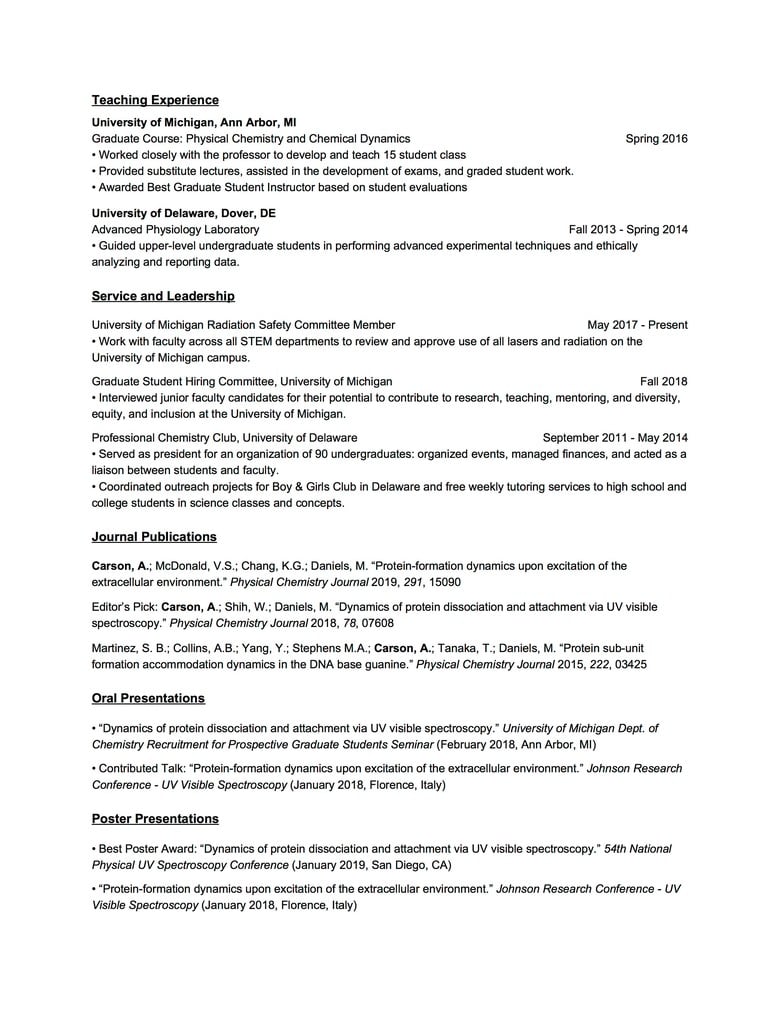
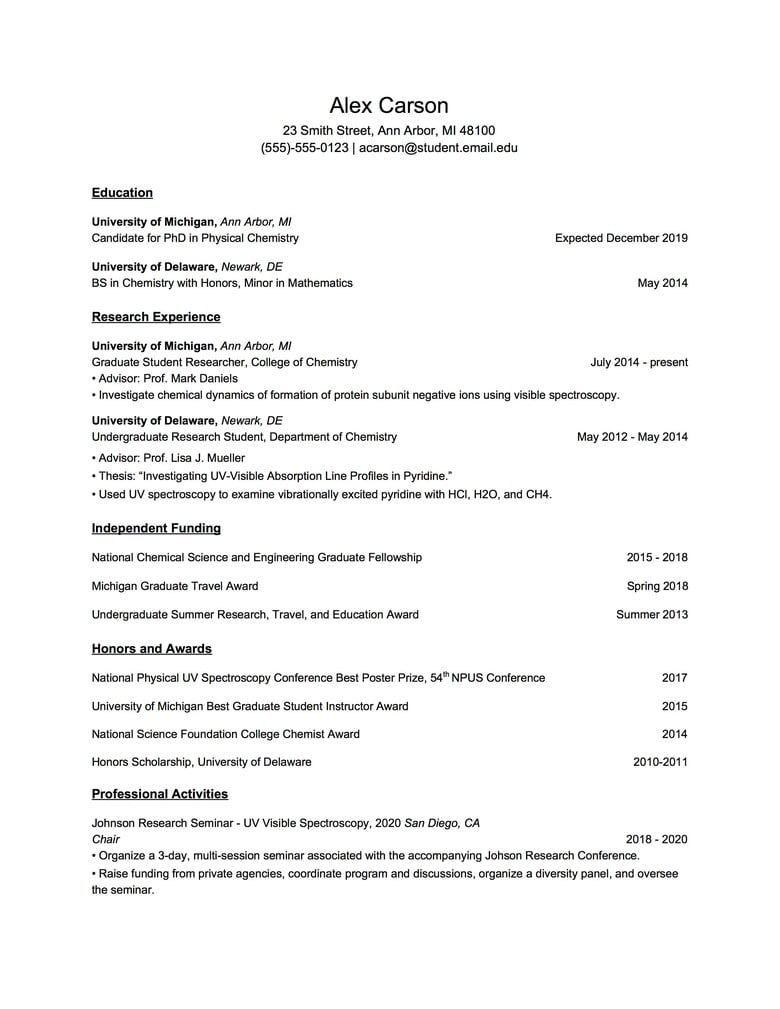
An Example Curriculum Vitae
Still need to see all this laid out to get a good idea of what a curriculum vitae should really look like? Check out our example below for a student who is just completing a PhD in a research-based
Think of your CV as a fluid document. ΓÇ£People donΓÇÖt often craft a resume until theyΓÇÖre looking for their next job,ΓÇ¥ Goodfellow points out. In contrast, you should be updating your curriculum vitae constantly, she says.
Whenever you publish, present, or attend a conference, make a habit of immediately logging it on your CV. It may seem like a pain, but youΓÇÖll be glad you did it when it comes time to look for your next position. You wonΓÇÖt have to search your memory trying to recall the exact months and years everything happenedΓÇösaving you a lot of headaches in the long run.