
Garis besar topik

  • Assalamu'alaikum Wr. Wb

    Tabik pun.......

    Assalamualaikum wr. wb

    Welcome to my class, my beloved students. It is very nice to meet all of you in this semester. Hoping you all are in good condition and always be happy. 

    Welcome to my subject of English, especially for the Science Data students of Science Data Study Program. This subject consists of 2 SKS with 16 meetings include Mid Term and Final Exam. Pay attention with the rules of our teaching learning for this semester. There is the lesson plan and the teaching learning process in RPS.  The method of our teaching process is using explanation, discussion and answering and asking question. The whole materials you can see and download from this lms. darmajaya.   I really hope that all of you always be active and enjoy studying English with me in this teaching learning process. 

    May Allah bless us until the end of our study. Enjoy your class and have a nice learning. 

    Best Regards
    Wassalamu'alaikum Wr. Wb
    Betty Magdalena

    my photo

      • NAMA MATAKULIAH :  BAHASA IMGGRIS

        SEMESTER  : 2

        SKS (T/P) : 2 / 0 teori

        MATAKULIAH PRASYARAT : 

        KODE MATAKULIAH : FIK21203
      Capaian Pembelajaran Lulusan : Sikap
      1.  Bertaqwa Kepada Tuhan Yang Maha Esa dan menunjukan sikap religius.
      2.  Menunjukkan sikap bertanggungjawab atas pekerjaan di bidang keahliannya secara mandiri.

      3. Menghargai keanekaragaman budaya, pandangan, agama, dan kepercayaan, serta pendapat atau temuan orisinal orang lain;

      Keterampilan Umum: 

      1. Mampu menerapkan pemikiran logis, kritis, sistematis, dan inovatif dalam konteks pengembangan atau implementasi ilmu pengetahuan dan teknologi yang memperhatikan dan menerapkan nilai humaniora yang sesuai dengan bidang keahliannya;
      2. Mampu mengkaji implikasi pengembangan atau implementasi ilmu pengetahuan dan teknologi yang memperhatikan dan menerapkan nilai humaniora sesuai dengan keahliannya berdasarkan kaidah, tata cara dan etika ilmiah dalam rangka menghasilkan solusi, gagasan, desain atau kritik.
      3. Mampu menunjukkan kinerja mandiri, bermutu, dan terukur

      CP Keterampilan Khusus 

      1. Menguasai keterampilan berbahasa Inggris (speaking, writing, reading, listening)
      2. Menguasai teori dan praktik kepariwisataan, budaya dan industri kreatif

      CP Pengetahuan 

      1. Menguasai beragam kemampuan bahasa Inggris baik lisan dan tulis untuk diaplikasikan pada level program studi dibidang komputer dan IT 


      2. Metode Pembelajaran

      Dilakukan secara ekspositori yaitu : Ceramah, Diskusi, Presentasi, Study Case, Presentasi, Tanya Jawab,  Tugas (mandiri dan kelompok)

      3. Aspek Penilaian

      Sikap

      Cara menyampaikan pendapat dalam diskusi, keseriusan, tanggung jawab dan ketepatan waktu mengumpulkan tugas.

      Pengetahuan

      Penguasaan materi yang di tunjukkan dalam proses tanya jawab, diskusi, presentasi, ujian tengah semester dan ujian akhir semester.

       Ketrampilan

      Mempunyai kreatifitas dalam menyusun tugas yang berhubungan topik atau materi pembelajaran.

      4. Teknik penilaian terdiri dari:

      1) observasi

      2) partisipasi

      3) unjuk kerja

      4) test tertulis

      5) test lisan

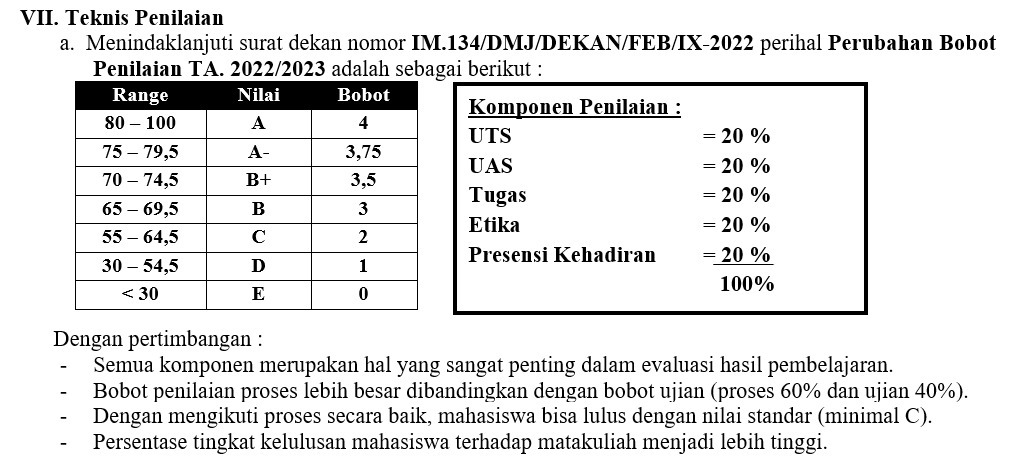
      Range Nilai Dan Komponen Penilaian

  • Part of Speech

    1. Explanation of part of speech

     2. Difination and usage of 8 part of speech


    • Parts of Speech - Definition, 8 Types and Examples

      In the English language, every word is called a part of speech. The role a word plays in a sentence denotes what part of speech it belongs to. Explore the definition of parts of speech, the different parts of speech and examples in this article. There are eight parts of speech in the English language: noun, pronoun, verb, adjective, adverb, preposition, conjunction, and interjection. The part of speech indicates how the word functions in meaning as well as grammatically within the sentence.
      8 Parts of Speech Definitions and Examples:

      1. Nouns are words that are used to name people, places, animals, ideas and things. Nouns can be classified into two main categories: Common nouns and Proper nouns. Common nouns are generic like ball, car, stick, etc., and proper nouns are more specific like Charles, The White House, The Sun, etc.

      Examples of nouns used in sentences:

          • She bought a pair of shoes. (thing)
          • I have a pet. (animal)
          • Is this your book? (object)
          • Many people have a fear of darkness. (ideas/abstract nouns)
          • He is my brother. (person)
          • This is my school. (place)

      Also, explore Singular Nouns and Plural Nouns.

      2. Pronouns are words that are used to substitute a noun in a sentence. There are different types of pronouns. Some of them are reflexive pronouns, possessive pronounsrelative pronouns and indefinite pronouns. I, he, she, it, them, his, yours, anyone, nobody, who, etc., are some of the pronouns.

      Examples of pronouns used in sentences:

          • I reached home at six in the evening. (1st person singular pronoun)
          • Did someone see a red bag on the counter? (Indefinite pronoun)
          • Is this the boy who won the first prize? (Relative pronoun)
          • That is my mom. (Possessive pronoun)
          • I hurt myself yesterday when we were playing cricket. (Reflexive pronoun)

      3. Verbs are words that denote an action that is being performed by the noun or the subject in a sentence. They are also called action words. Some examples of verbs are read, sit, run, pick, garnish, come, pitch, etc.

      Examples of verbs used in sentences:

          • She plays cricket every day.
          • Darshana and Arul are going to the movies.
          • My friends visited me last week.
          • Did you have your breakfast?
          • My name is Meenakshi Kishore.

      4. Adverbs are words that are used to provide more information about verbs, adjectives and other adverbs used in a sentence. There are five main types of adverbs namely, adverbs of manneradverbs of degreeadverbs of frequencyadverbs of time and adverbs of place. Some examples of adverbs are today, quickly, randomly, early, 10 a.m. etc.

      Examples of adverbs used in sentences:

          • Did you come here to buy an umbrella? (Adverb of place)
          • I did not go to school yesterday as I was sick. (Adverb of time)
          • Savio reads the newspaper everyday. (Adverb of frequency)
          • Can you please come quickly? (Adverb of manner)
          • Tony was so sleepy that he could hardly keep his eyes open during the meeting. (Adverb of degree)

      5. Adjectives are words that are used to describe or provide more information about the noun or the subject in a sentence. Some examples of adjectives include good, ugly, quick, beautiful, late, etc.

      Examples of adjectives used in sentences:

          • The place we visited yesterday was serene.
          • Did you see how big that dog was?
          • The weather is pleasant today.
          • The red dress you wore on your birthday was lovely.
          • My brother had only one chapati for breakfast.

      6. Prepositions are words that are used to link one part of the sentence to another. Prepositions show the position of the object or subject in a sentence. Some examples of prepositions are in, out, besides, in front of, below, opposite, etc.

      Examples of prepositions used in sentences:

          • The teacher asked the students to draw lines on the paper so that they could write in straight lines.
          • The child hid his birthday presents under his bed.
          • Mom asked me to go to the store near my school.
          • The thieves jumped over the wall and escaped before we could reach home.

      7. Conjunctions are a part of speech that is used to connect two different parts of a sentence, phrases and clauses. Some examples of conjunctions are and, or, for, yet, although, because, not only, etc.

      Examples of conjunctions used in sentences:

          • Meera and Jasmine had come to my birthday party.
          • Jane did not go to work as she was sick.
          • Unless you work hard, you cannot score good marks.
          • I have not finished my project, yet I went out with my friends.

      8. Interjections are words that are used to convey strong emotions or feelings. Some examples of interjections are oh, wow, alas, yippee, etc. It is always followed by an exclamation mark.

      Examples of interjections used in sentences:

          • Wow! What a wonderful work of art.
          • Alas! That is really sad.
          • Yippee! We won the match.

      Sentence Examples for the 8 Parts of Speech

          1. Noun ΓÇô Tom lives in New York.
          2. Pronoun ΓÇô Did she find the book she was looking for?
          3. Verb ΓÇô I reached home.
          4. Adverb ΓÇô The tea is too hot.
          5. Adjective ΓÇô The movie was amazing.
          6. Preposition ΓÇô The candle was kept under the table.
          7. Conjunction ΓÇô I was at home all day, but I am feeling very tired.
          8. Interjection ΓÇô Oh! I forgot to turn off the stove.

    • A Small Exercise to Check Your Understanding of Parts of Speech

      Let us find out if you have understood the different parts of speech and their functions. Try identifying which part of speech the highlighted words belong to.

          1. My brother came home late.
          2. am a good girl.
          3. This is the book was looking for.
          4. Whoa! This is amazing.
          5. The climate in Kodaikanal is very pleasant.
          6. Can you please pick up Dan and me on your way home?

      Now, let us see if you got it right. Check your answers.

          1. My ΓÇô Pronoun, Home ΓÇô Noun, Late ΓÇô Adverb
          2. Am ΓÇô Verb, Good ΓÇô Adjective
          3. I ΓÇô Pronoun, Was looking ΓÇô Verb
          4. Whoa ΓÇô Interjection, Amazing ΓÇô Adjective
          5. Climate ΓÇô Noun, In ΓÇô Preposition, Kodaikanal ΓÇô Noun, Very ΓÇô Adverb
          6. And ΓÇô Conjunction, On ΓÇô Preposition, Your ΓÇô Pronoun

      Frequently Asked Questions on Parts of Speech

      Q1

      What are parts of speech?

      The term ΓÇÿparts of speechΓÇÖ refers to words that perform different functions in a sentence  in order to give the sentence a proper meaning and structure.

      Q2

      How many parts of speech are there?

      There are 8 parts of speech in total.

      Q3

      What are the 8 parts of speech?

      Nouns, pronouns, verbs, adverbs, adjectives, prepositions, conjunctions and interjections are the 8 parts of speech.


  • Part of Speech

    1. Reading and Vocabulary

    2. Grammar focus : Verbal and  nominal sentence

    3. Writing : Making a short sentence based on verbal and nominal sentence and part of speech


    • What is NLP?

      Natural language processing, or NLP, combines computational linguisticsΓÇörule-based modeling of human languageΓÇöwith statistical and machine learning models to enable computers and digital devices to recognize, understand and generate text and speech.

      A branch of artificial intelligence (AI), NLP lies at the heart of applications and devices that can

      • translate text from one language to another
      • respond to typed or spoken commands
      • recognize or authenticate users based on voice
      • summarize large volumes of text
      • assess the intent or sentiment of text or speech
      • generate text or graphics or other content on demand

      often in real time. Today most people have interacted with NLP in the form of voice-operated GPS systems, digital assistants, speech-to-text dictation software, customer service chatbots, and other consumer conveniences. But NLP also plays a growing role in enterprise solutions that help streamline and automate business operations, increase employee productivity, and simplify mission-critical business processes.

      NLP use cases

      Natural language processing is the driving force behind machine intelligence in many modern real-world applications. Here are a few examples:

      • Spam detection: You may not think of spam detection as an NLP solution, but the best spam detection technologies use NLP's text classification capabilities to scan emails for language that often indicates spam or phishing. These indicators can include overuse of financial terms, characteristic bad grammar, threatening language, inappropriate urgency, misspelled company names, and more. Spam detection is one of a handful of NLP problems that experts consider 'mostly solved' (although you may argue that this doesnΓÇÖt match your email experience).
      • Machine translation: Google Translate is an example of widely available NLP technology at work. Truly useful machine translation involves more than replacing words in one language with words of another.  Effective translation has to capture accurately the meaning and tone of the input language and translate it to text with the same meaning and desired impact in the output language. Machine translation tools are making good progress in terms of accuracy. A great way to test any machine translation tool is to translate text to one language and then back to the original. An oft-cited classic example: Not long ago, translating ΓÇ£The spirit is willing but the flesh is weakΓÇ¥ from English to Russian and back yielded ΓÇ£The vodka is good but the meat is rotten.ΓÇ¥ Today, the result is ΓÇ£The spirit desires, but the flesh is weak,ΓÇ¥ which isnΓÇÖt perfect, but inspires much more confidence in the English-to-Russian translation.
      • Virtual agents and chatbots: Virtual agents such as Apple's Siri and Amazon's Alexa use speech recognition to recognize patterns in voice commands and natural language generation to respond with appropriate action or helpful comments. Chatbots perform the same magic in response to typed text entries. The best of these also learn to recognize contextual clues about human requests and use them to provide even better responses or options over time. The next enhancement for these applications is question answering, the ability to respond to our questionsΓÇöanticipated or notΓÇöwith relevant and helpful answers in their own words.
      • Social media sentiment analysis: NLP has become an essential business tool for uncovering hidden data insights from social media channels. Sentiment analysis can analyze language used in social media posts, responses, reviews, and more to extract attitudes and emotions in response to products, promotions, and eventsΓÇôinformation companies can use in product designs, advertising campaigns, and more.
      • Text summarization: Text summarization uses NLP techniques to digest huge volumes of digital text and create summaries and synopses for indexes, research databases, or busy readers who don't have time to read full text. The best text summarization applications use semantic reasoning and natural language generation (NLG) to add useful context and conclusions to summaries.

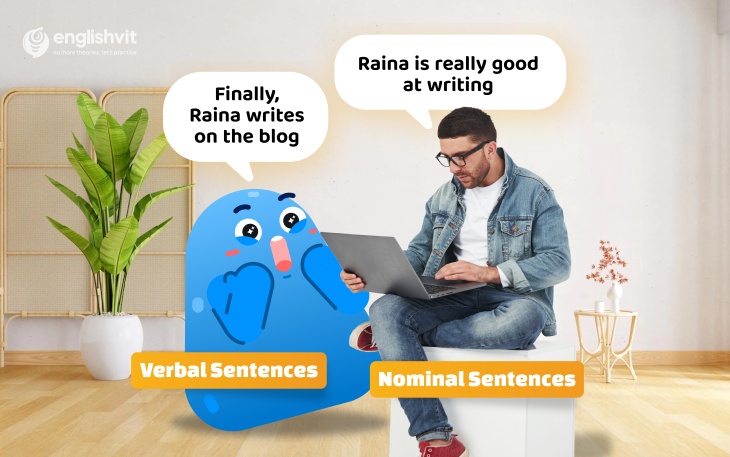
    • Nominal sentence is a sentence that have not a verb, but can be an adjective, noun or adverb, then the nominal sentence needs auxiliary verb, such as is, am, are, and it is followed by adjectives/ adverb/ noun. Verbal sentence is subject followed by verb.


      Kalimat verbal dan nominal adalah pengetahuan dasar Bahasa Inggris yang wajib dipelajari. Sama halnya dengan Bahasa Indonesia, Bahasa Inggris juga memiliki tata bahasa sesuai kaidahnya. Materi ini merupakan salah satu materi pokok dalam penyusunan kosa kata yang tepat dalam Bahasa Inggris. 

      Kalimat verbal dan nominal adalah pengetahuan dasar Bahasa Inggris yang wajib dipelajari. Sama halnya dengan Bahasa Indonesia, Bahasa Inggris juga memiliki tata bahasa sesuai kaidahnya. Materi ini merupakan salah satu materi pokok dalam penyusunan kosa kata yang tepat dalam Bahasa Inggris. Sehingga bagi para pemula, mempelajari materi ini juga sangat diperlukan. Tapi apa sih kalimat verbal dan nominal itu? Nah di artikel kali ini kita akan membahas tentang kalimat verbal dan nominal.

      ΓÇó Definisi kalimat

      Kalimat adalah kata-kata yang minimal terdiri dari subyek dan predikat. Jenis kalimat sendiri ada dua yaitu kalimat verbal dan nominal.


      ΓÇó Verbal Sentence adalah kalimat yang kata kerjanya menyatakan aktifitas dari subjek atau bisa disebut pekerjaan/tindakan seperti kata kerja eat, sleep, drink, sweep, ride, fly, ask, brush, call, dan lain-lain.

      Contoh:

      1. I walk to school
      2. We are studying English now
      3. They play football every afternoon
      4. My mother always buys vegetables

      ΓÇó Nominal Sentence adalah kalimat yang terdiri dari auxiliary verb atau kata kerja bantu yanb berupa is, am, are, was, weee, have, has, had, dan be yang tidak menyatakan aktivitas dari subjek, melainkan sebagai penghubung dan penjelas untuk menyatakan kondisi, status, dan keadaan dari complement (Adjective, Noun, Adverb of place).

      Contoh:

      1. I am a student
      2. She is a teacher
      3. He was smart student
      4. Her father has been here for one minute.
      5. We were in the class for studying, but now we are not

    • Nominal sentence is a sentence that have not a verb, but can be an adjective, noun or adverb, then the nominal sentence needs auxiliary verb, such as is, am, are, and it is followed by adjectives/ adverb/ noun. Verbal sentence is subject followed by verb.


      Kalimat verbal dan nominal adalah pengetahuan dasar Bahasa Inggris yang wajib dipelajari. Sama halnya dengan Bahasa Indonesia, Bahasa Inggris juga memiliki tata bahasa sesuai kaidahnya. Materi ini merupakan salah satu materi pokok dalam penyusunan kosa kata yang tepat dalam Bahasa Inggris. 

      Kalimat verbal dan nominal adalah pengetahuan dasar Bahasa Inggris yang wajib dipelajari. Sama halnya dengan Bahasa Indonesia, Bahasa Inggris juga memiliki tata bahasa sesuai kaidahnya. Materi ini merupakan salah satu materi pokok dalam penyusunan kosa kata yang tepat dalam Bahasa Inggris. Sehingga bagi para pemula, mempelajari materi ini juga sangat diperlukan. Tapi apa sih kalimat verbal dan nominal itu? Nah di artikel kali ini kita akan membahas tentang kalimat verbal dan nominal.

      ΓÇó Definisi kalimat

      Kalimat adalah kata-kata yang minimal terdiri dari subyek dan predikat. Jenis kalimat sendiri ada dua yaitu kalimat verbal dan nominal.


      ΓÇó Verbal Sentence adalah kalimat yang kata kerjanya menyatakan aktifitas dari subjek atau bisa disebut pekerjaan/tindakan seperti kata kerja eat, sleep, drink, sweep, ride, fly, ask, brush, call, dan lain-lain.

      Contoh:

      1. I walk to school
      2. We are studying English now
      3. They play football every afternoon
      4. My mother always buys vegetables

      ΓÇó Nominal Sentence adalah kalimat yang terdiri dari auxiliary verb atau kata kerja bantu yanb berupa is, am, are, was, weee, have, has, had, dan be yang tidak menyatakan aktivitas dari subjek, melainkan sebagai penghubung dan penjelas untuk menyatakan kondisi, status, dan keadaan dari complement (Adjective, Noun, Adverb of place).

      Contoh:

      1. I am a student
      2. She is a teacher
      3. He was smart student
      4. Her father has been here for one minute.
      5. We were in the class for studying, but now we are not

    • I. Answer the question basedn the text of Natural Language

      1. What is Natural Language Proccessing ?

      2. What is the importance and benefit of Natural Life in any fields?

      3. Natural language processing is the driving force behind machine intelligence in many modern real-world    applications. Can you give some of the application?


      II. Vocabulary. What is the meaning of vocabulary below :

      1.  translate  2.  sofware.   3. automatically,  4. impact   5. effective   6. detection.  7. accuracy


      III. Decide the bold words based on the part of speech :

      1. The best spam detection technologies use NLP's text classification. 

      2. Google translate is an example of widely available NLP technology at work.

      3. Effective translation has to capture accurately the meaning of the input language.

      4. NLP technology digests huge volume of digital text and creates summaries. 

      5. Sentiment analysis can analyze language used in social media post and to extract emotion and attitude.


      IV. Making a simple sentence in verbal or nominal sentence using the words below. 

      1.  translate  2.  sofware.   3. automatically,  4. impact   5. effective   6. detection.  7. accuracy


  • The Business Matters, IT Jobs and Duties

    1. Reading comprehension and Vocabulary Building

    2. Writing : Making a short sentence using some words related to the topic 

    • The Business Matters, IT Jobs and Duties


      IT Job Description: Roles, Requirements, and Outlook

      Learn what to expect in an IT job description, including job requirements, the future outlook for jobs in IT, salary expectations, and growth potential.

      Information technology (IT) is one of the world's fastest-growing industries and offers various opportunities for advancement and high-paying jobs. Skilled IT workers find work in nearly every industry, giving you the option to pursue a position in an industry youΓÇÖre most interested in. Understanding the different roles and qualifications within IT can help you plan your next steps to find a position that suits you. 

      What is an IT job?

      An IT job can range from an IT support specialistproject manager, or software designer. Positions in this field cover a broad variety of roles that can vary depending on the company. An IT position generally involves managing and storing data using computers, software, databases, networks, and servers. As an IT professional, you may write programs, maintain networks, analyze systems, and provide technical support.

      IT job outlook

      The US Bureau of Labor Statistics (BLS) reports that IT jobs are expected to grow 15 percent in this decade, with over 680,000 new jobs by 2031, a growth rate faster than other industries [1]. The average median salary for IT workers in 2021 was $97,430. If you're considering a career in IT, now may be an ideal time to start working toward one.

      14 IT roles and salaries

      When you think about information technology roles, you may envision role-based technician positions, like software developer, coder, and website administrator. However, positions in the industry include much more. The list below shows that IT job titles are as varied as the types of jobs available in the industry.

      *Note: The salary information below was sourced from Glassdoor in August 2023. Figures represent base salary and average annual additional pay. Additional pay may include commissions, bonuses, or profit-sharing.

      1. Applications engineerAverage annual salary (US): $121,335. An applications engineer builds software architecture, optimizes existing systems, and supports clients using their programs.
      2. Computer programmer. Average annual salary (US): $91,255. A computer  programmer writes, tests, and modifies code used by computers to operate software and complete specific tasks.
      3. Computer scientist. Average annual salary (US): $153,146. A computer scientist may take on various roles; they apply theory to develop computer systems, build databases, work with programming languages, and more.
      4. Data quality manager. Average annual salary (US): $124,419. Data quality managers work with every department in a company to efficiently recognize gaps in data quality and maintain the correct and accurate use of data.
      5. Data scientis. Average annual salary (US): $152,253, A data scientist develops predictive models to identify trends in data and forecast different business outcomes.
      6. IT coordinator. Average annual salary (US): $63,858. An IT coordinator maintains the technology used by a company. They may need to troubleshoot errors, manage servers, build databases, and purchase equipment. 
      7. IT director. Average annual salary (US): $210,699. An IT director manages a companyΓÇÖs IT professionals, technical operations, and may also track how they work to increase efficiency and minimize risk. 
      8. IT security specialist. Average annual salary (US): $133,267. IT security specialists protect confidential information by monitoring anti-virus protection systems, encrypting data, and creating firewalls. 
      9. Network engineer. Average annual salary (US): $100,285. Network engineers design infrastructure systems and improve existing network systems within a company.
      10.  Quality assurance tester. Average annual salary (US): $60,894. A quality assurance tester attempts to identify gaps or errors in software by conducting manual and automated tests to simulate different scenarios on the software.
      11.  Software engineer. Average annual salary (US): $139,696. Software engineers create computer systems and design applications to meet specific needs or solve real-world problems.
      12.  Support specialist. Average annual salary (US): $48,121. A support specialist works alongside administrative and technical support to resolve customer concerns directly or refer them to the appropriate department.
      13.  User experience designer. Average annual salary (US): $99,106. A user experience designer helps developers create programs and websites that are accessible for people and easy to use. 
      14.  Web administrator. Average annual salary (US): $64,509. A web administrator manages the company website to optimize its performance and increase its online visibility. 


      Job duties and responsibilities of IT professionals
      The key job duties of IT professionals typically include creating new computer systems, networks, and applications or finding software errors through troubleshooting. Many of them can be involved in various tasks depending on their roles and the company's needs.


      General skills to build for IT job roles 
      Beyond having technical skills, such as programming, IT professionals and employers look for workplace skills like communication since technical skills are learnable through hands-on work. Having a balanced set of both types of skills can make you an attractive applicant for IT roles. Here are some technical and workplace skills to consider building as you prepare for a career in IT. 

      IT education requirements 

      As an IT worker, you can expect to work with computer-based information systems, software, and hardware, typically by designing, developing, and managing them. Everyday responsibilities can include: 

      1. Identifying technical problems 

      2. Deploying the appropriate IT solutions to solve problems 

      3. Designing computer-based systems or programs

      4. Identifying user needs with technology 

      Technical skills
      Computer literacy : As an IT professional, youΓÇÖll spend a lot of time using computers, so understanding how to operate it and its basic functions is necessary.

      Coding: Many IT roles require coding knowledge in various programming languages, depending on your specific role. You may help code or develop new software and applications for your company.

      Application development: Having experience with application development can help you to understand the back-end of the software youΓÇÖre using. You may find this helpful in creating new software or applications and monitoring computer systems. 

       Workplace skills

      Analytical: Analytical skills like critical thinking can help you identify and solve technology-related issues. For example, you may need to assess the status and identify computer system and application errors.

      Communication: YouΓÇÖll communicate with various teams within your organization as an IT professional. This includes explaining technical concepts in a way that others can understand. 

      Organization: In an IT role, youΓÇÖll be tasked with multiple duties or projects at once, making organization a critical skill for success. With proper organization, your efficiency and productivity at work will drastically increase. 

      Problem-solving: Troubleshooting problems with the technology systems in your company can be difficult and confusing, so having advanced problem-solving techniques can lead you to be an effective team member. 

      Time management: IT professionals often have time-sensitive tasks with hard deadlines. ItΓÇÖs crucial to prioritize your time, designate tasks when needed, and complete projects correctly by their deadlines. 

      Many IT jobs require that you have an associate or bachelor's degree. You can attain a degree in various fields to qualify for IT roles, such as information technology, computer science, or computer engineering. Some common courses youΓÇÖll take to help prepare you for an IT career include statistics, calculus, data networking, and information security. Some employers also except relevant experience and certifications in lieu of a college degree.

      To better position yourself to reach senior-level positions, you can choose to pursue a masterΓÇÖs degree in any relevant field of study. While hands-on experience in the IT field will help you to become an attractive candidate for higher-level IT roles, an advanced degree can be an essential asset to prove your expertise and dedication to your work. 


    • I. Answer the question basedn the text of The Business Matter, IT jobs and Duties

      1. What is the meaning of IT jobs? Mention it

      2.  IT job titles are as varied as the types of jobs available in the industry. Can you give at least 5 types of jobs which is       more popular in the industry.

      3.  How much is the average annual salary for the type of IT jobs you mentioned above ? 

      4.  What are the job duties and responsibilties of IT profesionals ? Explain them clearly

      5.  IT profesionals must have some techinical skill as preparing for a career in IT. Mention the techinical skill of IT           professional

      II. Vocabulary. What is the meaning of vocabularies below :

      1.  optimize  2.  typically  3. various,  4. helpul   5. application  6. network  7. increase  8. prepare  9. function  10. duty

      III. Decide the bold words based on the part of speech :

      1. A computer programmer writes, test and modifies code to operate sofware

      2. IT security specialist is protecting the confidential information and creating firewall efficiently in most industries. 

      3. They usually apply theory to develop computer system, build databases, work with programming language . 

      4.  The job duties of IT professional typically include creating new computer system or finding software errors. 

      5.  Many IT roles require coding knowledge in various programming language depending on your role.

      IV. Making a simple sentence in verbal or nominal sentence using the words below. 

      1.  optimize  2.  typically  3. various,  4. helpul   5. application  6. network  7. increase  8. prepare  9. function  10. duty

  • Social Media and Communication Skill

    Social Media in business

    Reading Skill : Comprehension the text

    Speaking : procedural text how to make a login  of  IG, Twitter and you tobe


    • Social Media: Definition, Importance, Top Websites & Apps

      Social Media Definition

      What Is Social Media?

      Social media refers to a variety of technologies that facilitate the sharing of ideas and information among their users. From Facebook and Instagram to X platform (formerly Twitter) and YouTube, more than 4.7 billion people use social media, equal to roughly 60% of the world's population.1 In early 2023, 94.8% of users accessed chat and messaging apps and websites, followed closely by social platforms, with 94.6% of users.

      KEY TAKEAWAYS

      • Social media is digital technology that allows the sharing of ideas and information, including text and visuals, through virtual networks and communities.
      • Social media typically features user-generated content that lends itself to engagement via likes, shares, comments, and discussion.
      • More than 4.7 billion people around the world use social media.
      • Social media is credited with helping people build community and faulted for facilitating disinformation and hate speech.
      • Social media is also an increasingly important part of many companies' marketing campaigns.
      • The largest social media platforms worldwide are Facebook, YouTube, WhatsApp, Instagram, and WeChat.

      How Social Media Originated and Evolved

      Social media started out as a way for people to interact with friends and family but soon expanded to serve many different purposes. In 2004, MySpace was the first network to reach 1 million monthly active users.3

      Social media participation exploded in the years that followed with the entry of Facebook and Twitter (now X platform). Businesses gravitated toward these platforms in order to reach an audience instantly on a global scale.

      According to Global Web Index, 46% of internet users worldwide get their news through social media. That compares to 40% of users who view news on news websites. Gen Z and Millennials were most likely to view news on social sites versus other generations.2

      Social media plays a key role in many businesses' marketing strategies, not surprising given the sheer number of hours people spend each day on social websites and apps. At the same time, social media is an ever-changing field, with relatively recent apps such as TikTok, Signal, and Clubhouse joining the ranks of established social networks like Facebook, YouTube, X platform, and Instagram.

      What Social Media Is Used for Today

      Social media platforms are often divided into six categories: social networking, social bookmarking, social news, media sharing, microblogging, and online forums.

      These diverse platforms serve a vast range of purposes and user interests. Some appeal to hobbyists, others to people in their work lives. People use them to find others across the globe who share their political or other views. Entertainers use social media to engage with fans, politicians with voters, charities with donors. Governments often turn to social media to convey vital information during emergencies.

      For businesses, social media has become a key marketing tool. Companies use it to find and engage with customers, drive sales through advertising and promotion, identify fast-moving consumer trends, provide customer service or support, and collect data on users, sometimes surreptitiously.

      94.6% 

      Percentage of internet users age 16 to 64 who visited a social networking site in the past month.1


      Pros and Cons of Social Media

      Social media platforms allow people to access information in real time, to connect with others, and to find niche communities. At its best, it makes the world more interconnected.

      On the other hand, social media is also very good at spreading disinformation, creating polarization, and even causing harmful psychological effects.

      Still, according to a 2019 survey by Pew Research Center, people's use of social media is correlated with having more friends and more diverse personal networks, especially within emerging economies.4 Some 80% of teenagers say social media allows them to feel more connected to their peers, according to a 2022 Pew Research Center survey of U.S. teens ages 13 to 17. Overall, one in three said that social media has had a mostly positive effect on them, while 59% said it had neither a positive nor a negative effect.5

      At the same time, many teens' use, and overuse, of social media has raised questions about its effect on their physical and mental health by "distracting them, disrupting their sleep, and exposing them to bullying, rumor spreading, unrealistic views of other people's lives, and peer pressure," as the Mayo Clinic notes.6

      Businesses, meanwhile, have found social media to be an often effective and relatively inexpensive way to reach consumers and build an image for their brands. According to Facebook, more than 200 million small businesses use its service for various purposes.7 Separately, close to 90% of marketers say they use Facebook for promotion.

      In 2022, social media and search advertising spending made up roughly 55% of overall ad spending globally. It is also the fastest-growing category across advertising channels.


      The Top 10 Social Media Platforms Worldwide

      These were the most widely used social media providers as of January 2023, according to DataReportal:

      1. Facebook (2.96 billion users)
      2. YouTube (2.51 billion users)
      3. WhatsApp (2 billion users)
      4. Instagram (2 billion users)
      5. WeChat (1.31 billion users)
      6. TikTok (1.05 billion users)
      7. Facebook Messenger (931 million users)
      8. Douyin (715 million users)
      9. Telegram (700 million users)
      10. Snapchat (635 million users)

      Interestingly, two that are especially well-known in the U.S.ΓÇöX platform and PinterestΓÇödidn't make the top 10 list globally. X platform was 14th, with 556 million users worldwide, while Pinterest was 15th with 445 million.

      What Is the Most Popular Social Media?

      Globally, the most popular social media site is Facebook, with close to 3 billion users, according to one recent estimate.1

      How Much Time Do People Spend on Social Media?

      Internet users age 16 to 64 worldwide spent a daily average of 2 hours and 31 minutes on social media as of late 2022, according to DataReportal, which adds that "social media now accounts for its greatest ever share of total online time, with almost four in every 10 minutes spent online now attributable to social media activities."1

      What Is Social Media Marketing?

      Social media marketing is the use of social networks as a sales and marketing tool. Companies with products or services to promote can go beyond traditional advertising to build an online presence and engage directly with their customers.

      In particular, social media marketing has opened up opportunities for local businesses to reach out to potential customers without spending a fortune on ad placement.

      The Bottom Line

      For better or worse, social media has reshaped our lives, capturing more than 4.7 billion users worldwide and counting. From a business perspective, it has also revolutionized commerce and seems likely to continue to do so.


    • Procedure Text: Definition, Generic Structures, Steps/Method, Purpose, Characteristics of Procedure Text, and Examples


         A.    Definition
         1 .      Text that explain how something works or how to use instruction/operation manuals e.g. how to use the video, the computer, the tape recorder, the photocopier, the fax.
         2 .      Text that instruct how to do a particular activity e.g. recipes, rules for games, science experiments, road safety rules.
         3 .      Text that deal with human behavior, e.g. how to live happily, how to succeed.
         B.     Generic Structure
         1.      Goal/Aim
      This text contains about purpose of making or operating of something.
         2.      Materials/Equipment
      Materials consist of ingredients that are used in making something. But not all parts of procedure text includes materials, sometimes a procedure text does not have materials section.
         3.      Steps/Methods
      Contains the steps or sequences that must be done so that the objectives outlined in the aim/goal to be achieved. Steps or sequences must be a sequence from the first to the last.
         C.    Purpose
      The purpose of procedure text is to tell the reader how to do or make something. The information is presented in a logical sequence of events which is broken up into small sequenced steps. These texts are usually written in the present tense. The most common example of a procedural text is a recipe.  
          D.    Characteristics Procedure Text
      ├╝  Using imperative sentence patters (Command), for example, Cut, Do not mix, and so on.
      ├╝  Using active verbs, such as turn, put, do, mix, etc.
      ├╝  Using connectives (Conjunction) to sort of activities, such as then, while, etc.
      ├╝  Using adverbials (Adverbs) to express detail the time, place, manner accurate, for example, for five minutes, 2 hours, etc.
      ├╝  Using the simple present tense. 


      Procedure Text : The Steps to Repair Printer
      Replace printer ink-jet cartridge:
      Release the ink cartridge by pressing down on it, then tipping it back (or forward) and out.
      To replace the cartridge, do the reserve, snapping the new cartridge into the cradle.
      Clean a printer ink-jet head:

      Remove the ink- jet head or cartridge following the above instructions.
      Use a dry alcohol-damped swab to wipe away ink from cach nozzle.
      Reinstall the cartridge head.
      Clean and maintain a dot matrix or ink-jet printer:

      Clean the interior of the printer by blowing out dust with a scan of compressed air or by vacuuming with a small vacuum cleaner.
      Clean guide rails with a soft lint-free cloth damped with isopropyl alcohol, then relubricate the rails.
      Lubricate rails with a drop of lightweight household oil. Slide the print head to distribute the lubricant. Carefully spray silicone on cleaned gears.
      Clean the platen and the rollers by turning the platen while holding a cloth damped with alcohol against each roller.
      Clean a laser printer:

      Let the printer cool completely because it gets hot.
      Blow out dust from around the drum and the corona wire.
      Lightly rub a cotton swab along the corona wire to clean off built up toner and dust.

      Procedure Text  : How To Use Microwave

      Please do the following steps:
      Plug the electronic cord of the microwave into a socket.
      Put the food into the microwave.
      Don't forget to press the start button to heat the food.
      Wait for the beep sound, it indicates that the heating process is done.
      Finally, take out the food and enjoy
      Don't forget to wash your hands after cleaning the microwave.

      Procedure Text 14 : How to Turn Off the PC
      Purpose: After using a PC/Laptop you must turn it off properly. Because if the PC or laptop is not turned off according to the procedure, it will quickly become damaged and malfunction.

      Here's the method to turn off your PC/Laptop properly. The steps are

      First, close all applications that are already in use
      After that, click the start menu in the bottom left corner of the screen.
      Then click the shutdown command
      Choose the OK command.
      Waiting for the PC/Laptop until the monitor turns off
      Make sure the PC/Laptop and CPU are off
      Cut off the electricity on the PC/Laptop so that the PC/ Laptop is always comfortable.
      Tidying up the PC/Laptop, CPU and mouse that have been used

    • foto
  • Communic ation Skills

    Reading Skill : Comprehension the text of Communication Skill

    Speaking : How to giving some idea and comment about one topic by using good communication skill


    • What are Communication Skills?

      Did you know that Communication Skills can be your secret weapon for achieving remarkable success in the business world? It's true! In addition to the usual stuff like presentations and negotiations, there's another level where effective communication can make a difference. With the help of powerful techniques like active listening, understanding emotions, and using clear messages, you can enhance your Communication Skills effortlessly. In this blog will help you discover the power of Communication Skills, helping you improve your skills, and excel in your career.

      Table of Contents

      1) What are Communication Skills?  

      2) How to improve your Communication Skills? 

      3) Why do you require Communication Skills?  

      4) Examples of Communication Skills  

      5)  How to communicate effectively?  

      6) Communication Skills in job interviews 

      7) Conclusion  

      What are Communication Skills?  

      Communication Skills are the abilities and techniques used to exchange information, ideas, and feelings effectively. It involves expressing yourself clearly, listening actively, understanding non-verbal cues, and adapting communication to different situations. Strong Communication Skills enable individuals to build positive relationships, collaborate effectively, resolve conflicts, and convey messages with impact.   

      Communication Skills encompass verbal and non-verbal communication and proficiency in various digital platforms like email and social media. By enhancing your Communication Skills, you can better understand others, work together successfully, and quickly achieve your business goals. For example, when you share your thoughts on a topic, you want to be persuasive and make an impact. Keeping others updated on project progress is essential for transparency and keeping everyone in the loop. It's also helpful to express your feelings in a respectful way to create a positive work environment.   

      Points to consider: 

      a) Business Communication isn't limited to face-to-face or phone conversations. 

      b) Being comfortable with digital tools like Social Media and Email is essential for effective remote collaboration and networking.  

      c) Good business communication involves listening, observing, and understanding others. It builds trust, improves teamwork, and leads to successful negotiations.

      Learn real-world Communication Skills that can be applied in the organisation by registering for our Communication Skills Training. Register now! 

      How to improve your Communication Skills? 

      The following tips will tell you all about How to Improve Your Communication Skills. 

      Consider your audience 

      Effective Communication begins with understanding your audience. Take the time to assess who you are communicating with. Consider their background, expertise, interests, and expectations. Whether you are speaking to a colleague, a client, or a group of employees, tailoring your message to align with their needs and preferences is crucial. By doing so, you can ensure that your message resonates more effectively and is more likely to be well-received. 

      Think about the most effective way to convey your message 

      Communication is not one-size-fits-all. Different situations call for different approaches. Reflect on the message you want to convey and the context in which you are communicating. Should you send an email, schedule a face-to-face meeting, or pick up the phone? Consider the urgency of the message, the complexity of the topic, and the preferences of your audience. Choosing the right communication channel and style enhances the chances of your message being understood and acted upon. 

      Encourage participation 

      Effective Communication is a dialogue, not a monologue. Encourage participation by creating an open and inclusive atmosphere. Invite questions, feedback, and input from others. Actively listen to their responses, showing that you value their perspective. When people feel heard and included, they are more likely to engage with your message and contribute meaningfully to the conversation. This participatory approach can lead to better collaboration and problem-solving. 

      Leverage face-to-face contact 

      While digital communication tools offer convenience, there's no substitute for face-to-face interactions when it comes to building trust and conveying complex messages. Whenever possible, engage in in-person conversations, especially for important or sensitive topics. Being physically present allows you to pick up on cues like body language, tone of voice, and facial expressions, which can provide valuable context and enhance understanding. 

      Make eye contact 

      Eye contact is a powerful non-verbal communication tool. When you maintain appropriate eye contact during a conversation, you signal to the other person that you are engaged, focused, and attentive. It conveys confidence and sincerity, helping to establish a connection. However, be mindful not to overdo it, as overly intense or prolonged eye contact can make others uncomfortable. Striking the right balance is key. 

      Recognise non-verbal cues 

      Effective Communication goes beyond words. Pay attention to non-verbal cues, such as body language, facial expressions, and gestures. These subtle signals can provide valuable insights into the emotions and reactions of others. Being attuned to these cues allows you to adjust your communication approach in real-time. For instance, if someone appears confused, you can offer clarification, and if they seem agitated, you can take a more empathetic and soothing tone. 

      Reduce interruptions 

      To ensure that your message is received and understood, it's important to minimise distractions and interruptions during conversations. Give your full attention to the person you are communicating with. This not only demonstrates respect for their time and ideas but also promotes a more focused and productive exchange of information. Turn off notifications on your devices, close unnecessary tabs or documents, and create an environment conducive to meaningful Communication. By doing so, you create a space where ideas can flow freely and without disruption.

      Why do you require Communication Skills?

      Communication Skills are necessary because they help us effectively share information, understand others, and build connections. They play a vital role in professional relationships, education, and work. Good Communication enables clear expression, active listening, and collaboration. It improves understanding, resolves conflicts and enhances leadership. Developing Communication Skills leads to successful interactions and achieving goals in your professional career. LetΓÇÖs dive deeper to know why Communication Skills are so important:
       

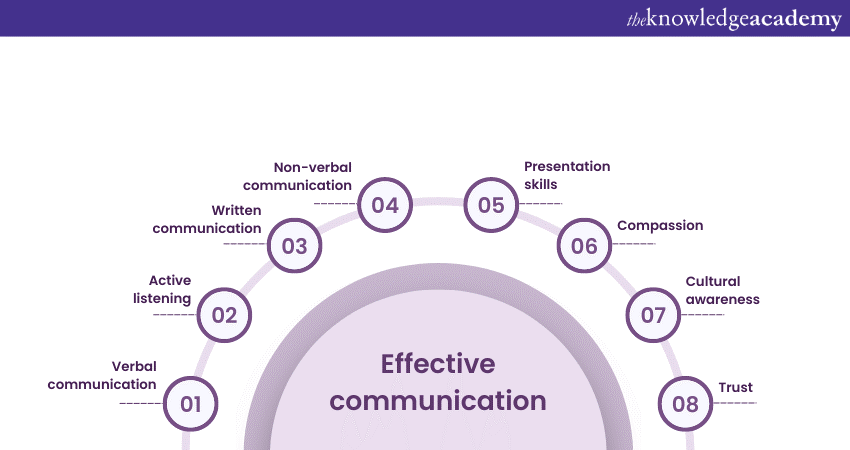
      Effective Communication


      Improve relationships 

      When we communicate effectively, we can express our thoughts, feelings, and needs clearly, leading to better understanding and connection with others. It helps to resolve conflicts, build trust, and strengthen bonds. Effective Communication also promotes empathy, active listening, and the ability to respond constructively, all of which contribute to better relationships.   

      Strong Communication Skills are crucial for maintaining positive relationships with colleagues, clients, and stakeholders. It facilitates collaboration, builds trust, and enhances teamwork, ultimately leading to improved productivity and success in the workplace. 

      Maximise workplace benefits 

      Communication Skills are highly valued in the professional world. Effective communication allows for efficient coordination, clear instructions, and the smooth flow of information within a team or organisation. It helps to avoid misunderstandings, conflicts, and costly errors. Additionally, good communication fosters a positive work environment, boosts morale, and enhances employee engagement and satisfaction. 

      Effective Communication is essential for delivering impactful presentations, conducting successful meetings, negotiating deals, and providing constructive feedback. It also helps resolve conflicts and manage challenging conversations, enabling better teamwork and overall organisational success. 

      Increase self-confidence 

      Practical Communication Skills in business can increase self-confidence by enabling individuals to express themselves, deliver impactful speeches, assert their needs, build professional relationships, and confidently handle challenging situations. Excellent Communication Skills enhance self-confidence, professional networking, and career advancement opportunities. They enable individuals to convey ideas, influence others, and showcase expertise, leading to greater recognition and success. 

      Master the art of effective communication with our Effective Communication Skills Sign up now! 

      Boosting customer loyalty 

      Effective Communication Skills play an essential role in building and maintaining strong customer relationships. Businesses can enhance customer satisfaction and loyalty by actively listening to customer needs, addressing their concerns promptly, and providing clear and empathetic communication. This improves business relations, positive word-of-mouth referrals, and long-term success. 

      Navigating cross-cultural communication 

      In today's global business landscape, cross-cultural Communication Skills are increasingly valuable. Understanding cultural gaps, adapting communication styles, and respecting diverse perspectives are essential for successful international collaborations and negotiations. Businesses prioritising cross-cultural Communication Skills gain a competitive edge in the global marketplace. 

      Learn how to implement effective strategies to improve cross-cultural Communication Skills with our Cross Cultural Communications Training Join today! 

      Usage of digital communication platforms 

      As digital communication continues to evolve, proficiency in leveraging digital platforms is crucial. Business Communication Skills extend beyond traditional methods to encompass email, social media, video conferencing, and virtual collaboration tools. Mastering these channels enables effective remote communication, virtual team collaboration, and broader reach to a global audience.  

      Effective communication resolves crisis 

      During times of crisis or uncertainty, businesses must communicate effectively to maintain trust and confidence. Crisis Communication Skills involve timely and transparent communication, empathetic messaging, and proactive management of stakeholders' concerns. Businesses that handle crises with clear and empathetic communication can mitigate reputational damage and maintain stakeholder trust. 

      Master the art of Effective Communication with our Effective Communication Skills Course.Sign up now! 

      Examples of Communication Skills

      When applying for a job, showcasing the Communication Skills that recruiters value in your cover letter and resume is essential. These skills are also crucial to demonstrate during your job interview. Here are some examples of Communication Skills and what they include:

      a) Active listening: Active listening means focusing entirely on and understanding what others say. It involves giving your undivided attention, asking clarifying questions, and providing verbal and non-verbal feedback to show you are engaged. For example, during a team meeting, actively listening would involve maintaining eye contact, nodding in agreement, and paraphrasing what others have said to demonstrate understanding. 

      b) Non-verbal Communication: Non-verbal Communication refers to the messages conveyed through gestures, facial expressions, and body language. It plays a vital role in how others perceive and interpret your communication. For example, maintaining an open and confident posture, smiling, and using appropriate hand gestures can enhance communication effectiveness. 

      c) Respectful Communication: Respectful Communication includes treating others with dignity, courtesy, and consideration. It involves valuing diverse perspectives and opinions, even when they differ from your own. Respecting others' ideas creates a positive and inclusive work environment. During an interview or in your cover letter, emphasising your ability to actively listen, appreciate differing viewpoints, and provide constructive feedback demonstrates respectful communication. 

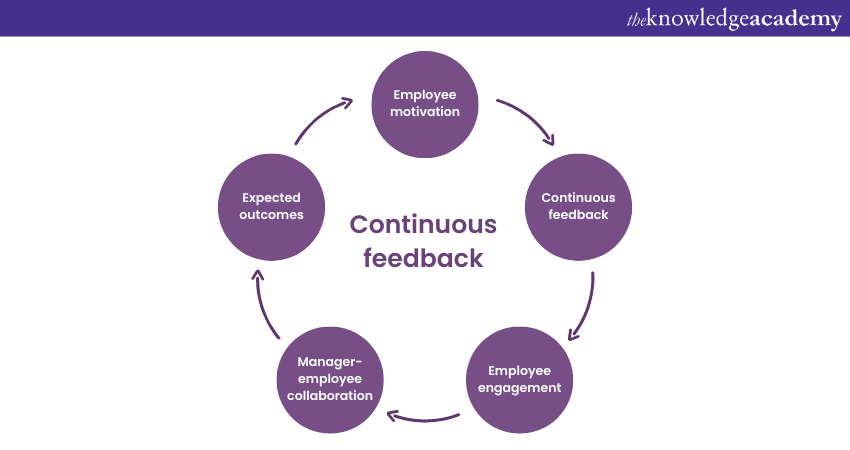
      d) Constructive feedback: Giving and taking constructive feedback is crucial for personal and professional growth. It involves providing specific and actionable suggestions to help others improve. Being open to feedback and responding positively also showcases your willingness to learn and grow. In an interview, you can highlight instances where you have given or received constructive feedback, emphasising its generated positive outcomes.   

      e) Clear and effective expression: Clear communication is essential for accurately conveying ideas and information. It involves articulating thoughts clearly, using appropriate language and tone, and structuring your message concisely and organised. In your cover letter, resume, and interview responses, focus on showcasing your ability to express yourself effectively, using simple and concise language that is easy to understand. 
       

      Continuous feedback   


      How to communicate effectively? 

      In various work situations, you will employ different Communication Skills. However, there are a few simple ways to become an effective communicator in the workplace:  

      a) Be clear and concise: To ensure easy and effective communication, make your message short using concise language. Avoid lengthy and detailed sentences, focusing instead on the core meaning of your message. While providing context can be helpful, prioritise sharing the essential information to effectively convey your idea, instruction, or message. 

      b) Practice empathy: Understanding your colleagues' feelings, ideas, and goals can enhance communication. For instance, empathise with their concerns or hesitations when seeking assistance from other departments for a project. By considering their perspective, you can position your message to address their apprehensions and foster cooperation. 

      c) Assert yourself respectfully: Sometimes, it's necessary to be assertive in the workplace to achieve your goals, such as asking for a raise, pursuing project opportunities, or expressing disagreement with an unfavourable idea. Present your thoughts with confidence while maintaining respect in conversations. Use an even tone and provide sound reasons for your assertions to increase the likelihood of others being receptive to your ideas. 

      d) Maintain calmness and consistency: When faced with disagreements or conflicts, it's crucial to remain calm and composed during communication. Avoid letting emotions dictate your interactions. Be mindful of your body language, refraining from crossing your arms or displaying negative gestures. Consistently maintain a neutral tone of voice and body language to facilitate peaceful and productive resolutions. 

      e) Pay attention to body language: Body language plays a significant role in workplace communication. Pay close attention to the non-verbal cues expressed through others' facial expressions and body movements. Equally important is being mindful of your body language and the unintentional messages it may convey. By understanding and using body language effectively, you can enhance the overall effectiveness of your communication.

      Communication Skills for job interviews 

      In a job interview, make sure to actively listen to the person speaking to you. Make sure to sit straight and make eye contact with the interviewers whenever you are speaking. Remember to speak confidently, be positive, make eye contact and smile. 

      Almost everything you do, both in terms of the job interview as well as in life, can be seen as a form of communication. By correctly identifying and assessing your strengths and weaknesses and practising good communication habits, you can enhance your Communication Skills to a great extent.  

      Conclusion 

      To sum it up, effective Communication Skills are the key to building connections, fostering collaboration, and achieving success. Effective Communication promotes teamwork, collaboration, and problem-solving, improving productivity and positive outcomes. Improving your Communication Skills for personal and professional growth will help you explore better employment prospects and career options.  


    • General Communication Skills Interview Questions

      1. Tell me about a complex idea you had to explain to a colleague. How did you go about explaining it?
      2. Describe a time when you should have documented something important but failed to do so. What happened, and what did you learn from the experience?
      3. Tell me about a sensitive situation (that youΓÇÖre comfortable sharing, of course) that required you to communicate with intention and care.
      4. Tell me about a situation where you had to voice your opinion in a meeting or during a project.
      5. Describe a time when you successfully communicated with someone even though you werenΓÇÖt sure if they valued your perspective.
      6. Describe a time when you didnΓÇÖt communicate critical information to your manager or colleague. What was the outcome, and what did you learn from the situation?
      7. Tell me about a time when you leveraged your written communication skills to make your point of view clear.
      8. Give me an example of a time when you provided a direct report with information that helped them make a good decision.
      9. Describe a time when your communication skills helped you successfully accomplish a project or task.
      10. Tell me about a time when you had a misunderstanding with a colleague. What steps did you take to overcome your communication barriers?
      11. Give me an example of a time when you were slow to share information with your direct reports or team members, and it had a negative impact.

      Empathy Interview Questions

      1. Give me an example of a time when you noticed a colleague felt down and provided words of encouragement or support.
      2. How do you ensure that people on your team and other colleagues feel heard when youΓÇÖre interacting with them (especially virtually)?
      3. Tell me about a time that you used empathy to turn a negative situation into a positive one.
      4. Tell me about a time when listening well was especially challenging. What was the result of that interaction?
      5. Tell me about a time when you picked up on negative feelings from a colleague and adapted your communication to overcome the situation.
      6. Tell me about a time when you made a mistake because you didnΓÇÖt listen carefully enough to what a team member said. How did you fix the situation?
      7. Sometimes we encounter emotional situations with coworkers. Describe a time when you didnΓÇÖt handle a situation like this well.
      8. Give me an example of a time when you were able to control and filter your emotions in a constructive way in the midst of a difficult situation.
      9. Describe a time when you had to deliver challenging news to a team member.
      10. Tell me about a time when you didnΓÇÖt show compassion to a team member. What did you learn from the experience?

      Attention to Detail Interview Questions

      1. Tell me about a time when you avoided making a mistake on something you were writing because of your attention to detail.
      2. Share an example of a time when your attention to detail helped you clearly communicate a complex idea or project with your team.
      3. Describe a time when you caught a writing mistake that your colleagues hadnΓÇÖt noticed.
      4. Describe a situation where attention to detail was either critical or unimportant for the task you were working on.
      5. Give me an example of a time when you found communicating a projectΓÇÖs details to be especially challenging.
      6. Describe a time when you chose to focus on the big picture when you should have focused more on the details.

    • 5 popular communication skills interview questions
      • What would you say is your type of communication style? ...
      • Can you give me an example of when you had to deal with a conflict at work? ...
      • How do you go about building rapport with co-workers? ...
      • What do you do to ensure that you communicate effectively at work?
      Perform and mention your opinion about the question above using good commnication skill

  • Enterprise Social Media

    1. Reading Skils

    2. Speaking


    • What is an Enterprise Social Network? Top Benefits and features

      Réseau Social d'Entreprise (RSE) et Employés : Comment Choisir ?

      Companies are introducing enterprise social media networks (ESNs) to their organizations to help employees stay engaged and become more efficient. This guide will define ESNs, explain the social technologies employees use to communicate and collaborate within the company, and how social media platforms help enterprise companies perform better. 

      What is an Enterprise Social Network?

      An enterprise social network is a private internet social network. A companyΓÇÖs enterprise social media network is not the same as a public social media network like LinkedIn, which is for professionals. 

      Enterprise social networks make collaboration easier when the company has some team members working remotely and others working from the companyΓÇÖs offices. They usually include the following elements:

      • Collaboration tools
      • Instant messaging
      • Project management
      • Task management

      All of these elements are included in the same communication platform. An enterprise social network (ESN) is exactly the right medium for encouraging team members to communicate and collaborate across silos. It leads to a higher level of employee engagement and more creative idea-sharing. When these tools are used together, it also leads to higher productivity. 

      Where Enterprise Social Networks Came From

      How did enterprise social networks get started? In the early 1990s, internet users began going online to connect and form communities based on shared interests. At that time, websites were very popular places for sharing content. These early examples formed the basis for modern social media sites like Twitter, Facebook, and LinkedIn, which many people use today. 

      Social networks for businesses such as Jabber and Yammer also started to become popular. Yammer was a social network in the same vein as Facebook but used exclusively for internal communications. It allowed users to communicate with each other through the platformΓÇÖs interface. Businesses saw value in having a single platform on which to communicate and collaborate. This made it easier for users to stay up to date. Microsoft acquired Yammer in 2012. The company then used the Yammer model to build Microsoft Teams. 

      Use Cases of Enterprise Social Networks

      Businesses are starting to understand the capabilities of enterprise social networking software to create value in their organizations by improving communication, knowledge sharing, and collaboration. The following are some examples of use cases for enterprise social networking software:

      ΓÇö Internal Communications

      Enterprise social networks encourage users to engage in informal conversations. They are wonderful for building relationships among coworkers. They are very effective for communicating change in the workplace, clarifying corporate policies, or introducing new employees to the rest of the team.

      ΓÇö Team Collaboration

      When a group of employees is working on a presentation or preparing a report, team collaboration software can streamline the process. Enterprise social networks make it easy to collaborate with other team members to get work completed. 

      ΓÇö Community

      The Community function creates branded spaces where people who have common responsibilities and interests can share their knowledge. These individuals can gather and build relationships, which increases employee engagement and translates into higher job morale. Employees are happier and more productive.

      ΓÇö Social Customer Service and Extranets

      At times, company employees may need to work with an external team (such as contractors and public relations firms) to launch a new product or service. These shared projects must be conducted in a controlled environment. Extranet software with enterprise social networking capabilities has the capability to monitor and provide direction for these types of projects. 

      ESN software gives users a collaborative, controlled space that has enough flexibility to get the work completed. Its collaboration tools allow work teams to transfer files, share ideas, and interact in real-time. 

      Customer support can be improved with ESNs. Customer service representatives can use the companyΓÇÖs internal network to acquire knowledge while the public-facing part of the ESN software can provide support from the inside. Only one system is used by the company, which eliminates the need for steep learning curves when training team members. 

      Some systems can integrate with ticketing for advanced customer service, which improves efficiency and speed when providing customer support. The customer describes the type of issue they are having by filling in an online form, and a customer service representative will respond to the queries in the order they are received. The customer can provide billing or receipt numbers to help the customer service representative. The team can respond to issues at any time of the day to keep customer satisfaction levels high.

      Why is an Enterprise Social Network Important for a Business?

      Enterprise social media benefits can positively impact employeesΓÇÖ professional lives and help the company to thrive. 

      Efficient Communication

      ESNs streamline communication between coworkers by replacing lengthy email threads with either public or private communication channels. Workers can communicate using private channels and messaging within the ESNs. Employees can track the conversations and make sure they are not missing out on any crucial details. 

      The technology makes company directories more accessible. Employees donΓÇÖt need to spend time looking for email addresses to send coworkers messages. Instead, they can find their colleagues in real-time for communication purposes.

      Cloud-based Knowledge Repository

      Enterprise social networks function as an all-access platform. Employees can get access to all company documents, such as:

      • Data gathered for various projects
      • Guides
      • Industry news
      • Research papers
      • Training resources 

      Integrating a cloud-based knowledge repository streamlines the companyΓÇÖs document management. It also allows employees to access the most current version of any file. A centralized knowledge repository makes onboarding new employees quicker and easier. Since they can gain access to information right away, they can start contributing immediately.

      Internal Social Network

      ESNs are a good place to set up informal channels to build camaraderie between employees. They can discuss topics that interest them in a virtual space. Workers can be encouraged to share facts about themselves and form closer ties with their coworkers, even if they are working in different locations.

      Centralized Collaboration

      Placing all the companyΓÇÖs shared documents, task assignments, and project data in one platform makes it easy for employees to keep track of projects. Enterprise social networks make it easier for teams to collaborate no matter where the individual members are located. These platforms work well for teams that are fully remote or partly remote. 

      A communication network that allows all employees to collaborate in real-time improves overall employee morale. It helps all team members feel as though they belong. Fostering a sense of belonging is important among employees during times when team members may not have the opportunity to meet their colleagues face-to-face. 

      Encourages an Inclusive Corporate Culture

      Enterprise social network software canΓÇÖt transform a companyΓÇÖs corporate culture to make it an inclusive one. The corporate culture must be well established before the decision is made to introduce an ESN or any online tool. An ESN can clarify company culture for new hires and remote employees who arenΓÇÖt in the companyΓÇÖs offices daily. 

      When these workers watch videos and read content about their coworkers, it helps them get a clear idea of the company culture. They can feel comfortable about communicating with their colleagues and sharing their ideas, which can only benefit the company as a whole. 

      Encourages Cross-team Collaboration

      The ESN makes it easier for teams within the company to collaborate. The communication platform allows them to share documents for projects they are working on together. Document managing is made easier and more convenient. 

      Drives Transparency within the Company

      An ESN enhances transparency within the company. It creates a sense of being part of something bigger and encourages employee engagement. The transparency of an internal social media network makes it easier for a manager to share when an employee has done a great job with the rest of the team and the entire company. The positive feedback will encourage the employee to continue working hard and may influence others to follow suit.

      Remote Workers Feel Included

      Remote workers donΓÇÖt have the advantage of asking the person sitting near them a question when they have a problem at work. If their company has deployed an ESN, their coworkers are available to them through the enterprise social media networking tools. 

      All users can ask questions and make comments publicly or privately to stay connected with their fellow employees and managers. They can read company updates from executives and feel as though they are connected to what is happening in the corporation.

      Supports Professional Communities

      The ESN allows employees with similar business interests to share their knowledge. These workers can ensure that the group has current information related to their professional interests. The group can share their knowledge with other employees through blog posts and lunch-and-learn sessions. The group can also function as an in-house source of expertise for employees who have questions in this area.

      What are the Main Features of an Enterprise Social Network?

      An employee social media platform is made up of several features meant to engage and empower employees, no matter where they work.

      Communities of Interest

      Communities of interest allow employees to connect and bond through their personal interests and hobbies. Participants can share their interests with their colleagues using text posts, photos, videos, and links. These social interactions are important for remote workers to help them feel connected to their coworkers. 

      Employees can bond around any topic they are interested in from cooking to rock climbing or pets. All they need is a few colleagues who share their interests to get a group started. 

      Communities of Practice

      Communities of practice are established to allow employees and teams to share their professional knowledge in specific disciplines. Company experts have the opportunity to connect and engage with each other around specific practice hubs

      Employees can ask specific questions and gain expertise by sharing their experiences with the group. Experts can be made available to provide feedback and support. The communities of practice can store documents related to their expertise and make them available to employees. 

      Diversity and Inclusion

      Ideally, a companyΓÇÖs workforce should reflect the community. When the workforce is diverse and inclusive, the business has less turnover because the company creates a welcoming environment for everyone

      The company can encourage diversity and inclusion by creating an online center for affinity groups to meet in Open Communities. Everyone is welcome to read, engage, and comment. By sharing thoughts and opinions, employees from different backgrounds and points of view will learn to understand and appreciate each other. 

      Employee Dashboard for Google Workspace/Microsoft 365

      Employees can get access to the work apps and resources they need in a centralized interface. Interfaces can be customized to meet the needs of each employee so that each worker can be productive and collaborate easily with their team and coworkers. 

      Apps can be organized according to the ones the employee uses most often. Alternatively, employees can add or remove apps to organize their interface to suit themselves. A worker can access their favorite apps with a single click. 

      Dashboard Google Workspace

      Employee Directory

      Employees can post their professional profiles in the employee directory. The profile can include the employeeΓÇÖs skills, department, location, education, and anything else the employee wishes to share

      When someone in the company wants to connect with an expert, they can consult the employee directory. It also highlights employeesΓÇÖ special skills and talents that may not be immediately obvious from their job titles.

      HR Portal

      Employees need an efficient HR communication portal to access information, documents, news, and other resources. The HR portal can remind employees about important dates like open enrollment. It can also display answers to common questions and announce new arrivals and internal moves within the company. The HR portal can be used to post surveys to collect employee feedback, display an internal job board, and show employees shortcuts to HR apps. 

      Leadership Corner

      The leadership corner is the company CEO Blog. This is a great way for the company leader to communicate with all employees. Through the blog, they can provide information about company strategy, and news, and gain feedback. Employees can ask the CEO questions and all employees can read the answer in a blog post. 

      The CEO blog can include surveys and polls on topics of interest to employees. The executives can keep their fingers on the pulse of how employees feel, which can only improve relationships between the two.


      LeaderShip Corner - LumApps Intranet Use Case


      Learning Center

      The learning center is the online home for departmental training. Employees visit there for departmental training and professional development for all teams. It is also used to share information about training sessions and upcoming events. A learning center is also a good place for employees to find helpful articles about how to acquire new capabilities to excel at work and learn how to be better employees.

      Onboarding Center

      The onboarding center helps to make a new employeeΓÇÖs first days and weeks with the company a great experience. It guides the new hire through a set of steps to help them get connected and engaged with the company from the start. The employee enjoys a personalized experience that is clear and manageable for them. It can reduce the time it takes for a new hire to become acclimatized to their new workplace. 


      lumapps-hero-onboardingcenter


      Policy Hub

      A dedicated policy hub allows employees to gain access to critical business information and news necessary to ensure compliance. It should include the employee handbook, ethics policies, company insurance information, and data security procedures.

      Video Center

      The company video center is a comprehensive catalog of internal and external videos. It includes onboarding materials, training videos, sales assets, and marketing materials. 

      The videos can be hosted with Sharepoint Online or Google Drive. They can also be linked externally to YouTube. The content can be customized by displaying it in thumbnails or in a list format. 


      LumApps Video Center


      How to Set up an Enterprise Social Network for your Company?

      When setting up an enterprise social network site for your company, youΓÇÖll want to proceed logically. 

      1. Review the companyΓÇÖs existing systems

      Before making any changes, itΓÇÖs a good idea to get a thorough understanding of the tools and manual processes employees are using to get their work completed. Ask employees what is working and what isnΓÇÖt working for them. Repeat this process frequently throughout the implementation. 

      Conduct individual sessions and offer workshops to teams and departments throughout the company. Capture employee feedback with anonymous surveys. 

      2. Update company content before moving it to the new system

      It takes time to move documents and metadata. Updating all the companyΓÇÖs user details will also take a considerable amount of time. To be successful, an ESN relies on its connection to the company content. Be sure to have a plan in place for moving content and maintaining it after the move. 

      3. Develop a formal adoption strategy

      Make a plan for training employees on the new system. All employees wonΓÇÖt be able to train at the same time, which means a schedule must be established. Once everyone has been trained, there needs to be somewhere within the system where employees can go to refresh their memories if they get stuck.

      When new features are introduced, post instructions on user forums. Host lunch-and-learn sessions for employees who would like someone to guide them through the new options. Some employees would rather send an email or post a message online with their questions. Give them that option too, so they can get assistance in a way that they feel comfortable with. 

      4. Establish guidelines for using the enterprise social media platform

      Before launching the ESN for the business, employees should set guidelines for acceptable use. These guidelines should cover appropriate business etiquette when using these social tools. Compliance guidelines should also be discussed. 

      5. Recruit socially active employees to help with adoption

      Find employees who are already active on social media sites. These workers can bring their experience and enthusiasm to the table to encourage their coworkers in getting on board with the company ESN. They can also be a source of help and support for employees who may have questions or concerns about participating in discussions or posting comments using the ESN software. 

      6. Avoid using the ESN as a silo

      Introducing an ESN to the company is meant to share information between teams, not keep it limited to silos that are only accessed by specific groups within the company. Unless the information is specifically marked as confidential, it should be shared openly so that more employees can access it and benefit from it. Shared knowledge will allow workers to become more competent, confident, and efficient when performing their duties.

      7. Design the business enterprise social network for mobile applications

      Many employees will be accessing the ESN with a mobile device. Be sure that the enterprise social network is designed with this in mind. If employees canΓÇÖt read the login screen easily or access the apps they want to use, they wonΓÇÖt continue to use the ESN on their mobile devices.

      8. Use the ESN to streamline your business

      Integrate the ESN with the company intranet along with email and messaging capabilities. Integrate the enterprise social network with business apps employees are already using. This step will streamline your business and help employees to become more efficient. 

    • I. Answer the question basedn the text of The Business Matter, IT jobs and Duties

      1. What is the meaning of IT jobs? Mention it

      2.  IT job titles are as varied as the types of jobs available in the industry. Can you give at least 5 types of jobs which is       more popular in the industry.

      3.  How much is the average annual salary for the type of IT jobs you mentioned above ? 

      4.  What are the job duties and responsibilties of IT profesionals ? Explain them clearly

      5.  IT profesionals must have some techinical skill as preparing for a career in IT. Mention the techinical skill of IT           professional

      II. Vocabulary. What is the meaning of vocabularies below :

      1.  optimize  2.  typically  3. various,  4. helpul   5. application  6. network  7. increase  8. prepare  9. function  10. duty

      III. Decide the bold words based on the part of speech :

      1. A computer programmer writes, test and modifies code to operate sofware

      2. IT security specialist is protecting the confidential information and creating firewall efficiently in most industries. 

      3. They usually apply theory to develop computer system, build databases, work with programming language . 

      4.  The job duties of IT professional typically include creating new computer system or finding software errors. 

      5.  Many IT roles require coding knowledge in various programming language depending on your role.

      IV. Making a simple sentence in verbal or nominal sentence using the words below. 

      1.  optimize  2.  typically  3. various,  4. helpul   5. application  6. network  7. increase  8. prepare  9. function  10. duty

  • 1. Definition 

    2. Type 

    3. Example

    4. Speaking (Practice in the procedure of login into tik tok, twitter, IG)


    • What is a procedure text

      Procedure text is a type of text that is written to explain how to do something. ItΓÇÖs a step-by-step explanation of a process or a set of instructions for completing a specific task. Procedure text is used in many contexts, such as manuals, recipes, scientific experiments, or instructions for assembling products.

      What is the structure of a procedure text?

      1. Goal

      The goal is the starting point of a procedure text. It sets the stage by providing a clear statement of what the reader is trying to achieve by following the instructions. It gives context and purpose, helping the reader to understand why they are undertaking the task.

      For example, in a recipe, the aim might be to bake a chocolate cake. In a science experiment, the goal could be to demonstrate a particular chemical reaction. By stating the aim or goal, the reader can focus on what needs to be accomplished.

      2. Materials or ingredients 

      This section provides a comprehensive list of everything needed to carry out the task. It ensures that the reader has everything at hand before starting.

      • Materials: This could include tools, equipment, or other supplies. For example, if youΓÇÖre assembling a piece of furniture, this section would list all the required parts and tools like screws, nails, a hammer, etc.
      • Ingredients: In a cooking context, this refers to all the food items and quantities needed to prepare a dish. ItΓÇÖs like a shopping list for your recipe, ensuring you have everything you need to start cooking.

      The Materials/Ingredients section is essential for preparation and helps ensure that the procedure goes smoothly from start to finish.

      3. Steps 

      The Steps are the heart of a procedure text. This section provides a detailed, step-by-step guide on how to achieve the aim or goal. It breaks down the task into manageable parts, often in a chronological or logical order.

      Each step is usually written in a clear and concise manner, using imperative language (commands). ItΓÇÖs vital that these steps are easy to understand and follow, as any ambiguity or complexity can lead to confusion or mistakes.

      What are the language features of a procedure text?

      1. Simple present tense

      The simple present tense in a procedure text makes the action immediate and relevant. ItΓÇÖs as if the procedure is happening right now, in real time, guiding the reader as they perform the task.

      Example:

      • Pour the water into the glass 
      • Mix the ingredients until well combined 

      2. Imperative sentences

      Imperative sentences are command forms that tell someone to do something. They are direct and to the point, which is essential in instructions.

      Example:

      • Knead the dough until smooth, then cover and let it rest for 30 minutes
      • Apply the paint evenly across the canvas, using broad strokes for a textured effect

      3. Connectives 

      Connectives (or conjunctions) are words or phrases that link different parts of a text. They can show the order of steps, the relationship between different parts, or add additional information.

      Examples of connectives in procedure texts include words like then, next, after that, before, or finally. These words help guide the reader through the process in a logical and coherent way.

      Example:

      • First, wash the rice; then, soak it for 20 minutes
      • Measure the ingredients carefully. After that, mix them in a bowl

      4. Adverbs

      Adverbs can provide additional detail about how an action is to be performed, adding precision and clarity to the instructions. They can describe how, when, where, or to what extent something is done.

      Example:

      • Slowly add water to the flour, stirring constantly
      • Thoroughly wash the vegetables to remove any dirt or pesticides

      The adverbs ΓÇÿslowlyΓÇÖ and ΓÇÿthoroughlyΓÇÖ in these examples add nuance to the action, guiding the reader on how exactly to perform the task

    • Presentation how to login to

      1. Whats up

      2. Tweeter

      3. Facebook

      Based on the procerude text above

  • Network mobiles

    The essential functionalities include connectivity, communication, data access, computing services, location-based services, and security


    • Mobile Network | Definition, Types & Examples

      What is a mobile data network?

      A mobile data network is a system that transmits and receives radio signals to mobile subscriber devices. It is similar to a wireless network but has unique elements.

      What are the types of mobile networks?

      Mobile networks vary based on producer and can be 3G, 4G, 5G, WAN, or LAN, but they all use the same essential system. The first element is a Public Switched Telephone Network, which send signals to the Mobile Telephone Switching Office, which transmits signals to cells sites. Then, the electric call signal is sent via radio signal to mobile subscriber units.


      A mobile network (also wireless network) route's communications in the form of radio waves to and from users. It is composed of base stations that each cover a delimited area or "cell." When joined together these cells provide radio coverage over a wide geographic area. This enables a large number of portable transceivers (e.g., mobile phones, pagers, etc.) to communicate with each other and with fixed transceivers and telephones anywhere in the network, even if some of the transceivers are moving through more than one cell during transmission.

      Mobile networks are rapidly becoming the universal service delivery vehicle for all applications. The key question is whether they can manage to keep up with the underlying bandwidth demands. The rising demand for mobile broadband services has accelerated the move to LTE and LTE-Advanced. This latest mobile technology further increases not only bandwidth but also quality requirements of the backhaul network. 

      A mobile network, also known as a cellular network, enables wireless communication between many end users, and across vast distances, by transmitting signals using radio waves. 

      Most portable communication devices ΓÇô including mobile phone handsets, laptops, tablets, and so on ΓÇô are equipped to connect to a mobile network and enable wireless communication through phone calls, electronic messages and mail, and data. 

      How do mobile networks work?

      Mobile networks are effectively a web of whatΓÇÖs known as base stations. These base stations each cover a specific geographical land area ΓÇô called a cell ΓÇô and are equipped with at least one fixed-location transceiver antenna that enables the cell to send and receive transmissions between devices using radio waves. 

      When people experience poor reception or connection using their mobile devices, this is usually because they arenΓÇÖt in close enough range to a base station. This is also why, in order to provide the best possible network coverage, many network providers and operators will employ as many base station transceivers as they can, and overlap their cell areas. 

      How mobile devices connect to mobile networks

      In the past, mobile phones ΓÇô or portable transceivers ΓÇô used an analog technology called AMPS (Advanced Mobile Phone System) to connect to cellular networks. Today, however, portable communication devices such as the Apple iPhone or Samsung Galaxy Android phone use digital cellular technologies to send and receive transmissions.

      These technologies can include:

      • global system for mobile communications (GSM)
      • code division multiple access (CDMA).
      • time division multiple access (TDMA).

      What is the difference between GSM and CDMA?

      Devices that use the global system for mobile communications (GSM):

      • can transmit data and voice at the same time
      • do not have built-in encryption, and are typically less secure
      • store data on a subscriber identity module (SIM) card that can be transferred between devices

      Devices that use code division multiple access (CDMA), on the other hand:

      • cannot send both data types at the same time
      • have built-in encryption and more security
      • store data on the mobile device itself, rather than a SIM

      Another key difference is in terms of usage: GSM is the predominant technology used in Europe and other parts of the world, while CDMA is used in fewer countries.

      What are the different types of mobile networks?

      Mobile networks have become progressively faster and more advanced over the past few decades.

      2G

      2G dates back to the early 1990s and eventually enabled early SMS and MMS messaging on mobile phones. It is also noteworthy because it marked the move from the analog 1G to digital radio signals. Its use has been phased out in some areas of the world, such as Europe and North America, but 2G is still available in many developing regions.

      3G

      3G was introduced in the early 2000s, and is based on universal mobile telecommunication service (UMTS) standards. For the first time, mobile devices could use web browsers and stream music and videos. 3G is still widely in use around the world today. 

      4G

      4G was first introduced around 2010 and offered a significant step forward for mobile networks. Speed increases significantly with 4G, enabling advanced streaming capabilities and better connectivity and performance for mobile games and other smartphone apps even when not connected to WiFi.

      5G

      5G is the newest addition to the family of mobile networks, rolling out at the end of the 2010s and still being introduced in major centres around the world today. Through high-frequency radio waves, the 5G network offers significantly increased bandwidth and is approximately 100 times faster than the upper limit of 4G.

      Different mobile networks providers in the UK

      UK networks vary in the United Kingdom, but all are regulated by Ofcom, the regulators and competition authority for UK communication industries such as fixed-line telecoms, mobiles, and wireless device airwaves. ItΓÇÖs worth noting that mobile networks can also fall under the jurisdiction of the Financial Conduct Authority when offering services such as phone insurance.

      What are the UKΓÇÖs main mobile networks?

      The UK has four main mobile network providers:

      1. Vodafone
      2. EE
      3. O2
      4. Three

      Between them, these four mobile operators ΓÇô known as the big four ΓÇô own and manage the UKs mobile network infrastructure. TheyΓÇÖre also known as host mobile phone networks, supporting all other mobile service providers ΓÇô called mobile virtual network operators (MVNOs) ΓÇô in the UK.

      Examples of mobile virtual network operators in the UK

      • ID Mobile, which uses the Three network
      • GiffGaff, which uses the O2 network
      • Tesco Mobile, which uses the O2 network
      • Virgin Mobile from Virgin Media, which uses the Vodafone and O2 networks
      • Sky Mobile, which uses the O2 network
      • BT Mobile, which uses the EE network
      • Plusnet Mobile, which uses the EE network
      • Asda Mobile, which uses the Vodafone network
      • VOXI, which uses the Vodafone network
      • SMARTY, which uses the Three network
      • Talkmobile, which uses the Vodafone network
      • Lebara, which uses the Vodafone network

      Other mobile phone businesses, such as Carphone Warehouse, work with multiple providers to offer consumers several options in one place when looking for a new phone provider.

      Competition between mobile providers

      Regardless of which mobile provider that UK mobile customers choose, there are just four networks supporting the providerΓÇÖs service. This means that having the UKΓÇÖs fastest or most reliable network is a huge selling point, and many customers use a dedicated coverage checker to investigate their preferred option. It also means that providers offer a number of additional perks and mobile phone deals to help secure mobile phone contracts.

      These benefits might include:

      • reduced tariffs for customers who sign up for a rolling monthly contract
      • data plans such as an unlimited data allowance or data rollover, which allows customers to rollover any unused data at the end of the month into the next month
      • deals and discounts for other services offered by the providers, such as household broadband deals or mobile broadband services
      • access to affiliated entertainment services, such as Netflix, Amazon Prime, or BT Sport
      • discounted SIM-only deals and plans such as a reduced one-month rolling SIM or a 12-month SIM

      Explore mobile and computer networks

      Discover more about mobile networks and advance your career in computer science with the 100% online MSc Computer Science from the University of York. This flexible Masters programme has been designed for working professionals and graduates who may not currently have a computer science background and want to launch their career in this cutting-edge and lucrative field.

      One of the key modules on this programme covers computer and mobile networks, so you will examine internet architecture, protocols, and technologies ΓÇô as well as their real-world applications. You will also discuss networks and the internet, network architecture, communication protocols and their design principles, wireless and mobile networks, network security issues, and networking standards, as well as related social, privacy, and copyright issues.  

  • Web Hosting

    Learn about website management and administration using web hosting services.


    • What is web hosting?

      Web hosting is a service that provides storage for the files that make up your website and the software, physical hardware, and network infrastructure that makes your website available to others on the internet.

      Web hosting service providers offer a variety of hosting options, ranging from expensive to inexpensive. The cost is essentially determined by the following:

      • The amount of storage space and computing capacity allocated specifically for your site.

      • The degree to which your site shares computing resources with other sites or is isolated from the impact of other sites sharing the same resources.

      • The additional capabilities and services offered (e.g., number of email inboxes with your domain name, blogging capabilities, etc.).

      • The degree of control and flexibility you have (e.g., which operating system (OS) and/or content management system (CMS) you can use, support for special web applications, etc.).

      • The extent to which you manage your web site or have the service provider manage it for you.
      Achieve workplace flexibility with DaaS

      Read how desktop as a service (DaaS) enables enterprises to achieve the same level of performance and security as deploying the applications on premises.

      Related content

        Register for the guide on hybrid cloud

      Common hosting options

      These are the three most common hosting options, ranging from least to most expensive:

      Shared hosting
      In shared hosting, the hosting provider hosts your website and several others (co-tenants) on a single computerΓÇöyou share the CPU, memory, storage space, and the web server software (the software that delivers web content to browsers that request it).

      Because youΓÇÖre sharing these resources with owners of other web sites, you pay less for them. However, even though the single shared computer is usually very powerful, unexpectedly high traffic to one of the hosted sites can rob the others of resources and slow them down dramatically. Additionally, if one site is victimized by a virus or security attack, the other sites on the server could be vulnerable.

      Shared hosting is a good choice for personal web sites, personal blogs, small non-transactional business sites (e.g., a creative portfolio) or non-business sites. For more information about shared hosting, see ΓÇ£What is Cloud Hosting?ΓÇ¥

      Virtual private server (VPS) hosting or cloud-based VPS
      In VPS hosting, your site gets its own dedicated virtual server. As with shared hosting, you do share the hardware resources of a single computer (in most cases), but you share them with far fewer co-tenants, and their problemsΓÇösecurity breaches, crashes ΓÇöare much less likely to impact your site.

      With a VPS you typically have complete control over your OS, CMS, and other software, which makes it a better choice for hosting custom web applications or web-based software (Software-as-a-Service, or SaaS). As you might have guessed, VPS is more expensive than shared hosting.

      While VPS hosting shares resources among fewer websites, as each site grows and attracts more traffic, they can strain the resources of a single computer. For this reason, many hosting providers offer cloud-based VPS hosting, in which each site shares the combined resources of multiple computers in a single data center (or even in different geographical locations). This makes it easier to scale computing power, storage capacity, and bandwidth as needed and provides additional resiliency in the event of hardware problems or natural/man-made disasters.

      VPS or cloud-based VPS hosting is ideal for the majority of business web sites.

      Learn more about virtual private server (VPS) hosting.

      Dedicated hosting
      Dedicated hosting gives you exclusive access to your own web server hardware. You get the same control over system and application software that you get with a VPS, but because yours is the only site using the hardware, your site runs faster. You are also completely immune to performance or security issues on other web sites.

      Dedicated hosting does have some drawbacks, howeverΓÇöitΓÇÖs the most expensive option because yours is the only site using the hardware. If you donΓÇÖt have the talent on staff to manage the server yourself, youΓÇÖll need to pay additional fees for the provider to manage it for you. Dedicated hosting also canΓÇÖt scale on the fly because someone has to physically upgrade the server with more RAM, storage, etc. when needed. As a result, dedicated hosting is typically worthwhile only when performance and security considerations justify the additional cost.

      The term ΓÇ£bare metal serversΓÇ¥ is sometimes used interchangeably with ΓÇ£dedicated servers,ΓÇ¥ but bare metal servers typically add cloud-like benefits like provisioning in minutes (vs. hours), billing in hourly increments (instead of monthly billing), and higher-end hardware.


  • Database

    Database systems administration, which provides them with a unique blend of technical expertise, problem-solving skills, and security awareness


    • What Is a Database?


      database

      What Is a Database?

      Database defined

      A database is an organized collection of structured information, or data, typically stored electronically in a computer system. A database is usually controlled by a database management system (DBMS). Together, the data and the DBMS, along with the applications that are associated with them, are referred to as a database system, often shortened to just database.

      Data within the most common types of databases in operation today is typically modeled in rows and columns in a series of tables to make processing and data querying efficient. The data can then be easily accessed, managed, modified, updated, controlled, and organized. Most databases use structured query language (SQL) for writing and querying data.

      What is Structured Query Language (SQL)?

      SQL is a programming language used by nearly all relational databases to query, manipulate, and define data, and to provide access control. SQL was first developed at IBM in the 1970s with Oracle as a major contributor, which led to implementation of the SQL ANSI standard, SQL has spurred many extensions from companies such as IBM, Oracle, and Microsoft. Although SQL is still widely used today, new programming languages are beginning to appear.

      Evolution of the database

      Databases have evolved dramatically since their inception in the early 1960s. Navigational databases such as the hierarchical database (which relied on a tree-like model and allowed only a one-to-many relationship), and the network database (a more flexible model that allowed multiple relationships), were the original systems used to store and manipulate data. Although simple, these early systems were inflexible. In the 1980s, relational databases became popular, followed by object-oriented databases in the 1990s. More recently, NoSQL databases came about as a response to the growth of the internet and the need for faster speed and processing of unstructured data. Today, cloud databases and self-driving databases are breaking new ground when it comes to how data is collected, stored, managed, and utilized.

      WhatΓÇÖs the difference between a database and a spreadsheet?

      Databases and spreadsheets (such as Microsoft Excel) are both convenient ways to store information. The primary differences between the two are:

      • How the data is stored and manipulated
      • Who can access the data
      • How much data can be stored

      Spreadsheets were originally designed for one user, and their characteristics reflect that. TheyΓÇÖre great for a single user or small number of users who donΓÇÖt need to do a lot of incredibly complicated data manipulation. Databases, on the other hand, are designed to hold much larger collections of organized informationΓÇömassive amounts, sometimes. Databases allow multiple users at the same time to quickly and securely access and query the data using highly complex logic and language.

      Types of databases

      There are many different types of databases. The best database for a specific organization depends on how the organization intends to use the data.

        Relational databases

      • Relational databases became dominant in the 1980s. Items in a relational database are organized as a set of tables with columns and rows. Relational database technology provides the most efficient and flexible way to access structured information.
      • Object-oriented databases

      • Information in an object-oriented database is represented in the form of objects, as in object-oriented programming.
      • Distributed databases

      • A distributed database consists of two or more files located in different sites. The database may be stored on multiple computers, located in the same physical location, or scattered over different networks.
      • Data warehouses

      • A central repository for data, a data warehouse is a type of database specifically designed for fast query and analysis.
      • NoSQL databases

      • NoSQL, or nonrelational database, allows unstructured and semistructured data to be stored and manipulated (in contrast to a relational database, which defines how all data inserted into the database must be composed). NoSQL databases grew popular as web applications became more common and more complex.
      • Graph databases

      • A graph database stores data in terms of entities and the relationships between entities.
      • OLTP databases. An OLTP database is a speedy, analytic database designed for large numbers of transactions performed by multiple users.

      These are only a few of the several dozen types of databases in use today. Other, less common databases are tailored to very specific scientific, financial, or other functions. In addition to the different database types, changes in technology development approaches and dramatic advances such as the cloud and automation are propelling databases in entirely new directions. Some of the latest databases include

        Open source databases

      • An open source database system is one whose source code is open source; such databases could be SQL or NoSQL databases.
      • Cloud databases

      • cloud database is a collection of data, either structured or unstructured, that resides on a private, public, or hybrid cloud computing platform. There are two types of cloud database models: traditional and database as a service (DBaaS). With DBaaS, administrative tasks and maintenance are performed by a service provider.
      • Multimodel database

      • Multimodel databases combine different types of database models into a single, integrated back end. This means they can accommodate various data types.
      • Document/JSON database

      • Designed for storing, retrieving, and managing document-oriented information, document databases are a modern way to store data in JSON format rather than rows and columns.
      • Self-driving databases

      • The newest and most groundbreaking type of database, self-driving databases (also known as autonomous databases) are cloud-based and use machine learning to automate database tuning, security, backups, updates, and other routine management tasks traditionally performed by database administrators.

      What is database software?

      Database software is used to create, edit, and maintain database files and records, enabling easier file and record creation, data entry, data editing, updating, and reporting. The software also handles data storage, backup and reporting, multi-access control, and security. Strong database security is especially important today, as data theft becomes more frequent. Database software is sometimes also referred to as a ΓÇ£database management systemΓÇ¥ (DBMS).

      Database software makes data management simpler by enabling users to store data in a structured form and then access it. It typically has a graphical interface to help create and manage the data and, in some cases, users can construct their own databases by using database software.

      What is a database management system (DBMS)?

      A database typically requires a comprehensive database software program known as a database management system (DBMS). A DBMS serves as an interface between the database and its end users or programs, allowing users to retrieve, update, and manage how the information is organized and optimized. A DBMS also facilitates oversight and control of databases, enabling a variety of administrative operations such as performance monitoring, tuning, and backup and recovery.

      Some examples of popular database software or DBMSs include MySQL, Microsoft Access, Microsoft SQL Server, FileMaker Pro, Oracle Database, and dBASE.

      What is a MySQL database?

      MySQL is an open source relational database management system based on SQL. It was designed and optimized for web applications and can run on any platform. As new and different requirements emerged with the internet, MySQL became the platform of choice for web developers and web-based applications. Because itΓÇÖs designed to process millions of queries and thousands of transactions, MySQL is a popular choice for ecommerce businesses that need to manage multiple money transfers. On-demand flexibility is the primary feature of MySQL.

      MySQL is the DBMS behind some of the top websites and web-based applications in the world, including Airbnb, Uber, LinkedIn, Facebook, Twitter, and YouTube.

      Using databases to improve business performance and decision-making

      With massive data collection from the Internet of Things transforming life and industry across the globe, businesses today have access to more data than ever before. Forward-thinking organizations can now use databases to go beyond basic data storage and transactions to analyze vast quantities of data from multiple systems. Using database and other computing and business intelligence tools, organizations can now leverage the data they collect to run more efficiently, enable better decision-making, and become more agile and scalable. Optimizing access and throughput to data is critical to businesses today because there is more data volume to track. ItΓÇÖs critical to have a platform that can deliver the performance, scale, and agility that businesses need as they grow over time.

      The self-driving database is poised to provide a significant boost to these capabilities. Because self-driving databases automate expensive, time-consuming manual processes, they free up business users to become more proactive with their data. By having direct control over the ability to create and use databases, users gain control and autonomy while still maintaining important security standards.

      Database challenges

      TodayΓÇÖs large enterprise databases often support very complex queries and are expected to deliver nearly instant responses to those queries. As a result, database administrators are constantly called upon to employ a wide variety of methods to help improve performance. Some common challenges that they face include:

      • Absorbing significant increases in data volume. The explosion of data coming in from sensors, connected machines, and dozens of other sources keeps database administrators scrambling to manage and organize their companiesΓÇÖ data efficiently.
      • Ensuring data security. Data breaches are happening everywhere these days, and hackers are getting more inventive. ItΓÇÖs more important than ever to ensure that data is secure but also easily accessible to users.
      • Keeping up with demand. In todayΓÇÖs fast-moving business environment, companies need real-time access to their data to support timely decision-making and to take advantage of new opportunities.
      • Managing and maintaining the database and infrastructure. Database administrators must continually watch the database for problems and perform preventative maintenance, as well as apply software upgrades and patches. As databases become more complex and data volumes grow, companies are faced with the expense of hiring additional talent to monitor and tune their databases.
      • Removing limits on scalability. A business needs to grow if itΓÇÖs going to survive, and its data management must grow along with it. But itΓÇÖs very difficult for database administrators to predict how much capacity the company will need, particularly with on-premises databases.
      • Ensuring data residency, data sovereignty, or latency requirements. Some organizations have use cases that are better suited to run on-premises. In those cases, engineered systems that are pre-configured and pre-optimized for running the database are ideal.

      Addressing all of these challenges can be time-consuming and can prevent database administrators from performing more strategic functions.

      How autonomous technology is improving database management

      Self-driving databases are the wave of the futureΓÇöand offer an intriguing possibility for organizations that want to use the best available database technology without the headaches of running and operating that technology.

      Self-driving databases use cloud-based technology and machine learning to automate many of the routine tasks required to manage databases, such as tuning, security, backups, updates, and other routine management tasks. With these tedious tasks automated, database administrators are freed up to do more strategic work. The self-driving, self-securing, and self-repairing capabilities of self-driving databases are poised to revolutionize how companies manage and secure their data, enabling performance advantages, lower costs, and improved security.

      Future of databases and autonomous databases

      The first autonomous database was announced in late 2017, and multiple independent industry analysts quickly recognized the technology and its potential impact on computing.

      • What is RDBMS?
      • What is data redundancy?
      • Describe the different types of relationships in a database.
      • What are the advantages of database normalisation?
      • Describe different types of normalisation.
      • What is the difference between a record and a field?

  • Resume / Curricullum Vitae


    • How to write a resume for a job

      Chances are, if you write a compelling resume, youΓÇÖll be booked for interviews for every job you apply for. But what makes a good resume?

      Keep reading! WeΓÇÖve broken down the instructions for how to create a resume, step-by-step.

      STEP 1

      Gather your professional information

      Preparation is key to writing a resume that stands out. WeΓÇÖll cover what essential information you should gather before writing your resume to save time and put your best foot forward. 

      To ensure a well-prepared resume, carefully examine your relevant qualifications and match them with the requirements of your desired job. 

      Take the time to organize a comprehensive list that includes:

      • Impressive measurable accomplishments from your previous positions that highlight your achievements and contributions.
      • A complete inventory of your soft skillshard skills and technical skills that match the skills outlined in the job description.
      • Detailed information about your previous employers, including their names, dates of employment, locations, job titles and a clear outline of your responsibilities.
      • Educational credentials, such as your college degree, certifications or licenses that demonstrate your expertise in specific areas.
      • Any volunteer work where you gained skills and experience relevant to the role you are applying for. 
      • Notable awards and honors you have received, which further validate your exceptional abilities and dedication.

      Review these qualifications against the job description and note where there is a match. Writing a customized resume is a great way to impress employers and secure interviews.

      Make me (the hiring manager ) believe your are interested in our job, not just any job. Specifically, try to use the language of the job posting in your resume. This will also make sure your application makes it past any automated screening software designed to toss out irrelevant applicants. - CJ Johnson, veteran people manager for Silicon Valley startups and unicorns

      By planning to include these matching qualifications in your resume, you set yourself up for success.

      A compelling, tailored document that effectively highlights your qualifications increases your chances of securing your desired job.

      STEP 2

      Pick the best resume format for your needs

      Now that youΓÇÖve prepared your information, itΓÇÖs time to choose a resume format that effectively showcases your qualifications.

      There are three standard formats. Each uses the same resume sections but organizes them differently, so choose one that works best for your work experience level and your professional goals. WeΓÇÖve detailed each format below: 

      The chronological resume format is the most commonly used. ItΓÇÖs perfect for candidates who want to highlight their work experience when building a resume because it places it front and center. ItΓÇÖs the ideal format for individuals with consistent professional backgrounds and no employment gaps. 
      The functional resume format focuses on showcasing your skills and training. ItΓÇÖs designed to highlight the abilities that make you a valuable addition to any team, even if youΓÇÖre applying for your first job or changing careers. This format is especially beneficial for those with employment gaps or limited work experience.
      The combination resume format, also known as the hybrid resume, combines the best of the functional and chronological formats. This resume format allows you to showcase your skills while also highlighting your relevant work experience. ItΓÇÖs an excellent choice for job seekers with more than 10 years of experience and those seeking to move up in their careers.

      STEP 3

      Add your contact information

      One of the most important aspects of writing a resume is ensuring that your contact information is clearly displayed so that hiring managers can contact you for an interview.  

      Check out the resume header examples below to learn what contact information to include, where to place it and how to format it for maximum impact. 

      You can also explore our library of 800+ resume examples to draw additional inspiration for ways to display your contact information.

      HereΓÇÖs what to include in your resume contact information: 

      • Your full name.
      • A reliable phone number.
      • Your professional email address.
      • Your city, state and ZIP code. 
      • A link to your professional social media account, website or portfolio if you have them.

      Here is a sample of how to write a resume header:

      Kathy Backer | 555-555-5555 | Milwaukee, WI 53209

      example@example.com | https://www.linkedin.com/in/kathy-baker/

      Resume Header Contact Information

      STEP 4

      Write a compelling resume summary

      resume summary is a concise and impactful overview of a candidateΓÇÖs qualifications, skills and career goals.

      According to Simon Murray, co-founder and director of fleet safety and performance company Cameramatics, the best way to create a great resume is to ΓÇ£Craft a captivating professional summary that succinctly highlights your most valuable skills and accomplishments.ΓÇ¥ 

      Murray emphasizes that a resume summary should “hook the reader and entice them to explore your resume further,” avoiding generic clichés while highlighting what sets you apart from other applicants.

      Here is an example of a captivating resume summary:

      Efficient, accuracy-driven secretary successful at delivering key clerical support to internal teams, customers, vendors and other stakeholders. Demonstrated success in analytical problem-solving and boosting operational efficiency. Bringing 10 years of superior performance in related roles.

      Resume Summary

      If you are a first-time job seeker, changing careers or returning to work after a long absence, you should write a resume objective instead. 

      It is important to note that in modern resume writing, a professional summary or profile section is preferred over a traditional resume objective statement.

      If you choose to include an objective statement, ensure that you focus on the companyΓÇÖs needs rather than those of your own. HereΓÇÖs an example:

      As a medical assistant wanting to transition into a project manager role, my career objective is to leverage my strong organizational skills, attention to detail and ability to work collaboratively to lead projects from conception to completion effectively. I seek a challenging and dynamic environment where I can apply my skills and experience in health care administration and project management to achieve organizational goals and drive success. Through continued education and professional development, I aim to become a highly effective project manager who consistently delivers results and exceeds expectations.

      Resume Objective

      The bottom line: Whether you use a resume summary or a resume objective, make it compelling, concise and clear.

      STEP 5

      Make a resume work history section

      Potential employers want to know what they can gain by hiring you, so they will review your resume work history section to see how you have used your skills and knowledge to make an impact on current and previous employers.

      For each job, display three to five work accomplishments in bullet points and quantify them when possible. A 2018 survey conducted on behalf of CareerBuilder found that 34% of hiring managers identified a lack of quantifiable results in a resume as an instant deal breaker. 

      When you include quantifiable achievements in your resume, employers get a tangible idea of how youΓÇÖve positively contributed to the organization or company in past roles. 

      For example, a teacher might write: ΓÇ£35% of the senior class improved end-of-semester test scores by 25% within three months.ΓÇ¥ 

      Format this resume section by listing jobs in reverse-chronological order, with the current or latest position at the top. Include your title, the company name and location, the dates of employment and bullet points with your top achievements and responsibilities. For example:

      Secretary | BCforward - Milwaukee, WI | 08/2015 - Current

      • Conducted thorough research using diverse resources to assist professional staff with routine and special project tasks.
      • Provided clerical support to 200 company employees by copying, faxing and filing documents
      • Produced accurate office files, updated spreadsheets and crafted presentations to support executives and boost team efficiency

      Resume Work History


    • The Ultimate Guide to Writing a Curriculum Vitae (Example Included!)

      Whether you need to update an existing CV, want to build a new curriculum vitae from scratch, or maybe are still asking ΓÇ£what is a curriculum vitae?ΓÇ¥, weΓÇÖve got the answers for you. Read on for a curriculum vitae example, how to write your own curriculum vitae, how to format your CV, and how to make sure youΓÇÖre never scrambling when asked for your CV again.

      What Is a Curriculum Vitae?

      A curriculum vitae is an exhaustive listing of all of the significant achievements in your career. This includes education, research, work experience, publications, presentations, and anything else youΓÇÖve done in your professional life. Think of a CV as a complete account of everything that qualifies you as an expert in your field, Goodfellow says.

      If youΓÇÖve only ever made a resume, youΓÇÖre probably used to cutting down your skills, experience, and education to one pageΓÇöor in rare cases two pages. ThatΓÇÖs because youΓÇÖre trying to focus on only the things that are most relevant to the job youΓÇÖre applying to.

      With a CV, on the other hand, you donΓÇÖt take off and add details as you go along. You always include everything in a curriculum vitae; for folks later in their careers, that can add up to over 10 pages.

      In the U.S., a curriculum vitae is primarily used in fields where research, publications, and presentations are of great importanceΓÇöfor example, academia. But take note: Outside the U.S., the term CV refers to something closer to a resume (I know, itΓÇÖs confusing!). So youΓÇÖll want to follow the guidelines for making a resume instead. (But be sure to research what is normally included in a CV in the country where youΓÇÖre job hunting, as it can vary widely.)

      Despite the differences, the primary question both a resume and CV should answer is the same: What value will you bring to your new workplace?

      Who Really Needs a Curriculum Vitae?

      If youΓÇÖre in academia or a physician (particularly one who does research) you probably do need a curriculum vitae. If youΓÇÖre a researcher outside of academia or a mid-to-late-career lawyer, you might need one as well.

      HereΓÇÖs a list of fields where you might need a CV:

      • Academia: If youΓÇÖre a researcher, professor, or student who does research in academia, you definitely need a CV (and weΓÇÖve included a sample for you at the end of this article!). ThatΓÇÖs because so much of what makes you qualified depends on your research, where youΓÇÖve presented it, and whether youΓÇÖve kept up to date as an expert in your field. Note that college librarians often also need a curriculum vitae. However, if youΓÇÖre applying to a job at a university that doesnΓÇÖt involve research or teaching, you likely need a resume.
      • Medicine: If youΓÇÖre a physician, then you also need a curriculum vitae. Even if youΓÇÖre early in your career or not actively researching, CV is still the preferred terminology and formatting for doctors. If youΓÇÖre a nurse or medical assistant, the term curriculum vitae or CV may still be used in job listings, but is likely there because the same organizations often hire physicians. You probably need a resume instead.
      • Law: If youΓÇÖre a lawyer who is working in academiaΓÇöand therefore publishing, doing presentations, or teachingΓÇöyou will also need a curriculum vitae.
      • Research Outside of Academia: If you have a PhD or masterΓÇÖs degree and do research, but outside of academia, youΓÇÖre still likely to need a CV and should keep one up-to-date. In this situation, listing all of your research in one place is likely to add to your value as a potential hire, especially if the person reading your application is a fellow researcher in your field.

      If you are not in academia or medicine, your career is mostly judged by your performance on the job, and youΓÇÖre not expected to publish or present research at conferences, then you probably need a resume. (Quick rule of thumb: If you donΓÇÖt have the information for a curriculum vitae, then itΓÇÖs not for you, Goodfellow says.)

      Not sure if you need a curriculum vitae or a resume for a particular job application? Ask! Reach out to the job contact or HR department and ask which document they prefer. If you canΓÇÖt get in touch with anyone and canΓÇÖt tell from context, uploading both documents (and clearly labeling them) works in a pinch.

      That said, thereΓÇÖs no advantage to submitting a curriculum vitae when the hiring manager is looking for a resume. Consider that the average resume gets looked at for only six seconds. If you submit a longer curriculum vitae, that window likely wonΓÇÖt grow. So now a recruiter will have to glean the same information about you, in the same amount of time, from a longer document.

      How Do I Write a CV?

      So youΓÇÖre sure that you need a curriculum vitae, but how do you write one? Start by making a comprehensive list of all of your professional and educational accomplishments that fall under the following categories:

      • Contact Information: This section will be similar to what youΓÇÖd include on a resume and include your name, address, phone number, and email address.
      • Education: For each school you attended, include the name, location, what degree you received, and the dates you were there. If you donΓÇÖt have a separate research experience section, you can add details about the research that led to each degree here. If you have more than one school or degree, list them in reverse chronological order. (Same goes for all sections of your CVΓÇöthe most recent experience or information in each section goes first.)
      • Teaching Experience/Work Experience/Research Experience: This could be three separate sections, or you could decide to combine them or leave one or more off. Just as you would on a resume, you should describe your past and current work, research, and teaching experience with strong, well-written bullet points that explain your duties and achievements. This is also a place where you can tailor your curriculum vitae for an ATSΓÇöthat is, an applicant tracking system that often scans your application materials and compares them to a job description before a human lays eyes on them. To do so, youΓÇÖll want to add in keywords from the job description, and your experience sections are a prime place to do this since you have the most flexibility.
      • Conference Presentations: Include the title of your presentation, what event it was given at, where the event was, and whether it was an oral or poster presentation. When it comes to describing the conference itself, take into account who will be reading your CV. If itΓÇÖs an expert in your field, you donΓÇÖt need to describe a major conference to them because they already know. However, if your curriculum vitae is going to be read by a recruiter or hiring manager first, you might want to consider giving a bit of description to the conference itself. This is also true if youΓÇÖre looking to switch fields.
      • Conference Attendance: This includes conferences where you attended but did not present and serves to show potential employers what youΓÇÖre doing to stay up-to-date in your field outside of your own research.
      • Honors and Awards: Include the name of the recognition and date.
      • Grants or Funding: Make sure you include the name of the grant and the period it was awarded for.
      • Publications: If youΓÇÖre in academia, youΓÇÖre familiar with the adage ΓÇ£publish or perish,ΓÇ¥ and your CV is where you can show how good you are at staying alive. For this section list out any of your publications the same way that you would cite them, regardless of what number author you were. Underline or bold your name so it stands out as part of the list of authors.
      • Professional Affiliations/Memberships: Note dates and if you held any positions within these organizations. Depending on the job youΓÇÖre applying for, this might be another place to expand on what your duties were.
      • Community Outreach (optional): List dates and describe what you did in the same way you would describe a past job on a resume.
      • Key (or Research) Skills (optional): This is another section where you can think about the ATS. If a job description is looking for a certain set of skills, and you have them, but itΓÇÖs not immediately clear from the rest of your CV, a skills section can help you get past the ATS and on your way to your next job.
      • Language Skills (optional): If you speak a number of languages or a language that is especially useful in your field (for example, a doctor who speaks fluent Spanish in the U.S.), you might want to add a language skills section.
      • References (personal choice): A Google search may leave you questioning whether or not you should include a references section on a curriculum vitae. Goodfellow notes that once upon a time, references were always included, and thatΓÇÖs why you often see the section on CV examples or in advice on how to write a curriculum vitae. However, the practice is falling out of favor. You probably wonΓÇÖt be dinged either wayΓÇöunless you failed to follow explicit instructions about references in the job listing. If you donΓÇÖt include a references section, be sure to have your list of references formatted, up-to-date, and ready to send off. (But no need to say ΓÇ£references available upon requestΓÇ¥ΓÇöitΓÇÖs just a waste of space.)

      Not all of the sections listed above are mandatory, nor are all of the possible sections for a CV on the list. Some of them, like Research and Work Experience, or Honors and Grants, may work better if combined for some people.

      As far as section order, you have some flexibility. Contact information should of course go at the top, but after that itΓÇÖs whatever has the most value. When youΓÇÖre a student or just out of school, your education should come first. But as your career progresses, a major award or tenure-track teaching position might move into that slot. You want to make sure the most important information you have is on page one because you donΓÇÖt want anyone to lose interest in you as a candidate before they get to page two.

      What Else Do I Need to Know About Formatting a Curriculum Vitae?

      When it comes to formatting your curriculum vitae, you need to be meticulous. Look at where all your quotations and punctuation are and be consistent. A lot of universities will have guidelines for how you should format your CV. Follow them.

      This also isnΓÇÖt the place to show off your graphic design skills. While adding visual elements to a resume can be a way to stand out (depending on your field), a curriculum vitae should have no flashy formatting. ΓÇ£YouΓÇÖre not gaining points because itΓÇÖs visually appealing,ΓÇ¥ Goodfellow says.

      Bold, underlining, and caps for emphasis and ease of reading are OK. (And italics often have set use when writing out your presentations and publications.) But your curriculum vitae is not the place for humor or exciting graphic design. ItΓÇÖs where you show off your ability to be professional, thorough, and detail-oriented.

      An Example Curriculum Vitae

      Still need to see all this laid out to get a good idea of what a curriculum vitae should really look like? Check out our example below for a student who is just completing a PhD in a research-based


      Think of your CV as a fluid document. ΓÇ£People donΓÇÖt often craft a resume until theyΓÇÖre looking for their next job,ΓÇ¥ Goodfellow points out. In contrast, you should be updating your curriculum vitae constantly, she says.

      Whenever you publish, present, or attend a conference, make a habit of immediately logging it on your CV. It may seem like a pain, but youΓÇÖll be glad you did it when it comes time to look for your next position. You wonΓÇÖt have to search your memory trying to recall the exact months and years everything happenedΓÇösaving you a lot of headaches in the long run.  

    • Create a CV based on your information

      Show the result of your CV here


  •  Cover Letter / Application Letter

    • What Is a Cover Letter? Types and How To Write One

      What Is a Cover Letter?

      cover letter is a written document commonly submitted with a job application outlining the applicant's credentials and interest in the open position. Since a cover letter is often one of only two documents sent to a potential employer, a well- or poorly-written letter can impact whether the applicant is called for an interview.

      KEY TAKEAWAYS

      • A cover letter is commonly submitted with a job application explaining the applicant's credentials and interest in the position.
      • A good cover letter complements the resume and explains why the candidate is the ideal person for the job.
      • Common cover letter mistakes can sink a job application 

      7 Cover Letter Blunders

      Understanding Cover Letters

      Most job postings are done online and no longer require a physical application. Instead, applicants send companies a copy of their resume along with a cover letter either by email or with a hard copy through the mail. A resume offers a glimpse into the professional and academic experience of a potential employee. The cover letter, on the other hand, acts as an introduction written by the candidate to express their interest in the position and what makes them the best fit for the job.1

      A good cover letter complements a resume by expanding on items relevant to the job.2 In essence, it's a sales pitch that describes why the applicant is the best person for the position. Career experts advise job seekers to spend time customizing each cover letter for the particular position, rather than using a generic missive. Although this requires extra effort, it can be very helpful in allowing an applicant to stand out above the competition. 

      Types of Cover Letters

      While there is no set template for a cover letter, the type of letter that you write will depend on the requirements of each individual company or employer. The information that is included in a cover letter will vary depending on the goals and purpose of your application.

      • An application cover letter is the most familiar type of cover letter. This is generally written in response to a vacancy that is posted on a company's website or a job board. In addition to answering any specific questions posted in the job ad, it may also highlight any experience or skills that are suitable for the position. 3
      • A referral cover letter is similar to an application letter, but it includes the name of a colleague or employee who recommended the applicant for the open position. A strong referral can help you stand out against other applicants. 4
      • A prospecting cover letter, also known as a letter of interest, is written by a job seeker and addressed to a company where they would like to work. However, it is not aimed at a specific role or vacancy. Instead, this type of letter inquires about open positions in general and may highlight any special skills that make the writer suitable for the company. 3

      How to Write a Cover Letter

      When employers post a job ad that requires a cover letter, they may specify certain requirements for the cover letter to address. For example, they may require applicants to answer certain questions, or to respect a certain word limit. It is important to follow these requirements, as they reflect on the applicant's ability to understand and follow directions.

      If the employer does not set any expectations, a typical cover letter should be about a page or less, and may include a formal greeting, contact information, and links to the applicant's portfolio or work. It should highlight any special skills, and explain why you would be a good fit for the position. This is your chance to impress the employer: Even if your resume does not have everything an employer wants, a well-written cover letter can make the applicant stand out from the crowd.4

      However, it is possible to include too much information. Most employers will simply glance at the majority of their cover letters, and a long-winded essay might end up at the bottom of the pile. A few short paragraphs explaining your skills, and why you chose that specific employer, should be enough to put your best foot forward.4

      Tips for Writing a Cover Letter

      Writing a cover letter doesn't have to be tediousΓÇöeven though it may seem like it's a chore. Here are a few simple tips you may want to consider when composing your cover letter:

      • Personalize your letter for each role. Never use a generic cover letter. This means you have to write a new one for each position. Be sure to include your strengths and skills, and explain why youΓÇÖre the perfect candidate.
      • Include contact information. If the posting doesn't include the hiring manager's name, call the company, or check its website. Including this person's name gives your letter a proper greeting and also shows you have initiative. And don't forget to add your contact information, too. This is important if your resume gets separated from your cover letter.
      • Simplify your letter. Communicate clearly and concisely. Using complex words and sentences would most certainly fail to convey your intentions with the company and the person reading the letter probably won't bother with the rest of your application.
      • Be specific when needed. Don't rehash your resume, so be sure to quantify your accomplishments. For instance, expand on your marketing experience in your cover letter by saying you brought in 200 additional clients each month and increased revenue to $10,000. This can set you apart from candidates with vague personal details.
      • Proofread. After youΓÇÖve written the letter, go over it a few times to ensure there are no errors. Then ask someone else to do a once-over and recommend any changes you may need to make.2
      A simple, focused cover letter without any typos or grammatical errors will get you noticed by potential employers.

      A perfect resume can often be sabotaged by a poorly thought-out cover letter or one that is laden with mistakes. Whether you include the letter as per required submission guidelines, or you simply want to emphasize your interest in the job, make sure you avoid making these blunders.

      • Names matter. This includes the name of the hiring manager, the company, and yes, even yours. Make sure you have the right names and the correct spelling. And don't forget to change the names if you're using the same cover letter for multiple jobs.
      • Restating your resume. Since the cover letter is used to identify your skills and explain how your previous experience is applicable to the desired position, don't restate the stuff on your resume. Remember, the cover letter should complement your resume, not just summarize it.
      • Keep your letter tight. Recruiters often go through hundreds of applications and don't have time to read through a three-page missive. The absolute maximum length for a cover letter should be one page, with a few concise paragraphs.
      • Omit unnecessary details. Stay on topic. There's no need to mention your graphic-design skills if you're applying for an accounting position. It's a good idea to leave out personal things like your IQ, recreational accomplishments, interests, and hobbies. That is unless they relate to the job or company.
      • Avoid sounding arrogant. Ensure your cover letter does not make you appear arrogant. While the cover letter is about you and your accomplishments, find a way of saying "I'm the best" without actually saying it. Avoid overusing words like "I," "me," or "my."
      • Remember that spelling counts. Typos and grammatical errors can show you didn't bother to proofread your own letter. And make sure to be consistentΓÇödon't convey a dash with "--" in one place and "ΓÇö" in another.
      • Design matters: with the proliferation of publishing, design trends, and software, candidates have become creative in making their cover letter stand out from a design perspective. Make sure your cover letter projects your personality in terms of design while remaining professional. That is personal signature and branding.

      How Long Should a Cover Letter Be?

      According to Indeed, a leading job-seeking site, a typical cover letter should be about three or four paragraphs long and highlight any special experience or achievements that make the applicant exceptionally well-suited to the position.4

      How Do You Start a Cover Letter?

      A cover letter should start with a formal greeting, preferably addressed to the hiring manager. If you do not know who will be reading your cover letter, a generic "to whom it may concern" is an acceptable, albeit old-fashioned, way to address a cover letter. It is also acceptable to address the letter to a title, such as "Dear Hiring Manager," or "Dear Talent Acquisition Team."5

      What Should a Cover Letter Contain?

      An effective cover letter should highlight the applicant's skills, experience, and any achievements that make them a good fit for their prospective employer. It is also a good chance to mention anything that is not included in the resume: For example, if an applicant is drawn to a certain employer because they love a certain product, the cover letter is a great place to mention it. Make sure your cover letter also includes your name and contact information.

      The Bottom Line

      In a competitive jobs market, an effective cover letter is one way to make a job application stand out. This is a chance for an applicant to demonstrate why they think they would be a good fit. However, a poorly-written or meandering cover letter can hurt an application more than it helps.     


    • How To Write an Application Letter (With Examples)

      An application letter, also known as a cover letter, is sent with your resume during the job application process. An effective letter can add a personal touch to your application by providing more details about your background and your specific interest in the position.

      In this article, we explain how to write an effective and engaging job application letter and we provide a template, example and tips.

      What is a job application letter?

      An application letter is a standalone document you submit to a potential employer to express your interest in an open position. The job application letter explains who you are as a professional and an individual. The letter should highlight your achievements and skills, helping to get the attention of the hiring manager or recruiter responsible for reviewing applications. When written well, this letter explains to the reader why they should ask you in for an interview and highlights the key qualifications that make you a fit for the role.

      A job application letter can impress a potential employer and set you apart from other applicants. In your letter, you may also want to show your familiarity with the company to which youΓÇÖre applying. You can talk about how your professional goals and aspirations align with the companyΓÇÖs goals. ItΓÇÖs important to use your job application letter to showcase aspects of your personality.

      Job application letter tips

      When preparing a job application letter, follow these tips to make sure your letter includes the information a hiring manager needs:

      1. Emphasize your skills and abilities

      An application letter is your opportunity to sell yourself as an excellent candidate for the open position. Include specific examples of situations in which you applied your experience, abilities and skills to benefit the organization. It is also helpful to include data that supports your claims.

      2. Stay concise

      Although it may be tempting to include a lot of detailed information about yourself, it is important to be concise. If a hiring manager receives a letter that is multiple pages, they may not take the time to read it. A brief letter is more manageable and appealing.

      3. Proofread the letter

      Since this letter is serving as your first impression, you want to make sure It is as positive as possible. Make sure your letter does not have any grammatical or spelling errors to avoid a potentially negative first impression.

      4. Review the job listing keywords

      Most job postings will include certain skills and abilities that the hiring manager and supervisor want applicants to possess. Including these keywords in your application letter helps to show the person reviewing it you would be a good fit in that specific role.

      5. Send a letter for every position to which you apply

      Unless a job posting specifically states not to send an application letter, it is smart to send one for each job to which you apply. This letter offers the opportunity for a potential employer to learn more about you and gives you the chance to set yourself apart from other applicants.

      How to format an application letter

      When writing an application letter for a job, follow these steps to make sure you include information about yourself and your professional experience that will appeal to a hiring manager:

      1. Use a professional format.

      2. Create the heading.

      3. Address the letter to the hiring manager.

      1. Use a professional format

      A job application letter should be more professional than a thank-you card or an email to a coworker or friend. The alignment of the document should include single spacing, one-inch margins and left alignment. ItΓÇÖs best to use a professional and traditional font, such as Times New Roman, in a size from 10 to 12 points. Try to keep your job application letter to one page. When a hiring manager reviews your job application letter, they will get their first impression of you as a potential employee, so take time to format it professionally and keep it concise.

      2. Create the heading

      Use a formal business heading for your job application letter. The heading should include your name and contact information, the date and the company name and address. If you send your job application letter via email, you can eliminate your name and contact information from the header and put it at the bottom of the email after the signature instead.

      Example header:

      [Your name]
      [Your city and ZIP code]
      [Your phone number]
      [Your email address]

      [Date]

      [Name of hiring manager or supervisor]
      [Title of hiring manager or supervisor]
      [Company name]
      [Company physical address]

      By including a professional and detailed heading, you can make it easier for the hiring manager to follow up with you regarding the position.

      3. Address the letter to the hiring manager

      In your research, try to find the name of the person reviewing applications for the job. Address your letter to this person with a common business greeting, such as ΓÇ£Dear Mr./Ms.ΓÇ¥ and their last name. If youΓÇÖre unable to find their preferred gender pronouns (she/her, them/they) of the individual reviewing your application, you can use ΓÇ£Dear [first and last name]ΓÇ¥ or ΓÇ£Dear Hiring Manager.ΓÇ¥

      How to write an application letter

      1. Review information about the company and position

      2. Open the letter by describing your interest

      3. Outline your experience and qualifications

      4. Include aspects of your personality

      5. Express appreciation

      6. Close the letter

      1. Review information about the company and position

      ItΓÇÖs best to write a new application letter for each position youΓÇÖre applying for so you can include pertinent details and show your interest in the particular open role. Spend some time reviewing the company information, which you can likely find on the website, as well as the position listing. Compare your qualifications and experience with the list of skills in that posting. You may also want to think about specific experiences that have prepared you for the role, such as leading a team or managing a major event.

      2. Open the letter by describing your interest

      In the first paragraph of your letter, mention the job title for which youΓÇÖre applying and where you saw the position posting. Include your specific interest in the role and company so the reader knows this is not a generic application letter. Briefly state the main experience or qualification you have that makes you a good fit. This is the section that will draw in the hiring manager as the reader of your application letter, so it is important to appeal to that person quickly and succinctly.

      Example: ΓÇ£I saw the posting for the marketing intern role on my universityΓÇÖs online job board, and I am very interested. IΓÇÖm drawn to your companyΓÇÖs mission of innovation and putting the customer first. I am in my final year of earning my bachelorΓÇÖs degree in marketing with a minor in communications, so I feel my educational experience has prepared me to work in a fast-paced marketing department like the one within your organization.ΓÇ¥

      3. Outline your experience and qualifications

      The next few paragraphs of your letter should highlight your experience, qualifications and skills, positioned in a way that aligns with the companyΓÇÖs goals and mission. For example, if you are applying for a job with a nonprofit organization that provides educational opportunities to underserved community members, you could talk about your experience with nonprofit organizations or educational offerings. Since a job application letter should stand on its own without a resume, itΓÇÖs helpful to include details about your experience that relate to the position to which youΓÇÖre applying.

      4. Include aspects of your personality

      As youΓÇÖre writing your job application letter, consider how you can incorporate aspects of your personality while remaining professional. A friendly and engaging letter is likely to appeal to the reader, especially when they can get an idea of how well you might fit with the team.

      For example, in the situation mentioned above, explain in your letter you are good at connecting with children or how you value community spirit.

      5. Express appreciation

      Before you sign off on your letter, express your appreciation to the hiring manager for reviewing your letter and considering you for the position. The hiring manager is taking time out of their day to read what you have written, so expressing your gratitude for that time spent is a polite and professional way to close the document.

      Example: ΓÇ£I appreciate the time you have taken to review my application letter. Since you likely received a number of applications and letters for this open position, I am extremely grateful for the time you have spent reading about me and what would make me a good fit for this role.ΓÇ¥

      6. Close the letter

      Many people use ΓÇ£SincerelyΓÇ¥ or ΓÇ£BestΓÇ¥ to close the letter, although any professional sign-off is fine to include. The final line of the letter should be your full name. If you submit a hard copy of the letter, include your signature above your typed name. When submitting an application letter via email, you should include your contact information beneath your name, rather than including it in the header.

      Sending a job application letter

      The format of your job application letter will depend on how you are sending it to the hiring manager or supervisor. If you plan to email the application letter, the formatting will differ from a printed, mailed letter. Your contact information should be at the bottom of an email, beneath your typed full name.

      When emailing a job application letter, it is also important to consider what subject line to use to make sure the hiring manager opens the email and reads your letter. When scanning their inbox, the hiring manager will see the subject line you included first, along with your name and email address. The decision to read or delete an email ultimately depends on what subject line you choose, which means it is your chance to make a first impression.


    • Write an aaplication based on the job vacancy you have

  • Getting Interview

    • Job interview

      job interview is an interview consisting of a conversation between a job applicant and a representative of an employer which is conducted to assess whether the applicant should be hired.[1] Interviews are one of the most common methods of employee selection.[1] Interviews vary in the extent to which the questions are structured, from an unstructured and informal conversation to a structured interview in which an applicant is asked a predetermined list of questions in a specified order;[1] structured interviews are usually more accurate predictors of which applicants will make suitable employees, according to research studies.[2]

      A job interview typically precedes the hiring decision. The interview is usually preceded by the evaluation of submitted r├⌐sum├⌐s from interested candidates, possibly by examining job applications or reading many resumes. Next, after this screening, a small number of candidates for interviews is selected.

      Potential job interview opportunities also include networking events and career fairs. The job interview is considered one of the most useful tools for evaluating potential employees.[3] It also demands significant resources from the employer, yet has been demonstrated to be notoriously unreliable in identifying the optimal person for the job.[3] An interview also allows the candidate to assess the corporate culture and the job requirements.

      Multiple rounds of job interviews and/or other candidate selection methods may be used where there are many candidates or the job is particularly challenging or desirable. Earlier rounds sometimes called 'screening interviews' may involve less staff from the employers and will typically be much shorter and less in-depth. An increasingly common initial interview approach is the telephone interview. This is especially common when the candidates do not live near the employer and has the advantage of keeping costs low for both sides. Since 2003, interviews have been held through video conferencing software, such as Skype.[4] Once all candidates have been interviewed, the employer typically selects the most desirable candidate(s) and begins the negotiation of a job offer.

      Strategies

      [edit]

      Researchers have attempted to identify interview strategies or "constructs" that can help interviewers choose the best candidate. Research suggests that interviews capture a wide variety of applicant attributes.[5][6][7] Constructs can be classified into three categories: job-relevant content, interviewer performance (behavior unrelated to the job but which influences the evaluation), and job-irrelevant interviewer biases.[8]

      Job-relevant interview content: Interview questions are generally designed to tap applicant attributes that are specifically relevant to the job for which the person is applying. The job-relevant applicant attributes that the questions purportedly assess are thought to be necessary for successful performance on the job. The job-relevant constructs that have been assessed in the interview can be classified into three categories: general traits, experiential factors, and core job elements. The first category refers to relatively stable applicant traits. The second category refers to job knowledge that the applicant has acquired over time. The third category refers to the knowledge, skills, and abilities associated with the job.

      General traits:

      • Mental ability: Applicants' capacity to listen, to communicate, to work with a team, to have attention to detail,[9] and to learn and process information,[6]
      • Personality: Conscientiousness, agreeableness, emotional stability, extroversion, openness to new experiences[5][6][7]
      • Interest, goals, and values: Applicant motives, goals, and person-organization fit[6]

      Experiential factors:

      • Experience: Job-relevant knowledge derived from prior experience[6][7]
      • Education: Job-relevant knowledge derived from prior education
      • Training: Job-relevant knowledge derived from prior training

      Core job elements:

      • Declarative knowledge: Applicants' learned knowledge[7]
      • Procedural skills and abilities: Applicants' ability to complete the tasks required to do the job[10]
      • Motivation: Applicants' willingness to exert the effort required to do the job[11]

      Interviewee performance Interviewer evaluations of applicant responses also tend to be colored by how an applicant behaves in the interview. These behaviors may not be directly related to the constructs the interview questions were designed to assess, but can be related to aspects of the job for which they are applying. Applicants may subconsciously engage in a number of behaviors that influence ratings of their performance. The applicant may have acquired these behaviors during training or from previous interview experience. These interviewee performance constructs can also be classified into three categories: social effectiveness skills, interpersonal presentation, and personal/contextual factors.

      Social effectiveness skills:

      • Impression management: Applicants' attempt to make sure the interviewer forms a positive impression of them[12][13]
      • Social skills: Applicants' ability to adapt his/her behavior according to the demands of the situation to positively influence the interviewer[14]
      • Self-monitoring: Applicants' regulation of behaviors to control the image presented to the interviewer[15]
      • Relational control: Applicants' attempt to control the flow of the conversation[16]

      Interpersonal presentation:

      • Verbal expression: Pitch, rate, pauses, tone[17][18]
      • Nonverbal behavior: Gaze, smile, hand movement, body orientation[19]

      Personal/contextual factors:

      • Interview training: Coaching, mock interviews with feedback[20]
      • Interview experience: Number of prior interviews[21]
      • Interview self-efficacy: Applicants' perceived ability to do well in the interview[22]
      • Interview motivation: Applicants' motivation to succeed in an interview[23]

      Job-irrelevant interviewer biases The following are personal and demographic characteristics that can potentially influence interviewer evaluations of interviewee responses. These factors are typically not relevant to whether the individual can do the job (that is, not related to job performance), thus, their influence on interview ratings should be minimized or excluded. In fact, there are laws in many countries that prohibit consideration of many of these protected classes of people when making selection decisions. Using structured interviews with multiple interviewers coupled with training may help reduce the effect of the following characteristics on interview ratings.[24] The list of job-irrelevant interviewer biases is presented below.

      • Attractiveness: Applicant physical attractiveness can influence the interviewer's evaluation of one's interview performance[19]
      • Race: Whites tend to score higher than Blacks and Hispanics;[25] racial similarity between interviewer and applicant, on the other hand, has not been found to influence interview ratings[24][26]
      • Gender: Females tend to receive slightly higher interview scores than their male counterparts;[5] gender similarity does not seem to influence interview ratings[24]
      • Similarities in background and attitudes: Interviewers perceived interpersonal attraction was found to influence interview ratings[27]
      • Culture: Applicants with an ethnic name and a foreign accent were viewed less favorably than applicants with just an ethnic name and no accent or an applicant with a traditional name with or without an accent[28]

      The extent to which ratings of interviewee performance reflect certain constructs varies widely depending on the level of structure of the interview, the kind of questions asked, interviewer or applicant biases, applicant professional dress or nonverbal behavior, and a host of other factors. For example, some research suggests that an applicant's cognitive ability, education, training, and work experiences may be better captured in unstructured interviews, whereas an applicant's job knowledge, organizational fit, interpersonal skills, and applied knowledge may be better captured in a structured interview.[6]

      Further, interviews are typically designed to assess a number of constructs. Given the social nature of the interview, applicant responses to interview questions and interviewer evaluations of those responses are sometimes influenced by constructs beyond those the questions were intended to assess, making it extremely difficult to tease out the specific constructs measured during the interview.[29] Reducing the number of constructs the interview is intended to assess may help mitigate this issue. Moreover, of practical importance is whether the interview is a better measure of some constructs in comparison to paper and pencil tests of the same constructs. Indeed, certain constructs (mental ability and skills, experience) may be better measured with paper and pencil tests than during the interview, whereas personality-related constructs seem to be better measured during the interview in comparison to paper and pencil tests of the same personality constructs.[1] In sum, the following is recommended: Interviews should be developed to assess the job-relevant constructs identified in the job analysis.[30][31]

      Assessment

      [edit]

      Person-environment fit

      [edit]

      Person-environment fit is often measured by organizations when hiring new employees. There are many types of Person-environment fit with the two most relevant for interviews being Person-job and Person-organization fit.[32][33] Interviewers usually emphasize Person-job fit and ask twice as many questions about Person-job fit compared to Person-organization fit.[32] Interviewers are more likely to give applicants with a good Person-job fit a hiring recommendation compared to an applicant with good a Person-organization fit.[33]

      An applicant's knowledge, skills, abilities, and other attributes (KSAOs) are the most commonly measured variables when interviewers assess Person-job fit.[33] In one survey, all interviewers reported that their organization measures KSAOs to determine Person-job fit.[33] The same study found that all interviewers used personality traits and 65% of the interviewers used personal values to measure Person-organization fit.[33]

      Despite fit being a concern among organizations, how to determine fit and the types of questions to use varies. When interview fit questions were examined, only 4% of the questions used in interviews were similar across the majority of organizations. 22% of questions were commonly used by recruiters in some organizations. In contrast, 74% of the questions had no commonality between organizations.[33] Although the idea of fit is similar in many organizations, the questions used and how that information is judged may be very different.[33]

      Person-job fit and Person-organization fit have different levels of importance at different stages of a multi-stage interview proves. Despite this, Person-job fit is considered of the highest importance throughout the entire process. Organizations focus more on job-related skills early on to screen out potentially unqualified candidates. Thus, more questions are devoted to Person-job fit during the initial interview stages.[32][33] Once applicants have passed the initial stages, more questions are used for Person-organization fit in the final interview stages. Although there is more focus on Person-organization fit in these later stages, Person-job fit is still considered to be of greater importance.[32]

      In a single-stage interview, both fits are assessed during a single interview.[32] Interviewers still put more weight on Person-job fit questions over the Person-organization questions in these situations as well. Again, Person-job fit questions are used to screen out and reduce the number of applicants.[32][33]

      Potential applicants also use job interviews to assess their fit within an organization. This can determine if an applicant will take a job offer when one is offered. When applicants assess their fit with an organization the experience they have during the job interview is the most influential.[34]

      Applicants felt that they had the highest fit with an organization when they could add information not covered during the interview that they wanted to share. Applicants also liked when they could ask questions about the organization, and when they could ask follow-up questions to ensure they answered the interviewer's questions to the level the interviewer wanted.[34] Interviewer behaviors that encourage fit perceptions in applicants include complimenting applicants on their resumes and thanking them for traveling to the interview.[34] Applicants like the interviewer giving contact information if follow-up information is needed, making eye contact, and asking if the applicant was comfortable.[34]

      The Interviewer can discourage fit perceptions by how they act during an interview as well. The biggest negative behavior for applicants was the interviewer not knowing information about their organization. Without information about the organization, applicants cannot judge how well they fit. Another negative behavior is not knowing applicantsΓÇÖ background information during the interview. Interviewers can also hurt fit perception by being inattentive during the interview and not greeting the applicant.[34]

      There are some issues with fit perceptions in interviews. ApplicantsΓÇÖ Person-organization fit scores can be altered by the amount of ingratiation done by the applicants.[35] Interviewers skew their Person-organization fit scores the more ingratiation applicants do during an interview. Applicants emphasizing similarities between them and their interviewers leads to higher Person-organization fit perceptions by the interviewers.[35] This higher perception of fit leads to a greater likelihood of the candidate being hired.[36][35][33]

      Process

      [edit]
      People waiting to be interviewed at an employment agency

      One way to think about the interview process is as three separate, albeit related, phases: (1) the pre-interview phase which occurs before the interviewer and candidate meet, (2) the interview phase where the interview is conducted, and (3) the post-interview phase where the interviewer forms judgments of candidate qualifications and makes final decisions.[37] Although separate, these three phases are related. That is, impressions interviewers form early on may affect how they view the person in a later phase.

      Pre-interview phase: The pre-interview phase encompasses the information available to the interviewer beforehand (e.g., resumes, test scores, social networking site information) and the perceptions interviewers form about applicants from this information prior to the actual face-to-face interaction between the two individuals. In this phase, interviewers are likely to already have ideas about the characteristics that would make a person ideal or qualified for the position.[1] Interviewers also have information about the applicant usually in the form of a resume, test scores, or prior contacts with the applicant.[37] Interviewers then often integrate information that they have on an applicant with their ideas about the ideal employee to form a pre-interview evaluation of the candidate. In this way, interviewers typically have an impression even before the actual face-to-face interview interaction. Nowadays with recent technological advancements, interviewers have an even larger amount of information available on some candidates. For example, interviewers can obtain information from search engines (e.g. Google, Bing, Yahoo), blogs, and even social networks (e.g. Linkedin, Facebook, Twitter). While some of this information may be job-related, some of it may not be. In some cases, a review of Facebook may reveal undesirable behaviors such as drunkenness or drug use. Despite the relevance of the information, any information interviewers obtain about the applicant before the interview is likely to influence their impression of the candidate.[37][38] Furthermore, researchers have found that what interviewers think about the applicant before the interview (pre-interview phase) is related to how they evaluate the candidate after the interview, despite how the candidate may have performed during the interview.[39]

      Interview phase: The interview phase entails the actual conduct of the interview, the interaction between the interviewer and the applicant. Initial interviewer impressions about the applicant before the interview may influence the amount of time an interviewer spends in the interview with the applicant, the interviewer's behavior and questioning of the applicant,[40] and the interviewer's post-interview evaluations.[39] Pre-interview impressions also can affect what the interviewer notices about the interviewee, recalls from the interview, and how an interviewer interprets what the applicant says and does in the interview.[38]

      As interviews are typically conducted face-to-face, over the phone, or through video conferencing[41] (e.g. Skype), they are a social interaction between at least two individuals. Thus, the behavior of the interviewer during the interview likely "leaks" information to the interviewee. That is, you can sometimes tell during the interview whether the interviewer thinks positively or negatively about you.[37] Knowing this information can actually affect how the applicant behaves, resulting in a self-fulfilling prophecy effect.[40][42] For example, interviewees who feel the interviewer does not think they are qualified may be more anxious and feel they need to prove they are qualified. Such anxiety may hamper how well they actually perform and present themselves during the interview, fulfilling the original thoughts of the interviewer. Alternatively, interviewees who perceive an interviewer believes they are qualified for the job may feel more at ease and comfortable during the exchange, and consequently, actually perform better in the interview. Because of the dynamic nature of the interview, the interaction between the behaviors and thoughts of both parties is a continuous process whereby information is processed and informs subsequent behavior, thoughts, and evaluations.

      Post-interview phase: After the interview is conducted, the interviewer must form an evaluation of the interviewee's qualifications for the position. The interviewer most likely takes into consideration all the information, even from the pre-interview phase, and integrates it to form a post-interview evaluation of the applicant. In the final stage of the interview process, the interviewer uses his/her evaluation of the candidate (i.e., in the interview form ratings or judgment) to make a final decision. Sometimes other selection tools (e.g., work samples, cognitive ability tests, personality tests) are used in combination with the interview to make final hiring decisions; however, interviews remain the most commonly used selection device in North America.[43]

      For interviewees: Although the description of the interview process above focuses on the perspective of the interviewer, job applicants also gather information on the job and/or organization and form impressions prior to the interview.[1] The interview is a two-way exchange and applicants are also making decisions about whether the company is a good fit for them. Essentially, the process model illustrates that the interview is not an isolated interaction, but rather a complex process that begins with two parties forming judgments and gathering information, and ends with a final interviewer decision.

      Types

      [edit]

      There are many types of interviews that organizations can conduct. What is the same across all interview types, however, is the idea of interview structure. How much an interview is structured, or developed and conducted the same way across all applicants, depends on the number of certain elements included in that interview. Overall, the interview can be standardized both with regard to the content (i.e., what questions are asked) and to the evaluative process (i.e., how the applicantsΓÇÖ responses to the questions are scored). When an interview is standardized, it increases the likelihood that an interviewee's ratings are due to the quality of his/her responses instead of non-job-related and often distracting factors, such as appearance. Interview structure is more appropriately thought to be on a continuum, ranging from completely unstructured to fully structured.[44] However, the structure is often treated as having only two categories (that is, structured vs. unstructured), which many researchers believe to be too simple of an approach.[44][45]

      Unstructured

      [edit]

      The unstructured interview, or one that does not include a good number of standardization elements, is the most common interview form today.[46] Unstructured interviews are typically seen as free-flowing; the interviewer can swap out or change questions as he/she feels is best, and different interviewers may not rate or score applicant responses in the same way. There are also no directions put in place regarding how the interviewer and the interviewee should interact before, during, or after the interview. Unstructured interviews essentially allow the interviewer to conduct the interview however he or she thinks is best.

      Given unstructured interviews can change based on who the interviewer might be, it is not surprising that unstructured interviews are typically preferred by interviewers.[47] Interviewers tend to develop confidence in their ability to accurately rate interviewees,[48] detect whether applicants are faking their answers,[49] and trust their judgment about whether the person is a good candidate for the job.[50] Unstructured interviews allow interviewers to do so more freely. Research suggests, however, that unstructured interviews are actually highly unreliable, or inconsistent between interviews. That means that two interviewers who conduct an interview with the same person may not agree and see the candidate the same way even if they were in the same interview with that applicant. Often interviewers who conduct unstructured interviews fail to identify the high-quality candidates for the job.[51] See the section on interview structure issues for a more in-depth discussion.

      Structured

      [edit]

      Interview structure is the degree to which interviews are identical and conducted the same across applicants.[45] Also known as guided, systematic, or patterned interviews, structured interviews aim to make both the content (the information addressed as well as the administration of the interaction) and the evaluation (how the applicant is scored) the same no matter for every interviewed applicant. Specifically, researchers commonly address 15 elements[52] that can be used to make the interview's content and evaluation process similar. An interview's degree of structure is often thought of as the extent to which these elements are included when conducting interviews.

      Content structure:

      • Ensure questions are relevant to the job, as indicated by a job analysis
      • Ask the same questions of all interviewees
      • Limit prompting, or follow up questions, that interviewers may ask
      • Ask better questions, such as behavioral description questions
      • Have a longer interview
      • Control ancillary information available to the interviewees, such as resumes
      • Do not allow questions from applicants during the interview

      Evaluation structure:

      • Rate each answer rather than making an overall evaluation at the end of the interview
      • Use anchored rating scales (for an example, see BARS)
      • Have the interviewer take detailed notes
      • Have more than one interviewer view each applicant (i.e. have panel interviews)
      • Have the same interviewers rate each applicant
      • Do not allow any discussion about the applicants between interviewers
      • Train the interviewers
      • Use statistical procedures to create an overall interview score

      Multiple research studies have shown that using these elements to design the interview increases the interview's ability to identify high-performing individuals. As mentioned, the structure of an interview is on a scale that ranges from unstructured to structured, but it remains unclear which or how many structure elements must be included before the interview can be considered ΓÇÿstructured.ΓÇÖ Some researchers argue that including at least some, but not all, elements into the interview should be considered ΓÇ£semi-structured.ΓÇ¥[53] Others have attempted to create levels of structure, such as Huffcutt, Culbertson, and Weyhrauch's[54] four levels of structure, which point to varying degrees of standardization in each level. Despite being difficult to say exactly what a structured interview is, structured interviews are widely seen as more preferred over unstructured interviews by organizations if an accurate and consistent measure of an applicant is desired.[54]

      Types of questions

      [edit]

      Regardless of the interview structure, there are several types of questions interviewers ask applicants. Two major types that are used frequently and that have extensive empirical support are situational questions[55] and behavioral questions (also known as patterned behavioral description interviews).[56] Best practices include basing both types of questions on "critical incidents" that are required to perform the job[57] but they differ in their focus (see below for descriptions). Critical incidents are relevant tasks that are required for the job and can be collected through interviews or surveys with current employees, managers, or subject matter experts.[58][52] One of the first critical incidents techniques ever used in the United States Army asked combat veterans to report specific incidents of effective or ineffective behavior of a leader. The question posed to veterans was "Describe the officer's actions. What did he do?" Their responses were compiled to create a factual definition or "critical requirements" of what an effective combat leader is.[57]

      Previous research has found mixed results regarding whether behavioral or situational questions will best predict the future job performance of an applicant.[59][60] It is likely that variables unique to each situation, such as the specific criteria being examined,[5] the applicant's work experience,[7] or the interviewee's nonverbal behavior[61] make a difference with regard to which question type is the best. It is recommended to incorporate both situational and behavioral questions into the interview to get the best of both question types.[62] The use of high-quality questions represents an element of structure and is essential to ensure that candidates provide meaningful responses reflective of their capability to perform on the job.[63]

      Situational interview questions

      [edit]

      Situational interview questions[55] ask job applicants to imagine a set of circumstances and then indicate how they would respond in that situation; hence, the questions are future-oriented. One advantage of situational questions is that all interviewees respond to the same hypothetical situation rather than describe experiences unique to them from their past. Another advantage is that situational questions allow respondents who have had no direct job experience relevant to a particular question to provide a hypothetical response.[64] Two core aspects of the SI are the development of situational dilemmas that employees encounter on the job, and a scoring guide to evaluate responses to each dilemma.[65]

      Behavioral interview questions

      [edit]

      Behavioral (experience-based or patterned behavioral) interviews are past-oriented in that they ask respondents to relate what they did in past jobs or life situations that are relevant to the particular job-relevant knowledge, skills, and abilities required for success.[56][66] The idea is that past behavior is the best predictor of future performance in similar situations. By asking questions about how job applicants have handled situations in the past that are similar to those they will face on the job, employers can gauge how they might perform in future situations.[64]

      Behavioral interview questions include:[67]

      • Describe a situation in which you were able to use persuasion to successfully convince someone to see things your way.
      • Give me an example of a time when you set a goal and were able to meet or achieve it.
      • Tell me about a time when you had to use your presentation skills to influence someone's opinion.
      • Give me an example of a time when you had to conform to a policy with which you did not agree.

      Examples include the STAR and SOARA techniques.

      Other types of questions

      [edit]

      Other possible types of questions that may be asked alongside structured interview questions or in a separate interview include background questions, job knowledge questions, and puzzle-type questions. A brief explanation of each follows.

      • Background questions include a focus on work experience, education, and other qualifications.[68] For instance, an interviewer may ask "What experience have you had with direct sales phone calls?" Interviews composed primarily of these types of questions are often labeled "conventional interviews".
      • Job knowledge questions may ask candidates to describe or demonstrate knowledge, skills, and abilities (KSAs) relevant to the job. These are typically highly specific questions.[69] For example, one question may be "What steps would you take to conduct a manager training session on safety?"
      • The puzzle interview was popularized by Microsoft in the 1990s and is now used in other organizations. The most common types of questions either ask the applicant to solve puzzles or brain teasers (e.g., "Why are manhole covers round?") or to solve unusual problems (e.g., "How would you weigh an airplane without a scale?").[70]

      Specialized formats

      [edit]

      Case

      [edit]
      Further information: Case interview

      A case interview is an interview form used mostly by management consulting firms and investment banks in which the job applicant is given a question, situation, problem or challenge and asked to resolve the situation. The case problem is often a business situation or a business case that the interviewer has worked on in real life.[citation needed]

      In recent years, companies in other sectors like Design, Architecture, Marketing, Advertising, Finance, and Strategy have adopted a similar approach to interviewing candidates. Technology has transformed the Case-based and Technical interview process from a purely private in-person experience to an online exchange of job skills and endorsements.[citation needed]

      Panel

      [edit]

      Another type of job interview found throughout the professional and academic ranks is the panel interview. In this type of interview, the candidate is interviewed by a group of panelists representing the various stakeholders in the hiring process. Within this format there are several approaches to conducting the interview. Example formats include;

      • Presentation format ΓÇô The candidate is given a generic topic and asked to make a presentation to the panel. Often used in academic or sales-related interviews.
      • Role format ΓÇô Each panelist is tasked with asking questions related to a specific role of the position. For example, one panelist may ask technical questions, another may ask management questions, another may ask customer service-related questions etc.
      • Skeet shoot format ΓÇô The candidate is given questions from a series of panelists in rapid succession to test his or her ability to handle stress filled situations.

      The benefits of the panel approach to interviewing include time savings over serial interviewing, more focused interviews as there is often less time spent building rapport with small talk, and an "apples to apples" comparison because each stakeholder/interviewer/panelist gets to hear the answers to the same questions.[71]

      Group

      [edit]

      In the group interview, multiple applicants are interviewed at one time by one or more interviewers. This type of interview can be used for selection, promotion, or assessment of team skills. Interviewers may also use a group interview to assess an applicant's stress management skills or assertiveness because in such a group setting the applicant will be surrounded by other applicants who also want to get the job. Group interviews can be less costly than one-on-one or panel interviews, especially when many applicants need to be interviewed in a short amount of time. In addition, because fewer interviewers are needed, fewer interviewers need to be trained.[72] These positive qualities of the group interview have made them more popular.[73]

      Despite the potential benefits to the group interview, there are problems with this interview format. In group interviews, the interviewer has to multitask more than when interviewing one applicant at a time. Interviewers in one-on-one interviews are already busy doing many things. These include attending to what applicants are saying and how they are acting, taking notes, rating applicant responses to questions, and managing what they say and how they act. Interviewing more than one applicant at a time makes it more challenging for the interviewer. This can negatively affect that interviewer and his/her job as an interviewer.[74] Another problem with group interviews is that applicants who get questioned later in the interview have more of a chance to think about how to answer the questions already asked by the interviewer. This can give applicants questioned later in the interview an advantage over the earlier-questioned applicants. These problems can make it less likely for group interviews to accurately predict who will perform well on the job.

      Group interviews have not been studied as much as one-on-one interviews, but the research that has been done suggests that in the field of education group interviews can be an effective method of selection.[75] For example, a 2016 study found that applicants for teaching jobs thought that the group interview was fair.[72] A 2006 study found conflicting findings.[73] These include that applicants in a group interview who were questioned later in the interview gave more complete and higher quality responses and that group interviews were seen as not fair. They also found that group interviews were not as effective as one-on-one interviews. Further research needs to be conducted to more extensively evaluate the group interview's usefulness for various purposes. This research needs to be done across various domains outside of the education sector. Research also needs to clarify conflicting findings by determining in which situations study results can be applied.

      Stress

      [edit]

      Stress interviews are still in common use. One type of stress interview is where the employer uses a succession of interviewers (one at a time or en masse) whose mission is to intimidate the candidate and keep him/her off-balance. The ostensible purpose of this interview is to find out how the candidate handles stress. Stress interviews might involve testing an applicant's behavior in a busy environment. Questions about handling work overload, dealing with multiple projects, and handling conflict are typical.[76]

      Another type of stress interview may involve only a single interviewer who behaves in an uninterested or hostile manner. For example, the interviewer may not make eye contact, may roll his eyes or sigh at the candidate's answers, interrupt, turn his back, take phone calls during the interview, or ask questions in a demeaning or challenging style. The goal is to assess how the interviewee handles pressure or to purposely evoke emotional responses. This technique was also used in research protocols studying stress and type A (coronary-prone) behavior because it would evoke hostility and even changes in blood pressure and heart rate in study subjects. The key to success for the candidate is to de-personalize the process. The interviewer is acting a role, deliberately and calculatedly trying to "rattle the cage". Once the candidate realizes that there is nothing personal behind the interviewer's approach, it is easier to handle the questions with aplomb.

      Example stress interview questions:

      • Sticky situation: "If you caught a colleague cheating on his expenses, what would you do?"
      • Putting one on the spot: "How do you feel this interview is going?"
      • "Popping the balloon": (deep sigh) "Well, if that's the best answer you can give ... " (shakes head) "Okay, what about this one ...?"
      • Oddball question: "What would you change about the design of the hockey stick?"
      • Doubting one's veracity: "I don't feel like we're getting to the heart of the matter here. Start again ΓÇô tell me what really makes you tick."

      Candidates may also be asked to deliver a presentation as part of the selection process. One stress technique is to tell the applicant that they have 20 minutes to prepare a presentation, and then come back to the room five minutes later and demand that the presentation be given immediately. The "Platform Test" method involves having the candidate make a presentation to both the selection panel and other candidates for the same job. This is obviously highly stressful and is therefore useful as a predictor of how the candidate will perform under similar circumstances on the job. Selection processes in academic, training, airline, legal, and teaching circles frequently involve presentations of this sort.

      Technical

      [edit]
      Further information: Coding interview

      This kind of interview focuses on problem solving and creativity. The questions aim at the interviewee's problem-solving skills and likely show their ability in solving the challenges faced in the job through creativity. Technical interviews are being conducted online at progressive companies before in-person talks as a way to screen job applicants.

      Technology in interviews

      [edit]

      Advancements in technology along with increased usage have led to interviews becoming more common through a telephone interview and through videoconferencing than face-to-face. Companies utilize technology in interviews due to its cheap costs, time-saving benefits, and their ease of use.[45]

      Also, technology enables a company to recruit more applicants from further away.[77] Although they are being utilized more, it is still not fully understood how technology may affect how well interviewers select the best person for the job when compared to in-person interviews.[78]

      Media richness theory states that more detailed forms of communication will be able to better convey complex information. The ability to convey this complexity allows more media-rich forms of communication to better handle uncertainty (like what can occur in an interview) than shallower and less detailed communication mediums.[79] Thus, in the job interview context, a face-to-face interview would be more media-rich than a video interview due to the amount of data that can be more easily communicated. Verbal and nonverbal cues are read more in the moment and in relation to what else is happening in the interview. A video interview may have a lag between the two participants. Poor latency can influence the understanding of verbal and nonverbal behaviors, as small differences in the timing of behaviors can change their perception. Likewise, behaviors such as eye contact may not work as well. A video interview would be more media-rich than a telephone interview due to the inclusion of both visual and audio data. Thus, in a more media-rich interview, interviewers have more ways to gather, remember, and interpret the data they gain about the applicants.

      So are these new types of technology interviews better? Research on different interview methods has examined this question using media richness theory. According to the theory, interviews with more richness are expected to result in a better outcome. In general, studies have found results are consistent with media richness theory. ApplicantsΓÇÖ interview scores and hiring ratings have been found to be worse in phone and video interviews than in face-to-face interviews.[80] Applicants are also seen as less likable and were less likely to be endorsed for jobs in interviews using video.[81] Applicants have had a say too. They think that interviews using technology are less fair and less job-related.[82] From the interviewersΓÇÖ view, there are difficulties for the interviewer as well. Interviewers are seen as less friendly in video interviews.[45] Furthermore, applicants are more likely to accept a job after a face-to-face interview than after a telephone or video interview.[77] Due to these findings, companies should weigh the costs and benefits of using technology over face-to-face interviews when deciding on selection methods.

      Interviewee strategies and behaviors

      [edit]

      Nonverbal behaviors

      [edit]

      It may not only be what you say in an interview that matters, but also how you say it (e.g., how fast you speak) and how you behave during the interview (e.g., hand gestures, eye contact). In other words, although applicantsΓÇÖ responses to interview questions influence interview ratings,[83] their nonverbal behaviors may also affect interviewer judgments.[84] Nonverbal behaviors can be divided into two main categories: vocal cues (e.g., articulation, pitch, fluency, frequency of pauses, speed, etc.) and visual cues (e.g., smiling, eye contact, body orientation and lean, hand movement, posture, etc.).[85] Oftentimes physical attractiveness is included as part of nonverbal behavior as well.[85] There is some debate about how large a role nonverbal behaviors may play in the interview. Some researchers maintain that nonverbal behaviors affect interview ratings a great deal,[83] while others have found that they have a relatively small impact on interview outcomes, especially when considered with applicant qualifications presented in r├⌐sum├⌐s.[86] The relationship between nonverbal behavior and interview outcomes is also stronger in structured interviews than in unstructured interviews,[87] and stronger when intervieweesΓÇÖ answers are of high quality.[86]

      ApplicantsΓÇÖ nonverbal behaviors may sway interview ratings through the inferences interviewers make about the applicant based on their behavior. For instance, applicants who engage in positive nonverbal behaviors such as smiling and leaning forward are perceived as more likable, trustworthy, credible,[85] warmer, successful, qualified, motivated, competent,[88] and socially skilled.[89] These applicants are also predicted to be better accepted and more satisfied with the organization if hired.[88]

      ApplicantsΓÇÖ verbal responses and their nonverbal behavior may convey some of the same information about the applicant.[84] However, despite any shared information between content and nonverbal behavior, it is clear that nonverbal behaviors do predict interview ratings to an extent beyond the content of what was said, and thus it is essential that applicants and interviewers alike are aware of their impact. You may want to be careful of what you may be communicating through the nonverbal behaviors you display.[citation needed]

      Physical attractiveness

      [edit]

      To hire the best applicants for the job, interviewers form judgments, sometimes using applicantsΓÇÖ physical attractiveness. That is, physical attractiveness is usually not necessarily related to how well one can do the job, yet has been found to influence interviewer evaluations and judgments about how suitable an applicant is for the job. Once individuals are categorized as attractive or unattractive, interviewers may have expectations about physically attractive and physically unattractive individuals and then judge applicants based on how well they fit those expectations.[90] As a result, it typically turns out that interviewers will judge attractive individuals more favorably on job-related factors than they judge unattractive individuals. People generally agree on who is and who is not attractive and attractive individuals are judged and treated more positively than unattractive individuals.[91] For example, people who think another is physically attractive tend to have positive initial impressions of that person (even before formally meeting them), perceive the person to be smart, socially competent, and have good social skills and general mental health.[90]

      Within the business domain, physically attractive individuals have been shown to have an advantage over unattractive individuals in numerous ways, that include, but are not limited to, perceived job qualifications, hiring recommendations, predicted job success, and compensation levels.[90] As noted by several researchers, attractiveness may not be the most influential determinant of personnel decisions but may be a deciding factor when applicants possess similar levels of qualifications.[90] In addition, attractiveness does not provide an advantage if the applicants in the pool are of high quality, but it does provide an advantage in increased hiring rates and more positive job-related outcomes for attractive individuals when applicant quality is low and average.[92]

      Vocal Attractiveness Just as physical attractiveness is a visual cue, vocal attractiveness is an auditory cue and can lead to differing interviewer evaluations in the interview as well. Vocal attractiveness, defined as an appealing mix of speech rate, loudness, pitch, and variability, has been found to be favorably related to interview ratings and job performance.[93][18] In addition, the personality traits of agreeableness and conscientiousness predict performance more strongly for people with more attractive voices compared to those with less attractive voices.[93]

      As important as it is to understand how physical attractiveness can influence the judgments, behaviors, and final decisions of interviewers, finding ways to decrease potential bias in the job interview is equally important. Conducting structured interview with elements is one possible way to decrease bias.[94]

      Coaching

      [edit]

      An abundance of information is available to instruct interviewees on strategies for improving their performance in a job interview. Information used by interviewees comes from a variety of sources ranging from popular how-to books to formal coaching programs, sometimes even provided by the hiring organization. Within the more formal coaching programs, there are two general types of coaching. One type of coaching is designed to teach interviewees how to perform better in the interview by focusing on how to behave and present themselves. This type of coaching is focused on improving aspects of the interview that are not necessarily related to the specific elements of performing the job tasks. This type of coaching could include how to dress, how to display nonverbal behaviors (head nods, smiling, eye contact), verbal cues (how fast to speak, speech volume, articulation, pitch), and impression management tactics. Another type of coaching is designed to focus interviewees on the content specifically relevant to describing one's qualifications for the job, in order to help improve their answers to interview questions. This coaching, therefore, focuses on improving the interviewee's understanding of the skills, abilities, and traits the interviewer is attempting to assess, and responding with relevant experience that demonstrates these skills.[95] For example, this type of coaching might teach an interviewee to use the STAR approach for answering behavioral interview questions.[96]

      A coaching program might include several sections focusing on various aspects of the interview. It could include a section designed to introduce interviewees to the interview process, and explain how this process works (e.g., administration of interview, interview day logistics, different types of interviews, advantages of structured interviews). It could also include a section designed to provide feedback to help the interviewee to improve their performance in the interview, as well as a section involving practice answering example interview questions. An additional section providing general interview tips about how to behave and present oneself could also be included.[97]

      It is useful to consider coaching in the context of the competing goals of the interviewer and interviewee. The interviewee's goal is typically to perform well (i.e. obtain high interview ratings), in order to get hired. On the other hand, the interviewer's goal is to obtain job-relevant information, in order to determine whether the applicant has the skills, abilities, and traits believed by the organization to be indicators of successful job performance.[95] Research has shown that how well an applicant does in the interview can be enhanced with coaching.[95][98][99][100] The effectiveness of coaching is due, in part, to increasing the interviewee's knowledge, which in turn results in better interview performance. Interviewee knowledge refers to knowledge about the interview, such as the types of questions that will be asked, and the content that the interviewer is attempting to assess.[101] Research has also shown that coaching can increase the likelihood that interviewers using a structured interview will accurately choose those individuals who will ultimately be most successful on the job (i.e., increase reliability and validity of the structured interview).[95] Additionally, research has shown that interviewees tend to have positive reactions to coaching, which is often an underlying goal of an interview.[97] Based on research thus far, the effects of coaching tend to be positive for both interviewees and interviewers.[102]

      Faking

      [edit]

      Interviewers should be aware that applicants can fake their responses during the job interview. Such applicant faking can influence interview outcomes when present. One concept related to faking is impression management (IM; when you intend or do not intend to influence how favorably you are seen during interactions[103]). Impression management can be either honest or deceptive.[21] Honest IM tactics are used to frankly describe favorable experiences, achievements and job-related abilities. Deceptive IM tactics are used to embellish or create an ideal image for the job in question.[104] Honest IM tactics such as self-promotion (positively highlighting past achievements and experiences) may be considered necessary by interviewers in the interview context. Consequently, candidates who do not use these tactics may be viewed as disinterested in the job. This can lead to less favorable ratings.[105] Faking can then be defined as "deceptive impression management or the intentional distortion of answers in the interview in order to get better interview ratings and/or otherwise create favorable perceptions".[21] Thus, faking in the employment interview is intentional, deceptive, and aimed at improving perceptions of performance.

      Faking in the employment interview can be broken down into four elements:[21]

      1. The first involves the interviewee portraying him or herself as an ideal job candidate by exaggerating true skills, tailoring answers to better fit the job, and/or creating the impression that personal beliefs, values, and attitudes are similar to those of the organization.
      2. The second aspect of faking is inventing or completely fabricating one's image by piecing distinct work experiences together to create better answers, inventing untrue experiences or skills, and portraying othersΓÇÖ experiences or accomplishments as one's own.
      3. Thirdly, faking might also be aimed at protecting the applicant's image. This can be accomplished through omitting certain negative experiences, concealing negatively perceived aspects of the applicant's background, and by separating oneself from negative experiences.
      4. The fourth and final component of faking involves ingratiating oneself to the interviewer by conforming personal opinions to align with those of the organization, as well as insincerely praising or complimenting the interviewer or organization.

      Of all of the various faking behaviors listed, ingratiation tactics were found to be the most prevalent in the employment interview, while flat out making up answers or claiming othersΓÇÖ experiences as one's own is the least common.[21] However, fabricating true skills appears to be at least somewhat prevalent in employment interviews. One study found that over 80% of participants lied about job-related skills in the interview,[106] presumably to compensate for a lack of job-required skills/traits and further their chances for employment.

      Most importantly, faking behaviors have been shown to affect the outcomes of employment interviews. For example, the probability of getting another interview or job offer increases when interviewees make up answers.[21]

      Different interview characteristics also seem to impact the likelihood of faking. Faking behavior is less prevalent, for instance, in past behavioral interviews than in situational interviews, although follow-up questions increased faking behaviors in both types of interviews. Therefore, if practitioners are interested in decreasing faking behaviors among job candidates in employment interview settings, they should utilize structured, past behavioral interviews and avoid the use of probes or follow-up questions.[21]

      Factors impacting effectiveness

      [edit]

      Interviewee characteristics

      [edit]

      Interviewees may differ on any number of dimensions commonly assessed by job interviews and evidence suggests that these differences affect interview ratings. Many interviews are designed to measure some specific differences between applicants, or individual difference variables, such as Knowledge, Skills, and Abilities needed to do the job well. Other individual differences can affect how interviewers rate the applicants even if that characteristic is not meant to be assessed by the interview questions.[107] For instance, General Mental Ability G factor (psychometrics) is moderately related to structured interview ratings and strongly related to structured interviews using behavioral description and situational judgment interview questions, because they are more cognitively intensive interview types.[108][109] Other individual differences between people, such as extraversion and emotional intelligence, are also commonly measured during a job interview because they are related to verbal ability, which may be useful for jobs that involve interacting with people.[108]

      Many individual difference variables may be linked to interview performance because they reflect applicantsΓÇÖ genuine ability to perform better in cognitively and socially demanding situations. For instance, someone with high general mental ability may perform better in a cognitively demanding situation, such as a job interview, which requires quick thinking and responding. Similarly, someone with strong social skills may perform better in a job interview, as well as in other social situations, because they understand how to act correctly. Thus, when an applicant performs well in an interview due to higher general mental abilities or better social skills, it is not necessarily undesirable, because they may also perform better when they are faced with situations on the job in which those skills would be valuable.[citation needed]

      On the other hand, not all individual difference variables that lead to higher interview performance would be desirable on the job. Some individual difference variables, such as those that are part of the dark triad, can lead to increased interview ratings, initially, but may not be reflective of actual KSAOs that would help the individual to perform better once hired.[citation needed]

      The Dark Triad

      [edit]
      Machiavellianism
      [edit]

      Individuals who are high in Machiavellianism may be more willing and more skilled at faking and less likely to give honest answers during interviews.[110][111][112] Individuals high in Machiavellianism have stronger intentions to use faking in interviews compared to psychopaths or narcissists and are also more likely to see the use of faking in interviews as fair.[113][114] Men and women high in Machiavellianism may use different tactics to influence interviewers. In one study, which examined how much applicants allowed the interviewers to direct the topics covered during the interview, women high in Machiavellianism tended to allow interviewers more freedom to direct the content of the interview. Men high in Machiavellianism, on the other hand, gave interviewers the least amount of freedom in directing the content of the interview.[115] Men high in Machiavellianism were also more likely to make up information about themselves or their experiences during job interviews.[116] Thus, while individuals high in Machiavellianism may appear to do well in interviews, this seems to be largely because they give untrue responses and because they want to control interpersonal interactions.

      Narcissism
      [edit]

      Narcissists typically perform well at job interviews, with narcissists receiving more favorable hiring ratings from interviewers than individuals who are not narcissists.[117] Even more experienced and trained raters evaluate narcissists more favorably.[118][119] This is perhaps because interviews are one of the few social situations where narcissistic behaviors, such as boasting actually create a positive impression, though favorable impressions of narcissists are often short-lived.[120] InterviewersΓÇÖ initial impressions of narcissistic applicants are formed primarily on the basis of highly visible cues, which makes them susceptible to biases.[121] Narcissists are more skilled at displaying likable cues, which lead to more positive first impressions, regardless of their long-term likability or job performance. Upon first meeting narcissists, people often rate them as more agreeable, competent, open, entertaining, and well-adjusted. Narcissists also tend to be neater and flashier dressers, display friendlier facial expressions, and exhibit more self-assured body movements.[122] Importantly, while narcissistic individuals may rate their own job performance more favorably, studies show that narcissism is not related to job performance.[123]

      Thus, while narcissists may seem to perform better and even be rated as performing better in interviews, these more favorable interview ratings are not predictive of favorable job performance, as narcissists do not actually perform better in their jobs than non-narcissists.

      Psychopathy
      [edit]

      Corporate psychopaths are readily recruited into organizations because they make a distinctly positive impression at interviews.[124] They appear to be alert, friendly, and easy to get along with and talk to. They look like they are of good ability, emotionally well adjusted and reasonable, and these traits make them attractive to those in charge of hiring staff within organizations. Unlike narcissists, psychopaths are better able to create long-lasting favorable first impressions, though people may still eventually see through their facades.[125] PsychopathsΓÇÖ undesirable personality traits may be easily misperceived by even skilled interviewers. For instance, their irresponsibility may be misconstrued by interviewers as risk-taking or entrepreneurial spirit. Their thrill-seeking tendencies may be conveyed as high energy and enthusiasm for the job or work. Their superficial charm may be misinterpreted by interviewers as charisma.[125][126] It is worth noting that psychopaths are not only accomplished liars, but they are also more likely to lie in interviews.[112] For instance, psychopaths may create fictitious work experiences or resumes.[125] They may also fabricate credentials such as diplomas, certifications, or awards.[125] Thus, in addition to seeming competent and likable in interviews, psychopaths are also more likely to outright make up information during interviews than non-psychopaths.

      Interviewer characteristics

      [edit]

      There are many differences among interviewers that may affect how well they conduct an interview and make decisions about applicants. A few of them are how much experience they have as an interviewer, their personality, and intelligence.[127] To date, it is not clear how experience affects the results of interviews. In some cases, prior experience as an interviewer leads them to use more of the information provided by the applicant to decide if an applicant is right for the job intelligence.[127] In other cases, the experience of the interviewer did not help them make more accurate decisions.[128] One reason for the different results could be the type of experience the interviewer had.[1] Also, other differences in the interviewer, such as personality or intelligence, could be a reason why results vary.[1]

      The mental ability of interviewers may play a role in how good they are as interviewers. Higher mental ability is important because, during the interview, a lot of information needs to be processed ΓÇô what the applicant said, what they meant, what it means for how they can do the job, etc. Research has shown that those higher in general mental ability were more accurate when judging the personality of others.[129] Also, interviewers who have higher social intelligence and emotional intelligence seem to do a better job of understanding how an applicant behaves in an interview and what that means for how they will act once on the job.[130] These abilities do not appear to be enough on their own to make accurate judgments.[131]

      The personality of the interviewer may also affect the ratings they give applicants. There are many ways that personality and social skills can impact one's ability to be a good judge or interviewer. Some of the specific social skills good judges display are warmth, interest in engaging with others, and eye contact.[130] Interviewers who display warm behaviors, such as smiling and leaning toward the applicant, are rated more positively than those who do not act this way or show cold behaviors.[132] Interviewers who prefer to engage with others also tend to judge applicants more accurately.[133] It is likely that these people are using information from their own personalities as well as how they see people in general to help them be more accurate.[133]

      Validity and predictive power

      [edit]

      There is extant data which puts into question the value of job interviews as a tool for selecting employees. Where the aim of a job interview is ostensibly to choose a candidate who will perform well in the job role, other methods of selection provide greater predictive power and often lower costs.[134]

      Interview structure issues

      [edit]
      An interview at a job fair

      As discussed previously, interviews with more structure are considered best practice, as they tend to result in much better decisions about who will be a good performing employee than interviews with less structure.[135] Structure in an interview can be compared to the standardization of a typical paper and pencil test: It would be considered unfair if every test taker were given different questions and a different number of questions on an exam, or if their answers were each graded differently. Yet this is exactly what occurs in an unstructured interview; interviewers decide the number and content of questions, rate responses using whatever strategy they want (e.g., relying on intuition, or using overall ratings at the end of the interview rather than after each time the applicant responds), and may score some applicants more harshly than others. Thus, interviewers who do not consider at least a moderate amount of structure may make it hard for an organization's interview to effectively select candidates that best fit the work needs of the organization.

      Interviewer rating reliability

      [edit]

      In terms of reliability, meta-analytic results provided evidence that interviews can have acceptable levels of interrater reliability, or consistent ratings across interviewers interrater reliability (i.e. .75 or above), when a structured panel interview is used.[136] In terms of criterion-related validity, or how well the interview predicts later job performance criterion validity, meta-analytic results have shown that when compared to unstructured interviews, structured interviews have higher validities, with values ranging from .20-.57 (on a scale from 0 to 1), with validity coefficients increasing with higher degrees of structure.[135][2][134] That is, as the degree of structure in an interview increases, the more likely interviewers can successfully predict how well the person will do on the job, especially when compared to unstructured interviews. In fact, one structured interview that included a) a predetermined set of questions that interviewers were able to choose from, and b) interviewer scoring of applicant answers after each individual question using previously created benchmark answers, showed validity levels comparable to cognitive ability tests (traditionally one of the best predictors of job performance) for entry-level jobs.[135]

      Honesty and integrity are attributes that can be very hard to determine using a formal job interview process: the competitive environment of the job interview may in fact promote dishonesty. Some experts on job interviews express a degree of cynicism towards the process. [who?]

      Applicant reactions

      [edit]

      Applicant reactions to the interview process include specific factors such as; fairness, emotional responses, and attitudes toward the interviewer or the organization.[137] Though the applicant's perception of the interview process may not influence the interviewer(s) ability to distinguish between individuals' suitability, applicants reactions are important as those who react negatively to the selection process are more likely to withdraw from the selection process.[138][139][140] They are less likely to accept a job offer, apply on future occasions,[141] or to speak highly of the organization to others and to be a customer of that business.[138][139][142] Compared to other selection methods, such as personality or cognitive ability tests, applicants, from different cultures may have positive opinions about interviews.[138][143]

      Interview design

      [edit]

      Interview design can influence applicants' positive and negative reactions, though research findings on applicants preferences for structured compared to unstructured interviews appear contradictory.[45][144] Applicants' negative reactions to structured interviews may be reduced by providing information about the job and organization.[145] Providing interview questions to applicants before the interview, or telling them how their answers will be evaluated, are also received positively.[146]

      Types of questions

      [edit]

      The type of questions asked can affect applicant reactions. General questions are viewed more positively than situational or behavioral questions[147] and 'puzzle' interview questions may be perceived as negative being perceived unrelated to the job, unfair, or unclear how to answer.[148] Using questions that discriminate unfairly in law unsurprisingly are viewed negatively with applicants less likely to accept a job offer, or to recommend the organization to others.[149]

      Some of the questions and concerns on the mind of the hiring manager include:

      • Does this person have the skills I need to get the job done?
      • Will they fit in with the department or team?
      • Can I manage this person?
      • Does this person demonstrate honesty, integrity, and a good work ethic?
      • What motivates this person?
      • Do I like this person, and do they get along with others?
      • Will they focus on tasks and stick to the job until it is done?
      • Will this person perform up to the level the company requires for success?

      A sample of intention behind questions asked for understanding observable responses, displayed character, and underlying motivation:

      • What did the candidate really do in this job?
      • What role did they play, supportive or leading?
      • How much influence did the candidate exert on the outcomes of projects?
      • How did the candidate handle problems that came up?
      • How does this candidate come across?
      • How serious is the candidate about their career and this job?
      • Are they bright and likable?
      • Did the candidate prepare for this interview?
      • Is the candidate being forthright with information?
      • Does this person communicate well in a somewhat stressful face-to-face conversation?
      • Does the candidate stay focused on the question asked or ramble along?
      • Did the candidate exhibit good judgment in the career moves he or she made?
      • Did the candidate grow in their job and take on more responsibilities over time or merely do the same thing repeatedly?
      • Did the candidate demonstrate leadership, integrity, effective communications, teamwork, and persuasion skills (among others)?

      Additional factors

      [edit]

      The 'friendliness' of the interviewer may be equated to fairness of the process and improve the likelihood of accepting a job offer,[150] and face-to-face interviews compared to video conferencing and telephone interviews.[77] In video conferencing interviews the perception of the interviewer may be viewed as less personable, trustworthy, and competent.[151]

      Interview anxiety

      [edit]

      Interview anxiety refers to having unpleasant feelings before or during a job interview.[152] It also reflects the fear of partaking in an interview.[101] Job candidates may feel this increased sense of anxiety because they have little to no control over the interview process.[153] It could also be because they have to speak with a stranger.[154] Due to this fear, anxious candidates display certain behaviors or traits that signal to the interviewer that they are anxious. Examples of such behaviors include frequent pauses, speaking more slowly than usual, and biting or licking of lips.[155]

      Research has identified five dimensions of interview anxiety: communication anxiety, social anxiety, performance anxiety, behavioral anxiety and appearance anxiety.[152] Further research shows that both the interviewer and applicant agree that speaking slowly is a clear sign of interview anxiety. However, they do not agree on other anxiety indicators such as frequent pauses and biting or licking of lips.[155] Trait judgments are also related to interview anxiety and can affect interviewer perceptions of anxiety. Low assertiveness has been identified as the key trait related to interview anxiety. Thus, the most important indicators of interview anxiety are slow speech rate and low assertiveness.[155]

      Another issue in interview anxiety is gender differences. Although females report being more anxious than males in interviews, their anxiety is not as readily detected as that for males. This can be explained by the Sex-Linked Anxiety Coping Theory (SCT). This theory suggests that females cope better than males when they are anxious in interviews.[156]

      Implications for applicants

      [edit]

      Whether anxieties come from individual differences or from the interview setting, they have important costs for job candidates. These include: limiting effective communication and display of future potential,[157] reducing interview performance and evaluation despite potential fit for the job,[152] and reducing the chance of a second interview compared to less anxious individuals.[158] Speaking slowly and low assertiveness have the strongest negative impact on perceptions of interview anxiety. Thus, candidates who experience anxiety in interviews should try to display assertive behaviors such as being dominant, professional, optimistic, attentive and confident[155] In addition, they should speak at a consistent pace that is not unusually slow.

      Implications for organizations

      [edit]

      Applicants who view the selection process more favorably tend to be more positive about the organization, and are likely to influence an organization's reputation.[152][159] whereas, in contrast, anxious or uncomfortable during their interview may view an organization less favorably, causing the otherwise qualified candidates not accepting a job offer.[152] If an applicant is nervous, they might not act the same way they would on the job, making it harder for organizations to use the interview for predicting someone's future job performance.[152]

      [edit]

      In many countries laws are put into place to prevent organizations from engaging in discriminatory practices against protected classes when selecting individuals for jobs.[160] In the United States, it is unlawful for private employers with 15 or more employees along with state and local government employers to discriminate against applicants based on the following: race, color, sex (including pregnancy), national origin, age (40 or over), disability, or genetic information (note: additional classes may be protected depending on state or local law). More specifically, an employer cannot legally "fail or refuse to hire or to discharge any individual, or otherwise discriminate against any individual with respect to his compensation, terms, conditions, or privilege of employment" or "to limit, segregate, or classify his employees or applicants for employment in any way which would deprive or tend to deprive any individual of employment opportunities or otherwise adversely affect his status as an employee."[161][162]

      The Civil Rights Act of 1964 and 1991 (Title VII) were passed into law to prevent the discrimination of individuals due to race, color, religion, sex, or national origin. The Pregnancy Discrimination Act was added as an amendment and protects women if they are pregnant or have a pregnancy-related condition.[163]

      The Age Discrimination in Employment Act of 1967 prohibits discriminatory practice directed against individuals who are 40 years of age and older. Although some states (e.g. New York) do have laws preventing the discrimination of individuals younger than 40, no federal law exists.[164]

      The Americans with Disabilities Act of 1990 protects qualified individuals who currently have or in the past have had a physical or mental disability (current users of illegal drugs are not covered under this Act). A person is covered if he has a disability that substantially limits a major life activity, has a history of a disability, is regarded by others as being disabled, or has a physical or mental impairment that is not transitory (lasting or expected to last six months or less) and minor. In order to be covered under this Act, the individual must be qualified for the job. A qualified individual is "an individual with a disability who, with or without reasonable accommodation, can perform the essential functions of the employment position that such individual holds or desires."[165] Unless the disability poses an "undue hardship," reasonable accommodations must be made by the organization. "In general, an accommodation is any change in the work environment or in the way things are customarily done that enables an individual with a disability to enjoy equal employment opportunities."[165] Examples of reasonable accommodations are changing the workspace of an individual in a wheelchair to make it more wheelchair accessible, modifying work schedules, and/or modifying equipment.[166] Employees are responsible for asking for accommodations to be made by their employer.[163]

      The most recent law to be passed is Title II of the Genetic Information Nondiscrimination Act of 2008. In essence, this law prohibits the discrimination of employees or applicants due to an individual's genetic information and family medical history information.

      In rare circumstances, it is lawful for employers to base hiring decisions on protected class information if it is considered a Bona Fide Occupational Qualification, that is, if it is a "qualification reasonably necessary to the normal operation of the particular business." For example, a movie studio may base a hiring decision on age if the actor they are hiring will play a youthful character in a film.[167]

      Given these laws, organizations are limited in the types of questions they legally are allowed to ask applicants in a job interview. Asking these questions may cause discrimination against protected classes, unless the information is considered a Bona Fide Occupational Qualification. For example, in the majority of situations it is illegal to ask in the USA (and some other countries) the following questions in an interview as a condition of employment:

      • What is your date of birth?[149]
      • Have you ever been arrested for a crime?[149]
      • Do you have any future plans for marriage and children?[149]
      • What are your spiritual beliefs?[168]
      • How many days were you sick last year? Have you ever been treated for mental health problems?[168]
      • What prescription drugs are you currently taking?[168]

      Applicants with disabilities

      [edit]

      Applicants with disabilities may be concerned with the effect that their disability has on both interview and employment outcomes. Research has concentrated on four key issues: how interviewers rate applicants with disabilities, the reactions of applicants with disabilities to the interview, the effects of disclosing a disability during the interview, and the perceptions different kinds of applicant disabilities may have on interviewer ratings.

      The job interview is a tool used to measure constructs or overall characteristics that are relevant for the job. Oftentimes, applicants will receive a score based on their performance during the interview. Research has found different findings based on interviewersΓÇÖ perceptions of the disability. For example, some research has found a leniency effect (i.e., applicants with disabilities receive higher ratings than equally qualified non-disabled applicants) in ratings of applicants with disabilities[169][170] Other research, however, has found there is a disconnect between the interview score and the hiring recommendation for applicants with disabilities. That is, even though applicants with disabilities may have received a high interview score, they are still not recommended for employment.[171][172] The difference between ratings and hiring could be detrimental to a company because they may be missing an opportunity to hire a qualified applicant.

      A second issue in interview research deals with the applicantsΓÇÖ with disabilities reactions to the interview and applicant perceptions of the interviewers. Applicants with disabilities and able-bodied applicants report similar feelings of anxiety towards an interview.[173] Applicants with disabilities often report that interviewers react nervously and insecurely, which leads such applicants to experience anxiety and tension themselves. The interview is felt to be the part of the selection process where covert discrimination against applicants with disabilities can occur.[173] Many applicants with disabilities feel they cannot disclose (i.e., inform potential employer of disability) or discuss their disability because they want to demonstrate their abilities. If the disability is visible, then disclosure will inevitably occur when the applicant meets the interviewer, so the applicant can decide if they want to discuss their disability. If an applicant has a non-visible disability, however, then that applicant has more of a choice in disclosing and discussing. In addition, applicants who were aware that the recruiting employer already had employed people with disabilities felt they had a more positive interview experience.[173] Applicants should consider if they are comfortable with talking about and answering questions about their disability before deciding how to approach the interview.

      Research has also demonstrated that different types of disabilities have different effects on interview outcomes. Disabilities with a negative stigma and that are perceived as resulting from the actions of the person (e.g., HIV-Positive, substance abuse) result in lower interview scores than disabilities for which the causes are perceived to be out of the individual's control (e.g., physical birth defect).[172] A physical disability often results in higher interviewer ratings than psychological (e.g., mental illness) or sensory conditions (e.g., Tourette Syndrome).[170][174] In addition, there are differences between the effects of disclosing disabilities that are visible (e.g., using a wheelchair) and non-visible (e.g., Epilepsy) during the interview. When applicants had a non-visible disability and disclosed their disability early in the interview they were not rated more negatively than applicants who did not disclose. In fact, they were liked more than the applicants who did not disclose their disability and were presumed not disabled.[175] Interviewers tend to be impressed by the honesty of the disclosure.[174] Strong caution needs to be taken with applying results from studies about specific disabilities, as these results may not apply to other types of disabilities. Not all disabilities are the same and more research is needed to find whether these results are relevant for other types of disabilities.

      Some practical implications for job interviews for applicants with disabilities include research findings that show there are no differences in interviewer responses to a brief, shorter discussion or a detailed, longer discussion about the disability during the interview.[174] Applicants, however, should note that when a non-visible disability is disclosed near the end of the interview, applicants were rated more negatively than early disclosing and non-disclosing applicants. Therefore, it is possible that interviewers feel individuals who delay disclosure may do so out of shame or embarrassment.[176][self-published source?] In addition, if the disability is disclosed after being hired, employers may feel deceived by the new hire and reactions could be less positive than would have been in the interview.[177] If applicants want to disclose their disability during the interview, research shows that a disclosure and/or discussion earlier in the interview approach may afford them some positive interview effects.[178] The positive effects, however, are preceded by the interviewers perception of the applicantsΓÇÖ psychological well-being. That is, when the interviewer perceives the applicant is psychologically well and/or comfortable with his or her disability, there can be positive interviewer effects. In contrast, if the interviewer perceives the applicant as uncomfortable or anxious discussing the disability, this may either fail to garner positive effect or result in more negative interview ratings for the candidate. Caution must again be taken when applying these research findings to other types of disabilities not investigated in the studies discussed above. There are many factors that can influence the interview of an applicant with a disability, such as whether the disability is physical or psychological, visible or non-visible, or whether the applicant is perceived as responsible for the disability or not. Therefore, applicants should make their own conclusions about how to proceed in the interview after comparing their situations with those examined in the research discussed here.[citation needed]

      Applicants with criminal backgrounds

      [edit]

      Although it is illegal[where?] for employers to ask about applicantsΓÇÖ arrest record during an interview as a deciding factor in applicant hiring decisions, employers do have the right to obtain information about applicantsΓÇÖ criminal convictions before hiring, including during the interview phase.[149] Many companies consider hiring applicants with criminal history a liability. For instance, if a company hired someone with an assault charge and that person later assaulted another employee or vendor, some people would say that the company was liable or legally responsible for not maintaining a safe work environment. Although the legalities are more complex, this potential responsibility an organization may carry often is a reason why many companies conduct criminal background checks. When making hiring decisions that somewhat depend on one's criminal background, employers must consider the following:

      • Employers should only ask about an applicant's criminal conviction history if it is job related.[179]
      • Treating job applicants with criminal histories differently based on their race or national origin is a disparate treatment liability.[180] Disparate treatment is defined as intentional discrimination[181] If employers ask about criminal convictions in the interview process, the interviewer must ask all interviewees and not just interviewees of a perceived sex, race, or national origin.
      • Excluding applicants with certain criminal records may end up overly excluding groups of individuals protected under Title VII[182] which is a disparate impact liability.[180] Disparate impact is defined as unintentional discrimination.[183]
      • Some states have different laws about how arrest and conviction records can be used in hiring decisions and when employers can obtain information about criminal records.[179]

      Although not much research has been conducted to examine whether applicants should talk about their criminal histories or not, a 2012 study[184] found that employers were more likely to hire someone with a criminal record if the applicant made face-to-face contact with the employer and was prepared and willing to discuss his/her job related knowledge. Applicants also had an increased chance of being hired if they discussed what they learned from their experience in the justice system, as well as how they were rehabilitated, during the interview. This study found that employers preferred applicants that revealed their criminal records upfront and were willing to take responsibility for their actions.[184]

      Ban the Box is a campaign to remove the question about criminal history from job applications as an opportunity to give people with criminal histories a reasonable chance in the employment selection process. By allowing applicants to be interviewed before disclosing their criminal histories, this campaign seeks to increase the number of applicants with criminal histories in the workplace.[185] The campaign focuses on how discrimination in the recruiting phase of selection makes it harder for people with criminal convictions to obtain employment. Not having employment makes it harder for people with criminal histories to support their families, and a lack of a job can lead to an increased chance of the person becoming a repeat offender.[186]

      Discrimination due to weight or pregnancy

      [edit]

      Job applicants who are underweight (to the point of emaciation), overweight or obese may face discrimination in the interview.[187][188] The negative treatment of overweight and obese individuals may stem from beliefs that weight is controllable and those who fail to control their weight are lazy, unmotivated, and lack self-discipline.[189][190] Underweight individuals may also be subject to appearance-related negative treatment.[188] Underweight, overweight and obese applicants are not protected from discrimination by any current United States laws.[187] However, some individuals who are morbidly obese and whose obesity is due to a physiological disorder may be protected against discrimination under the Americans with Disabilities Act.[191]

      Discrimination against pregnant applicants is illegal under the Pregnancy Discrimination Act of 1978, which views pregnancy as a temporary disability and requires employers to treat pregnant applicants the same as all other applicants.[192] Yet, discrimination against pregnant applicants continues both in the United States and internationally.[192][193] Research shows that pregnant applicants compared to non-pregnant applicants are less likely to be recommended for hire.[194][195] Interviewers appear concerned that pregnant applicants are more likely than non-pregnant applicants to miss work and even quit.[195] Organizations who wish to reduce potential discrimination against pregnant applicants should consider implementing structured interviews, although some theoretical work suggests interviewers may still show biases even in these types of interviews.[194][196]

      Other forms of discrimination

      [edit]

      Employers are using social networking sites like Facebook and LinkedIn to obtain additional information about job applicants.[197][198][199] While these sites may be useful to verify resume information, profiles with pictures also may reveal much more information about the applicant, including issues pertaining to applicant weight and pregnancy.[200] Some employers are also asking potential job candidates for their social media logins which has alarmed many privacy watch dogs and regulators.[201]

      Although this article does discuss some issues of job applicant discrimination, there could be many more types and factors of discrimination in the workplace than noted here. The most common types of discrimination within the workplace are ethnic and gender/sexual orientation discrimination. In an experiment performed in the US by Marianne Bertrand and Sendhil Mullainathan, it was noted that job applicants "with white-sounding names got 50 percent more callbacks for interviews than those with African-American-sounding names" [202] This shows that something as simple as a person's name could be the reason they do or do not get a chance to have a job interview.

      Another note to add to this article, is the idea of how discrimination within a workplace/job interview can affect a person's health and wellbeing. A person that is looking to find a job, no matter the industry, should not have to worry about whether or not they are a good candidate because of what discrimination might be placed against them. "Perceived discrimination can cause a lot of stress to an individual" [203] which in turn could make it more difficult for a person to get job/job interview.

      Cross-cultural issues

      [edit]

      As with the common comparisons between Eastern and Western cultures, interviews and the constructs assessed by the interview have been found to differ across the world. For example, studies of the United States of America (USA) to Canada have found conflicting results in average levels of agreeableness in each country.[204] People tend to use social comparison when reporting their own level of agreeableness.[204] Even though Canadians are likely to be more agreeable, they might score similarly to those individuals from the USA.[204] In situations where social comparison is a factor, an honest answer could result in under- or over-estimation.

      Because of these cultural differences, more businesses are adding cross-cultural training to their HR training.[205][206] The goal of cross-cultural training is to improve one's ability to adapt and judge people from other cultures. This training is a first step in ensuring the process of using the job interview to decide whom to hire works the same in a selection situation where there are cross-cultural factors.

      One cultural difference in the job interview is in the type of questions applicants will expect and not expect to be asked.[207] Interviewers outside the USA often ask about family, marital status, and children.[207] These types of questions are usually not allowed by USA job laws but are acceptable in other countries. Applicants can be surprised by questions interviewers ask them that are not appropriate or consistent with their own cultures. For example, in Belgium and Russia, interviewers are unlikely to ask about an applicant's personal values, opinions and beliefs.[207] Thus, USA interviewers who do ask applicants about their values can make non-USA applicants uneasy or misinterpret the reason they are not prepared.

      Another difference is in the consistency with which common constructs, even those that generalize across cultures, predict across different countries and cultures. For example, those who seem high in Agreeableness can do less well on the job in European workplaces.[205] But those high in Agreeableness in the USA or Japan will do better on the job as measured on the same criteria.[205] In some cases the structured Behavior Description Interview (BDI) that predicts who will do well on the job in some countries, from their interview scores, fails to predict accurately which applicants to hire in other countries.[205]

      Methodological biases

      [edit]

      Construct bias

      [edit]

      There are a few ways that cross-cultural differences can mess up the results of our attempts to predict job performance.[208] The first source of error is construct bias, the possibility that the construct being measured is viewed differently by those from another culture if it exists at all. One way this could happen is if the behaviors a person displays, that go with that construct, are viewed differently in different cultures. It could also be the extent to which the construct even exists in their country. For example, the Multidimensional Work Ethic Profile (MWEP), is a scale demonstrated to work across many countries.[209][210][211] However, in China the MWEP concept/dimension of Leisure has been shown to have poor equivalence with other countries, and may be a culturally inappropriate assessment due to the Confucian concept of hard work without leisure.[212] Research has shown that differences in the levels of established cross-cultural constructs such as Cultural Tightness-Looseness increase or decrease the effect of the Five Factor Model personality traits.[213] Tight cultures have strong social norms and adherence coupled with low tolerance for behavior that deviates from those norms, and loose cultures are the opposite with weak norms and high tolerance for deviance.[214] An interviewer from a tight culture might view the normal behaviors of a loose cultured interviewee as signs of a poor moral character despite the behavior being normal. As such, differences between the tightness-looseness of the interviewer's and interviewee's home countries can introduce method bias, negatively affecting the interviewer's assessment of the interviewee's answers and behaviors. First construct bias must be measured by comparing groups of persons from distinct cultures and comparing if any real differences are discovered. The information on those differences can be used to make the adjustments needed to allow the construct to measure what it is intended to measure in people from different cultures.

      Method bias

      [edit]

      Response bias is another cross-cultural difference that has been shown to affect how we measure constructs and interpret the results.[215] Social desirability bias is a tendency to give a socially acceptable answer, even if it is a lie because we want to look good. Giving socially acceptable, but partly or completely false, answers can inflate interview scores.[216] One simple example of socially acceptable answers is called acquiescence bias, which is a tendency to agree with all questions with a positive meaning.[216] People also have been found to show different attitudes towards answers on the extreme high and low end of a set of options (extremely agree or extremely disagree).[216] In some cases, people from different cultures may just be unfamiliar with a word (term, concept, context) or with a type of question.[216] Another research study found that self and other reports of conscientiousness failed to relate with expected job behaviors across cultures, demonstrating that one of the most predictive constructs in the USA is tied to aspects of USA culture that may not be present in a different type of culture.[204]

      For example, in the West, applicants prefer to eliminate details and focus on the larger issue, tending towards a comprehensive evaluation starting from individual elements and then moving towards the whole.[217] In Japan, a respondent would go from the general to the specific in answering, preferring to divide a problem and analyze it piece by piece. Likewise, there are differences between individualist and collectivist cultures in the types of answers they chose. When given a series of options, individualists tend to choose the task-oriented option that involves direct communication with others.[217] Yet collectivists choose the option that sees group harmony and protecting or saving face for others as more important.[217] These differences can introduce method bias when interviewers evaluate or score how the applicant did in the interview. This is why it is important to understand how and why the best answer in one culture is not the best elsewhere. It might even be completely wrong.

      Item bias

      [edit]

      There is also item bias introduced by the actual items or questions in an interview. Poor item translation can be a problem.[208] This might be incorrectly translating the same item to another language such as in an organization that hires both English and Spanish-speaking employees. Or it might be in someone not understanding the wording of an item because they are not native to that country's language. Similar to construct bias, the wording of an item can result in measuring different traits because of different meanings in the two different cultures.

      See also

      [edit]

      References

      [edit]
      1. Jump up to:a b c d e f g h Dipboye, Robert L.; Macan, Therese; Shahani-Denning, Comila (2012). "The Selection Interview from the Interviewer and Applicant Perspectives: Can't Have One without the Other". In Schmitt, Neal (ed.). The Oxford Handbook of Personnel Assessment and Selection. Oxford University Press. pp. 323ΓÇô352. doi:10.1093/oxfordhb/9780199732579.013.0015ISBN 978-0-19-993069-2.
      2. Jump up to:a b Wiesner, Willi H.; Cronshaw, Steven F. (December 1988). "A meta-analytic investigation of the impact of interview format and degree of structure on the validity of the employment interview*". Journal of Occupational Psychology61 (4): 275ΓÇô290. doi:10.1111/j.2044-8325.1988.tb00467.x.
      3. Jump up to:a b "The Value or Importance of a Job Interview"Houston Chronicle. Retrieved 2014-01-17.
      4. ^ "INTRODUCTION TO INTERVIEWING"Brandeis University. Retrieved 2015-05-02.
      5. Jump up to:a b c d Huffcutt, Allen I. (March 2011). "An Empirical Review of the Employment Interview Construct Literature: Employment Interview Constructs". International Journal of Selection and Assessment19 (1): 62ΓÇô81. doi:10.1111/j.1468-2389.2010.00535.xS2CID 142542835.
      6. Jump up to:a b c d e f Huffcutt, Allen I.; Conway, James M.; Roth, Philip L.; Stone, Nancy J. (2001). "Identification and meta-analytic assessment of psychological constructs measured in employment interviews"Journal of Applied Psychology86 (5): 897ΓÇô913. doi:10.1037/0021-9010.86.5.897PMID 11596806.
      7. Jump up to:a b c d e Salgado, Jesus F.; Moscoso, Silvia (September 2002). "Comprehensive meta-analysis of the construct validity of the employment interview". European Journal of Work and Organizational Psychology11 (3): 299ΓÇô324. doi:10.1080/13594320244000184S2CID 145118429.
      8. ^ Note: personal and demographic characteristics of applicants that may influence interviewer evaluations of interviewee responses in an illegal, discriminatory way
      9. ^ Pinciroli, Marco (18 December 2019). "Assessing the impact of business agility model on smart attitude of people : an empirical analysis" (PDF). hdl:10589/151793. {{cite journal}}: Cite journal requires |journal= (help)
      10. ^ Morgeson, Frederick P.; Reider, Matthew H.; Campion, Michael A. (September 2005). "Selecting Individuals in Team Settings: The Importance of Social Skills, Personality Characteristics, and Teamwork Knowledge". Personnel Psychology58 (3): 583ΓÇô611. CiteSeerX 10.1.1.471.4365doi:10.1111/j.1744-6570.2005.655.x.
      11. ^ Campbell, J. P., McCloy, R. A., Oppler, S. H., & Sager, C. E. (1993). A theory of performance. In N. Schmitt & W. C. Borman (Eds.), Personnel selection in organizations (pp. 35ΓÇô70). San Francisco: Jossey-Bass.
      12. ^ Schlenker, Barry R. (1980). Impression Management: The Self-concept, Social Identity, and Interpersonal Relations. Brooks/Cole Publishing Company. ISBN 978-0-8185-0398-6.[page needed]
      13. ^ Kacmar, K. Michele; Delery, John E.; Ferris, Gerald R. (August 1992). "Differential Effectiveness of Applicant Impression Management Tactics on Employment Interview Decisions1". Journal of Applied Social Psychology22 (16): 1250ΓÇô1272. doi:10.1111/j.1559-1816.1992.tb00949.x.
      14. ^ Ferris, Gerald R.; Witt, L. A.; Hochwarter, Wayne A. (2001). "Interaction of social skill and general mental ability on job performance and salary"Journal of Applied Psychology86 (6): 1075ΓÇô1082. doi:10.1037/0021-9010.86.6.1075PMID 11768051.
      15. ^ Snyder, Mark (October 1974). "Self-monitoring of expressive behavior"Journal of Personality and Social Psychology30 (4): 526ΓÇô537. doi:10.1037/h0037039S2CID 144979719.
      16. ^ Tullar, William L. (1989). "Relational control in the employment interview"Journal of Applied Psychology74 (6): 971ΓÇô977. doi:10.1037/0021-9010.74.6.971.
      17. ^ "The Sound of Employability: Interviewers Judge Your Voice"Association For Psychological Science. Retrieved 17 March 2021.
      18. Jump up to:a b DeGroot, Timothy; Motowidlo, Stephan J. (1999). "Why visual and vocal interview cues can affect interviewers' judgments and predict job performance"Journal of Applied Psychology84 (6): 986ΓÇô993. doi:10.1037/0021-9010.84.6.986.
      19. Jump up to:a b Burnett, Jennifer R.; Motowidlo, Stephan J. (December 1998). "Relations Between Different Sources of Information in the Structured Selection Interview". Personnel Psychology51 (4): 963ΓÇô983. doi:10.1111/j.1744-6570.1998.tb00747.x.
      20. ^ Maurer, Todd J.; Solamon, Jerry M.; Lippstreu, Michael (April 2008). "How does coaching interviewees affect the validity of a structured interview?: PREDICTIVE VALIDITY: COACHED AND UNCOACHED INTERVIEWEES". Journal of Organizational Behavior29 (3): 355ΓÇô371. doi:10.1002/job.512.
      21. Jump up to:a b c d e f g Levashina, Julia; Campion, Michael A. (November 2007). "Measuring faking in the employment interview: Development and validation of an interview faking behavior scale"Journal of Applied Psychology92 (6): 1638ΓÇô1656. CiteSeerX 10.1.1.473.7399doi:10.1037/0021-9010.92.6.1638PMID 18020802.
      22. ^ Tay, Cheryl; Ang, Soon; Van Dyne, Linn (March 2006). "Personality, biographical characteristics, and job interview success: A longitudinal study of the mediating effects of interviewing self-efficacy and the moderating effects of internal locus of causality"Journal of Applied Psychology91 (2): 446ΓÇô454. CiteSeerX 10.1.1.323.7495doi:10.1037/0021-9010.91.2.446PMID 16551195.
      23. ^ Becton, John Bret; Feild, Hubert S.; Giles, William F.; Jones-Farmer, Allison (April 2008). "Racial differences in promotion candidate performance and reactions to selection procedures: a field study in a diverse top-management context"Journal of Organizational Behavior29 (3): 265ΓÇô285. doi:10.1002/job.452.
      24. Jump up to:a b c McCarthy, Julie M.; Van Iddekinge, Chad H.; Campion, Michael A. (June 2010). "Are Highly Structured Job Interviews Resistant to Demographic Similarity Effects?". Personnel Psychology63 (2): 325ΓÇô359. doi:10.1111/j.1744-6570.2010.01172.x.
      25. ^ Huffcutt, Allen I.; Roth, Philip L. (1998). "Racial group differences in employment interview evaluations"Journal of Applied Psychology83 (2): 179ΓÇô189. doi:10.1037/0021-9010.83.2.179.
      26. ^ McFarland, Lynn A.; Ryan, Ann Marie; Sacco, Joshua M.; Kriska, S. David (August 2004). "Examination of Structured Interview Ratings Across Time: The Effects of Applicant Race, Rater Race, and Panel Composition". Journal of Management30 (4): 435ΓÇô452. doi:10.1016/j.jm.2003.09.004S2CID 145444585.
      27. ^ Wade, Kim J.; Kinicki, Angelo J. (February 1997). "Subjective Applicant Qualifications and Interpersonal Attraction as Mediators within a Process Model of Interview Selection Decisions". Journal of Vocational Behavior50 (1): 23ΓÇô40. doi:10.1006/jvbe.1996.1538.
      28. ^ Segrest Purkiss, Sharon L.; Perrew├⌐, Pamela L.; Gillespie, Treena L.; Mayes, Bronston T.; Ferris, Gerald R. (November 2006). "Implicit sources of bias in employment interview judgments and decisions"Organizational Behavior and Human Decision Processes101 (2): 152ΓÇô167. doi:10.1016/j.obhdp.2006.06.005S2CID 261091706.
      29. ^ Roth, Philip L.; Iddekinge, Chad H.; Huffcutt, Allen I.; Eidson, Carl E.; Schmit, Mark J. (December 2005). "Personality Saturation in Structured Interviews". International Journal of Selection and Assessment13 (4): 261ΓÇô273. doi:10.1111/j.1468-2389.2005.00323.x.
      30. ^ Van Iddekinge, Chad H.; Raymark, Patrick H.; Roth, Philip L. (May 2005). "Assessing Personality With a Structured Employment Interview: Construct-Related Validity and Susceptibility to Response Inflation"Journal of Applied Psychology90 (3): 536ΓÇô552. doi:10.1037/0021-9010.90.3.536PMID 15910148.
      31. ^ Klehe, Ute-Christine; Latham, Gary P. (June 2005). "The Predictive and Incremental Validity of the Situational and Patterned Behavior Description Interviews for Teamplaying Behavior". International Journal of Selection and Assessment13 (2): 108ΓÇô115. doi:10.1111/j.0965-075x.2005.00305.xS2CID 145083955.
      32. Jump up to:a b c d e f Chuang, Aichia; Sackett, Paul R. (1 January 2005). "The Perceived Importance of Person-Job Fit and Person-Organization Fit Between and within Interview Stages". Social Behavior and Personality33 (3): 209ΓÇô226. doi:10.2224/sbp.2005.33.3.209.
      33. Jump up to:a b c d e f g h i j Kristof-Brown, Amy L. (September 2000). "Perceived Applicant Fit: Distinguishing Between Recruiters' Perceptions of Person-Job and Person-Organization Fit". Personnel Psychology53 (3): 643ΓÇô671. doi:10.1111/j.1744-6570.2000.tb00217.x.
      34. Jump up to:a b c d e Kutcher, Eugene J.; Bragger, Jennifer D.; Masco, Jamie L. (September 2013). "How Interviewees Consider Content and Context Cues to Person-Organization Fit: Interviewee Person-Organization Fit". International Journal of Selection and Assessment21 (3): 294ΓÇô308. doi:10.1111/ijsa.12039S2CID 143277060.
      35. Jump up to:a b c Higgins, Chad A.; Judge, Timothy A. (2004). "The Effect of Applicant Influence Tactics on Recruiter Perceptions of Fit and Hiring Recommendations: A Field Study"Journal of Applied Psychology89 (4): 622ΓÇô632. doi:10.1037/0021-9010.89.4.622PMID 15327349.
      36. ^ Vivian Chen, Chun-Hsi; Lee, Hsu-Mei; Yvonne Yeh, Ying-Jung (September 2008). "The Antecedent and Consequence of Person-Organization Fit: Ingratiation, similarity, hiring recommendations and job offer". International Journal of Selection and Assessment16 (3): 210ΓÇô219. doi:10.1111/j.1468-2389.2008.00427.xS2CID 144973573.
      37. Jump up to:a b c d Dipboye, R. L., & Macan, T. (1988). A process view of the selection-recruitment interview. In R.Schuler, V.Huber, & S.Youngblood (Eds.), Readings in personnel and human resource management (pp. 217ΓÇô232). New York: West.
      38. Jump up to:a b Macan, Therese H; Dipboye, Robert L (December 1988). "The effects of interviewers' initial impressions on information gathering". Organizational Behavior and Human Decision Processes42 (3): 364ΓÇô387. doi:10.1016/0749-5978(88)90006-4.
      39. Jump up to:a b Macan, Therese Hoff; Dipboye, Robert L. (December 1990). "The relationship of interviewers' pre-interview impressions to selection and recruitment outcomes". Personnel Psychology43 (4): 745ΓÇô768. doi:10.1111/j.1744-6570.1990.tb00681.x.
      40. Jump up to:a b Dipboye, Robert L. (October 1982). "Self-Fulfilling Prophecies in the Selection-Recruitment Interview". The Academy of Management Review7 (4): 579ΓÇô586. doi:10.2307/257224JSTOR 257224.
      41. ^ Straus, Susan G.; Miles, Jeffrey A.; Levesque, Laurie L. (June 2001). "The effects of videoconference, telephone, and face-to-face media on interviewer and applicant judgments in employment interviews". Journal of Management27 (3): 363ΓÇô381. doi:10.1016/s0149-2063(01)00096-4.
      42. ^ Word, Carl O; Zanna, Mark P; Cooper, Joel (March 1974). "The nonverbal mediation of self-fulfilling prophecies in interracial interaction". Journal of Experimental Social Psychology10 (2): 109ΓÇô120. doi:10.1016/0022-1031(74)90059-6.
      43. ^ Ryan, Ann Marie; McFarland, Lynn; Baron, Helen (June 1999). "An international look at selection practices: Nation and culture as explanations for variability in practice". Personnel Psychology52 (2): 359ΓÇô392. doi:10.1111/j.1744-6570.1999.tb00165.x.
      44. Jump up to:a b Macan, Therese (September 2009). "The employment interview: A review of current studies and directions for future research". Human Resource Management Review19 (3): 203ΓÇô218. doi:10.1016/j.hrmr.2009.03.006.
      45. Jump up to:a b c d e Chapman, Derek Scott (2000). Modeling job applicant decision processes, integrating applicant reactions to selection procedures into the critical contact framework of recruiting (Thesis). hdl:10012/547.
      46. ^ Tsai, Wei-Chi; HsinHung Chen, Forrence; Chen, Hao-Yi; Tseng, Ko-Yao (March 2016). "When Will Interviewers Be Willing to Use High-structured Job Interviews? The role of personality: High-structured Interviews". International Journal of Selection and Assessment24 (1): 92ΓÇô105. doi:10.1111/ijsa.12133S2CID 145071658.
      47. ^ Dipboye, R. (1997). "Structured selection interviews: Why do they work? Why are they underutilized?". In Anderson, Neil; Herriot, Peter (eds.). Assessment and Selection in Organizations, International Handbook of Selection and Assessment. Wiley. pp. 455ΓÇô473. ISBN 978-0-471-96638-8.
      48. ^ Kausel, Edgar E.; Culbertson, Satoris S.; Madrid, Hector P. (November 2016). "Overconfidence in personnel selection: When and why unstructured interview information can hurt hiring decisions". Organizational Behavior and Human Decision Processes137: 27ΓÇô44. doi:10.1016/j.obhdp.2016.07.005.
      49. ^ Robie, Chet; Tuzinski, Kathleen A.; Bly, Paul R. (October 2006). "A survey of assessor beliefs and practices related to faking". Journal of Managerial Psychology21 (7): 669ΓÇô681. doi:10.1108/02683940610690204.
      50. ^ Highhouse, Scott (September 2008). "Stubborn Reliance on Intuition and Subjectivity in Employee Selection". Industrial and Organizational Psychology1 (3): 333ΓÇô342. doi:10.1111/j.1754-9434.2008.00058.xS2CID 55751417.
      51. ^ Levashina, Julia; Hartwell, Christopher J.; Morgeson, Frederick P.; Campion, Michael A. (March 2014). "The Structured Employment Interview: Narrative and Quantitative Review of the Research Literature". Personnel Psychology67 (1): 241ΓÇô293. doi:10.1111/peps.12052S2CID 26368968.
      52. Jump up to:a b Campion, Michael A.; Palmer, David K.; Campion, James E. (September 1997). "A review of structure in the selection interview". Personnel Psychology50 (3): 655ΓÇô702. doi:10.1111/j.1744-6570.1997.tb00709.xS2CID 14327965.
      53. ^ Kohn, Laura S.; Dipboye, Robert L. (May 1998). "The Effects of Interview Structure on Recruiting Outcomes"Journal of Applied Social Psychology28 (9): 821ΓÇô843. doi:10.1111/j.1559-1816.1998.tb01733.x.
      54. Jump up to:a b Huffcutt, Allen I.; Culbertson, Satoris S.; Weyhrauch, William S. (September 2014). "Moving Forward Indirectly: Reanalyzing the validity of employment interviews with indirect range restriction methodology: Employment Interview Validity". International Journal of Selection and Assessment22 (3): 297ΓÇô309. doi:10.1111/ijsa.12078S2CID 118751426.
      55. Jump up to:a b Latham, Gary P.; Saari, Lise M.; Pursell, Elliott D.; Campion, Michael A. (1980). "The situational interview"Journal of Applied Psychology65 (4): 422ΓÇô427. doi:10.1037/0021-9010.65.4.422.
      56. Jump up to:a b Janz, Tom (1982). "Initial comparisons of patterned behavior description interviews versus unstructured interviews"Journal of Applied Psychology67 (5): 577ΓÇô580. doi:10.1037/0021-9010.67.5.577.
      57. Jump up to:a b Flanagan, John C. (1954). "The critical incident technique"Psychological Bulletin51 (4): 327ΓÇô358. doi:10.1037/h0061470PMID 13177800S2CID 30937373.
      58. ^ Weekley, Jeff A.; Gier, Joseph A. (1987). "Reliability and validity of the situational interview for a sales position"Journal of Applied Psychology72 (3): 484ΓÇô487. doi:10.1037/0021-9010.72.3.484.
      59. ^ Conway, J. M., & Huffcutt, A. I. (1997). Effects of reliability, constructs, and job on structured interview validity. Paper presented at the 12th Annual Conference of the Society for Industrial and Organizational Psychology, St Louis, MO.
      60. ^ Searcy, C. A., Woods, P. N., Gatewood, R., & Lance, C. (1993). The validity of structured interviews: A meta-analytical search for moderators. Paper presented at the Annual Conference of the Society for Industrial and Organizational Psychology, San Francisco, CA.
      61. ^ Lievens, Filip; Peeters, Helga (January 2008). "Interviewers' Sensitivity to Impression Management Tactics in Structured Interviews". European Journal of Psychological Assessment24 (3): 174ΓÇô180. CiteSeerX 10.1.1.598.8863doi:10.1027/1015-5759.24.3.174S2CID 40571870.
      62. ^ Culbertson, Satoris S.; Weyhrauch, William S.; Huffcutt, Allen I. (March 2017). "A tale of two formats: Direct comparison of matching situational and behavior description interview questions". Human Resource Management Review27 (1): 167ΓÇô177. doi:10.1016/j.hrmr.2016.09.009.
      63. ^ Huffcutt, Allen I (Winter 2010). "From Science to Practice: Seven Principles for Conducting Employment Interviews". Applied H.R.M. Research12 (1): 121ΓÇô136. ProQuest 864539684.
      64. Jump up to:a b Pulakos, Elaine D.; Schmitt, Neal (June 1995). "Experience-based and situational interview questions: Studies of validity". Personnel Psychology48 (2): 289ΓÇô308. doi:10.1111/j.1744-6570.1995.tb01758.x.
      65. ^ Latham, Gary P.; Sue-Chan, Christina (1999). "A meta-analysis of the situational interview: An enumerative review of reasons for its validity"Canadian Psychology40 (1): 56ΓÇô67. doi:10.1037/h0086826.
      66. ^ Motowidlo, Stephan J.; Carter, Gary W.; Dunnette, Marvin D.; Tippins, Nancy (1992). "Studies of the structured behavioral interview". Journal of Applied Psychology77 (5): 571ΓÇô587. doi:10.1037/0021-9010.77.5.571.
      67. ^ Rehn, Karen (2014-11-05). "Behavioral Based Interview Questions. Master Your Fears!". HHStaffing. Archived from the original on 2014-11-13. Retrieved 8 December 2014.
      68. ^ Roth, Philip L.; Campion, James E. (March 1992). "An analysis of the predictive power of the panel interview and pre-employment tests"Journal of Occupational and Organizational Psychology65 (1): 51ΓÇô60. doi:10.1111/j.2044-8325.1992.tb00483.x.
      69. ^ Arvey, Richard D.; Miller, Howard E.; Gould, Richard; Burch, Phillip (March 1987). "Interview validity for selecting sales clerks". Personnel Psychology40 (1): 1ΓÇô12. doi:10.1111/j.1744-6570.1987.tb02373.x.
      70. ^ Honer, Jeremiah; Wright, Chris W; Sablynski, Chris J (Winter 2007). "Puzzle Interviews: What Are They and What Do They Measure?" (PDF). Applied H.R.M. Research11 (2): 79ΓÇô95. ProQuest 213487105.
      71. ^ "Panel Interview - The good, the bad and what do look out for!". Staffing-and-recruiting-essentials.com. 2011-02-09. Retrieved 2012-01-10.
      72. Jump up to:a b Bye, Hege H.; Sandal, Gro M. (December 2016). "Applicant Personality and Procedural Justice Perceptions of Group Selection Interviews"Journal of Business and Psychology31 (4): 569ΓÇô582. doi:10.1007/s10869-015-9430-9PMC 5102976PMID 27881901.
      73. Jump up to:a b Tran, Timothy; Blackman, Melinda C. (April 2006). "The Dynamics and Validity of the Group Selection Interview"The Journal of Social Psychology146 (2): 183ΓÇô201. doi:10.3200/SOCP.146.2.183-201PMID 16673847S2CID 18522376.
      74. ^ Kara A., Latorella. Investigating Interruptions: Implications for Flightdeck Performance. NASA Langley Technical Report Server. OCLC 1109600114.
      75. ^ Byrnes, Deborah A.; Kiger, Gary; Shechtman, Zipora (March 2003). "Evaluating The Use Of Group Interviews To Select Students Into Teacher-Education Programs". Journal of Teacher Education54 (2): 163ΓÇô172. doi:10.1177/0022487102250310S2CID 143545945.
      76. ^ "Stress Interview". Money-zine.com. Retrieved 2012-01-10.
      77. Jump up to:a b c Chapman, Derek S.; Uggerslev, Krista L.; Webster, Jane (October 2003). "Applicant reactions to face-to-face and technology-mediated interviews: A field investigation"Journal of Applied Psychology88 (5): 944ΓÇô953. doi:10.1037/0021-9010.88.5.944PMID 14516254.
      78. ^ Potosky, Denise (July 2008). "A Conceptual Framework for the Role of the Administration Medium in the Personnel Assessment Process"Academy of Management Review33 (3): 629ΓÇô648. doi:10.5465/amr.2008.32465704.
      79. ^ Daft, Richard L.; Lengel, Robert H. (May 1986). "Organizational Information Requirements, Media Richness and Structural Design"Management Science32 (5): 554ΓÇô571. doi:10.1287/mnsc.32.5.554S2CID 155016492.
      80. ^ Blacksmith, Nikki; Willford, Jon; Behrend, Tara (2016). "Technology in the Employment Interview: A Meta-Analysis and Future Research Agenda"Personnel Assessment and Decisions2 (1). doi:10.25035/pad.2016.002.
      81. ^ Sears, J. Greg; Zhang, Haiyan; Wiesner, H. Willi; Hackett, D. Rick; Yuan, Yufei (1 January 2013). "A comparative assessment of videoconference and face-to-face employment interviews". Management Decision51 (8): 1733ΓÇô1752. doi:10.1108/MD-09-2012-0642.
      82. ^ Bauer, Talya N.; Truxillo, Donald M.; Paronto, Matthew E.; Weekley, Jeff A.; Campion, Michael A. (March 2004). "Applicant Reactions to Different Selection Technology: Face-to-Face, Interactive Voice Response, and Computer-Assisted Telephone Screening Interviews". International Journal of Selection and Assessment12 (1ΓÇô2): 135ΓÇô148. doi:10.1111/j.0965-075x.2004.00269.x.
      83. Jump up to:a b Hollandsworth, James G.; Kazelskis, Richard; Stevens, Joanne; Dressel, Mary Edith (June 1979). "Relative contributions of verbal, articulate, and nonverbal communication to employment decisions in the job interview setting". Personnel Psychology32 (2): 359ΓÇô367. doi:10.1111/j.1744-6570.1979.tb02140.xS2CID 37397572.
      84. Jump up to:a b Burnett, Jennifer R.; Motowidlo, Stephan J. (December 1998). "Relations between different sources of information in the structured selection interview". Personnel Psychology51 (4): 963ΓÇô983. doi:10.1111/j.1744-6570.1998.tb00747.x.
      85. Jump up to:a b c DeGroot, Timothy; Motowidlo, Stephan J. (1999). "Why visual and vocal interview cues can affect interviewers' judgments and predict job performance"Journal of Applied Psychology84 (6): 986ΓÇô993. doi:10.1037/0021-9010.84.6.986S2CID 14190601.
      86. Jump up to:a b Rasmussen, Keith G. (1984). "Nonverbal behavior, verbal behavior, resum? credentials, and selection interview outcomes"Journal of Applied Psychology69 (4): 551ΓÇô556. doi:10.1037/0021-9010.69.4.551.
      87. ^ Barrick, Murray R.; Shaffer, Jonathan A.; DeGrassi, Sandra W. (November 2009). "What you see may not be what you get: Relationships among self-presentation tactics and ratings of interview and job performance"Journal of Applied Psychology94 (6): 1394ΓÇô1411. CiteSeerX 10.1.1.472.4709doi:10.1037/a0016532PMID 19916651.
      88. Jump up to:a b Imada, Andrew S.; Hakel, Milton D. (1977). "Influence of nonverbal communication and rater proximity on impressions and decisions in simulated employment interviews"Journal of Applied Psychology62 (3): 295ΓÇô300. doi:10.1037/0021-9010.62.3.295.
      89. ^ Gifford, Robert; Ng, Cheuk Fan; Wilkinson, Margaret (1985). "Nonverbal cues in the employment interview: Links between applicant qualities and interviewer judgments"Journal of Applied Psychology70 (4): 729ΓÇô736. doi:10.1037/0021-9010.70.4.729S2CID 44220891.
      90. Jump up to:a b c d Hosoda, Megumi; Stone-Romero, Eugene F.; Coats, Gwen (June 2003). "The effects of physical attractiveness on job-related outcomes: A meta-analysis of experimental studies". Personnel Psychology56 (2): 431ΓÇô462. doi:10.1111/j.1744-6570.2003.tb00157.x.
      91. ^ Langlois, Judith H.; Kalakanis, Lisa; Rubenstein, Adam J.; Larson, Andrea; Hallam, Monica; Smoot, Monica (2000). "Maxims or myths of beauty? A meta-analytic and theoretical review"Psychological Bulletin126 (3): 390ΓÇô423. CiteSeerX 10.1.1.320.1537doi:10.1037/0033-2909.126.3.390PMID 10825783S2CID 18665543.
      92. ^ Watkins, Lucy M.; Johnston, Lucy (June 2000). "Screening Job Applicants: The Impact of Physical Attractiveness and Application Quality". International Journal of Selection and Assessment8 (2): 76ΓÇô84. doi:10.1111/1468-2389.00135.
      93. Jump up to:a b DeGroot, Timothy; Kluemper, Donald (March 2007). "Evidence of Predictive and Incremental Validity of Personality Factors, Vocal Attractiveness and the Situational Interview". International Journal of Selection and Assessment15 (1): 30ΓÇô39. doi:10.1111/j.1468-2389.2007.00365.x.
      94. ^ Kutcher, Eugene J.; Bragger, Jennifer Denicolis (October 2004). "Selection Interviews of Overweight Job Applicants: Can Structure Reduce the Bias?1". Journal of Applied Social Psychology34 (10): 1993ΓÇô2022. doi:10.1111/j.1559-1816.2004.tb02688.x.
      95. Jump up to:a b c d Maurer, Todd J.; Solamon, Jerry M.; Lippstreu, Michael (April 2008). "How does coaching interviewees affect the validity of a structured interview?". Journal of Organizational Behavior29 (3): 355ΓÇô371. doi:10.1002/job.512.
      96. ^ Enck, Elizabeth (2 September 2014). "How To Answer Behavioral Interview Questions"Career Igniter.
      97. Jump up to:a b Maurer, Todd J.; Solamon, Jerry M. (June 2006). "The science and practice of a structured employment interview coaching program". Personnel Psychology59 (2): 433ΓÇô456. doi:10.1111/j.1744-6570.2006.00797.x.
      98. ^ Campion, Michael A.; Campion, James E. (December 1987). "Evaluation of an interviewee skills training program in a natural field experiment". Personnel Psychology40 (4): 675ΓÇô691. doi:10.1111/j.1744-6570.1987.tb00619.x.
      99. ^ Maurer, Todd J.; Solamon, Jerry M.; Andrews, Kimberly D.; Troxtel, Deborah D. (2001). "Interviewee coaching, preparation strategies, and response strategies in relation to performance in situational employment interviews: An extension of Maurer, Solamon, and Troxtel (1998)"Journal of Applied Psychology86 (4): 709ΓÇô717. doi:10.1037/0021-9010.86.4.709PMID 11519654.
      100. ^ Maurer, Todd; Solamon, Jerry; Troxtel, Deborah (1998). "Relationship of coaching with performance in situational employment interviews"Journal of Applied Psychology83 (1): 128ΓÇô136. doi:10.1037/0021-9010.83.1.128PMID 9494444.
      101. Jump up to:a b Tross, Stuart A.; Maurer, Todd J. (December 2008). "The effect of coaching interviewees on subsequent interview performance in structured experience-based interviews". Journal of Occupational and Organizational Psychology81 (4): 589ΓÇô605. doi:10.1348/096317907x248653.
      102. ^ Charles, Webb. "10 interview tips that will guarantee your success. Online Interview Coach"INFLUENCE_COACHING. Archived from the original on 2019-07-13. Retrieved 2019-07-13.
      103. ^ Ellis, Aleksander P. J.; West, Bradley J.; Ryan, Ann Marie; DeShon, Richard P. (2002). "The use of impression management tactics in structured interviews: A function of question type?"Journal of Applied Psychology87 (6): 1200ΓÇô1208. doi:10.1037/0021-9010.87.6.1200PMID 12558226S2CID 9409445.
      104. ^ Roulin, Nicolas; Bangerter, Adrian; Levashina, Julia (4 February 2014). "Interviewers' perceptions of impression management in employment interviews". Journal of Managerial Psychology29 (2): 141ΓÇô163. doi:10.1108/jmp-10-2012-0295S2CID 145449071.
      105. ^ Bozeman, Dennis P.; Kacmar, K.Michele (January 1997). "A Cybernetic Model of Impression Management Processes in Organizations". Organizational Behavior and Human Decision Processes69 (1): 9ΓÇô30. doi:10.1006/obhd.1996.2669.
      106. ^ Weiss, Brent; Feldman, Robert S. (12 April 2006). "Looking Good and Lying to Do It: Deception as an Impression Management Strategy in Job Interviews". Journal of Applied Social Psychology36 (4): 1070ΓÇô1086. doi:10.1111/j.0021-9029.2006.00055.x.
      107. ^ Van Iddekinge, Chad H.; Raymark, Patrick H.; Attenweiler, William J. (January 2004). "What Do Structured Selection Interviews Really Measure? The Construct Validity of Behavior Description Interviews". Human Performance17 (1): 71ΓÇô93. doi:10.1207/s15327043hup1701_4S2CID 143513584.
      108. Jump up to:a b Kluemper, Donald H.; McLarty, Benjamin D.; Bishop, Terrence R.; Sen, Anindita (September 2015). "Interviewee Selection Test and Evaluator Assessments of General Mental Ability, Emotional Intelligence and Extraversion: Relationships with Structured Behavioral and Situational Interview Performance"Journal of Business and Psychology30 (3): 543ΓÇô563. doi:10.1007/s10869-014-9381-6S2CID 144996644.
      109. ^ Roth, Philip L.; Huffcutt, Allen I. (January 2013). "A Meta-Analysis of Interviews and Cognitive Ability: Back to the Future?". Journal of Personnel Psychology12 (4): 157ΓÇô169. doi:10.1027/1866-5888/a000091.
      110. ^ Fletch, 1990
      111. ^ Levashina, Julia; Campion, Michael A. (15 November 2006). "A Model of Faking Likelihood in the Employment Interview". International Journal of Selection and Assessment14 (4): 299ΓÇô316. CiteSeerX 10.1.1.457.8886doi:10.1111/j.1468-2389.2006.00353.xS2CID 20646384.
      112. Jump up to:a b Roulin, Nicolas; Bourdage, Joshua S. (24 January 2017). "Once an Impression Manager, Always an Impression Manager? Antecedents of Honest and Deceptive Impression Management Use and Variability across Multiple Job Interviews"Frontiers in Psychology8: 29. doi:10.3389/fpsyg.2017.00029PMC 5258756PMID 28174546.
      113. ^ Lopes, Joana; Fletcher, Clive (1 January 2004). "Fairness of impression management in employment interviews: A cross-country study of the role of equity and Machiavellianism". Social Behavior and Personality32 (8): 747ΓÇô768. doi:10.2224/sbp.2004.32.8.747S2CID 143630396.
      114. ^ Roulin, Nicolas; Krings, Franciska (October 2016). "When Winning is Everything: The Relationship between Competitive Worldviews and Job Applicant Faking". Applied Psychology65 (4): 643ΓÇô670. doi:10.1111/apps.12072.
      115. ^ Weinstein, Eugene A.; Beckhouse, Lawrence S.; Blumstein, Philip W.; Stein, Robert B. (December 1968). "Interpersonal strategies under conditions of gain or loss 1"Journal of Personality36 (4): 616ΓÇô634. doi:10.1111/j.1467-6494.1968.tb01496.x.
      116. ^ Hogue, Mary; Levashina, Julia; Hang, Hongli (October 2013). "Will I Fake It? The Interplay of Gender, Machiavellianism, and Self-monitoring on Strategies for Honesty in Job Interviews"Journal of Business Ethics117 (2): 399ΓÇô411. doi:10.1007/s10551-012-1525-xS2CID 143749387.
      117. ^ Grijalva, Emily; Harms, P. D. (May 2014). "Narcissism: An Integrative Synthesis and Dominance Complementarity Model"Academy of Management Perspectives28 (2): 108ΓÇô127. doi:10.5465/amp.2012.0048.
      118. ^ Brunell, Amy B.; Gentry, William A.; Campbell, W. Keith; Hoffman, Brian J.; Kuhnert, Karl W.; DeMarree, Kenneth G. (December 2008). "Leader Emergence: The Case of the Narcissistic Leader"Personality and Social Psychology Bulletin34 (12): 1663ΓÇô1676. doi:10.1177/0146167208324101PMID 18794326S2CID 28823065.
      119. ^ Schnure, Kathy (August 2010). "Narcissism 101: How to limit ΓÇô or prevent ΓÇô the effects of morale-damaging employees"Industrial Engineer42 (8): 34ΓÇô39. Gale A234582537.
      120. ^ Paulhus, Delroy L. (1998). "Interpersonal and intrapsychic adaptiveness of trait self-enhancement: A mixed blessing?"Journal of Personality and Social Psychology74 (5): 1197ΓÇô1208. doi:10.1037/0022-3514.74.5.1197PMID 9599439.
      121. ^ Back, Mitja D.; Schmukle, Stefan C.; Egloff, Boris (2010). "Why are narcissists so charming at first sight? Decoding the narcissismΓÇôpopularity link at zero acquaintance"Journal of Personality and Social Psychology98 (1): 132ΓÇô145. doi:10.1037/a0016338PMID 20053038.
      122. ^ Berscheid, E.; Reis, H. T. (1998). "Attraction and close relationships". In Gilbert, D. T.; Fiske, S. T.; Lindzey, G. (eds.). The handbook of social psychology. McGraw-Hill. pp. 193ΓÇô281.
      123. ^ Campbell, W. Keith; Hoffman, Brian J.; Campbell, Stacy M.; Marchisio, Gaia (December 2010). "Narcissism in organizational contexts". Human Resource Management Reviewdoi:10.1016/j.hrmr.2010.10.007.
      124. ^ Cleckley H The Mask of Sanity (1988)
      125. Jump up to:a b c d "The Corporate Psychopath".
      126. ^ Hare R Snakes in Suits (2006)
      127. Jump up to:a b Graves, Laura M. (July 1993). "Sources of individual differences in interviewer effectiveness: A model and implications for future research". Journal of Organizational Behavior14 (4): 349ΓÇô370. doi:10.1002/job.4030140406.
      128. ^ Dipboye, R. L.; Jackson, S. L. (1999). "Interviewer experience and expertise effect". In Eder, R. W.; Harris, M. W. (eds.). The employment interview handbook. Thousand Oaks, CA: Sage Publications. pp. 259ΓÇô278.
      129. ^ Christiansen, Neil D.; Wolcott-Burnam, Shaina; Janovics, Jay E.; Burns, Gary N.; Quirk, Stuart W. (April 2005). "The Good Judge Revisited: Individual Differences in the Accuracy of Personality Judgments". Human Performance18 (2): 123ΓÇô149. doi:10.1207/s15327043hup1802_2S2CID 145787713.
      130. Jump up to:a b Letzring, Tera D. (August 2008). "The good judge of personality: Characteristics, behaviors, and observer accuracy"Journal of Research in Personality42 (4): 914ΓÇô932. doi:10.1016/j.jrp.2007.12.003PMC 2597833PMID 19649134.
      131. ^ De Kock, Fran├ºois S.; Lievens, Filip; Born, Marise Ph. (27 May 2015). "An In-Depth Look at Dispositional Reasoning and Interviewer Accuracy". Human Performance28 (3): 199ΓÇô221. doi:10.1080/08959285.2015.1021046S2CID 55565531.
      132. ^ Liden, Robert C.; Martin, Christopher L.; Parsons, Charles K. (1993). "Interviewer and Applicant Behaviors in Employment Interviews"The Academy of Management Journal36 (2): 372ΓÇô386. JSTOR 256527.
      133. Jump up to:a b Vogt, Dawne S.; Randall Colvin, C. (14 March 2003). "Interpersonal Orientation and the Accuracy of Personality Judgments: Interpersonal Orientation and Accuracy". Journal of Personality71 (2): 267ΓÇô295. doi:10.1111/1467-6494.7102005PMID 12693518.
      134. Jump up to:a b McDaniel, Michael A.; Whetzel, Deborah L.; Schmidt, Frank L.; Maurer, Steven D. (1994). "The validity of employment interviews: A comprehensive review and meta-analysis"Journal of Applied Psychology79 (4): 599ΓÇô616. doi:10.1037/0021-9010.79.4.599S2CID 12324059.
      135. Jump up to:a b c Huffcutt, Allen I.; Arthur, Winfred (1994). "Hunter and Hunter (1984) revisited: Interview validity for entry-level jobs"Journal of Applied Psychology79 (2): 184ΓÇô190. doi:10.1037/0021-9010.79.2.184.
      136. ^ Conway, James M.; Jako, Robert A.; Goodman, Deborah F. (October 1995). "A meta-analysis of interrater and internal consistency reliability of selection interviews"Journal of Applied Psychology80 (5): 565ΓÇô579. doi:10.1037/0021-9010.80.5.565.
      137. ^ K├╢nig, Cornelius J.; Klehe, Ute-Christine; Berchtold, Matthias; Kleinmann, Martin (March 2010). "Reasons for Being Selective When Choosing Personnel Selection Procedures" (PDF). International Journal of Selection and Assessment18 (1): 17ΓÇô27. doi:10.1111/j.1468-2389.2010.00485.xS2CID 145784621.
      138. Jump up to:a b c Hausknecht, John P.; Day, David V.; Thomas, Scott C. (September 2004). "Applicant Reactions to Selection Procedures: An Updated Model and Meta-Analysis"Personnel Psychology57 (3): 639ΓÇô683. doi:10.1111/j.1744-6570.2004.00003.xhdl:1813/75281.
      139. Jump up to:a b Truxillo, Donald M.; Bauer, Talya N.; Campion, Michael A.; Paronto, Matthew E. (2002). "Selection fairness information and applicant reactions: A longitudinal field study"Journal of Applied Psychology87 (6): 1020ΓÇô1031. CiteSeerX 10.1.1.598.5775doi:10.1037/0021-9010.87.6.1020PMID 12558210.
      140. ^ Chapman, Derek S.; Zweig, David I. (September 2005). "Developing a nomological network for interview structure: Antecedents and consequences of the structured selection interview". Personnel Psychology58 (3): 673ΓÇô702. doi:10.1111/j.1744-6570.2005.00516.x.
      141. ^ Gilliland, Stephen W.; Steiner, Dirk D. (2001). "Causes and Consequences of Applicant Perceptions of Unfairness". In Cropanzano, Russell (ed.). Justice in the Workplace: From Theory to Practice. Psychology Press. pp. 175ΓÇô195. ISBN 978-0-8058-2694-4.
      142. ^ Ambrose, Maureen L.; Cropanzano, Russell (2003). "A longitudinal analysis of organizational fairness: An examination of reactions to tenure and promotion decisions"Journal of Applied Psychology88 (2): 266ΓÇô275. doi:10.1037/0021-9010.88.2.266PMID 12731710.
      143. ^ Anderson, Neil; Salgado, Jes├║s F.; H├╝lsheger, Ute R. (16 August 2010). "Applicant Reactions in Selection: Comprehensive meta-analysis into reaction generalization versus situational specificity: Applicant Reactions Meta-Analysis"International Journal of Selection and Assessment18 (3): 291ΓÇô304. doi:10.1111/j.1468-2389.2010.00512.xS2CID 146666324.
      144. ^ Chapman, Derek S.; Rowe, Patricia M. (September 2002). "The Influence of Videoconference Technology and Interview Structure on the Recruiting Function of the Employment Interview: A Field Experiment". International Journal of Selection and Assessment10 (3): 185ΓÇô197. doi:10.1111/1468-2389.00208.
      145. ^ Dipboye et al., 1998
      146. ^ Day, Arla L.; Carroll, Sarah A. (January 2003). "Situational and Patterned Behavior Description Interviews: A Comparison of Their Validity, Correlates, and Perceived Fairness". Human Performance16 (1): 25ΓÇô47. doi:10.1207/s15327043hup1601_2S2CID 144419119.
      147. ^ Conway, James M.; Peneno, Gina M. (1999). "Comparing structured interview question types: Construct validity and applicant reactions". Journal of Business and Psychology13 (4): 485ΓÇô506. doi:10.1023/a:1022914803347S2CID 141482090.
      148. ^ Wright, Chris W.; Sablynski, Chris J.; Manson, Todd M.; Oshiro, Steven (November 2012). "Why Are Manhole Covers Round? A Laboratory Study of Reactions to Puzzle Interviews: Reactions to Puzzle Interviews". Journal of Applied Social Psychology42 (11): 2834ΓÇô2857. doi:10.1111/j.1559-1816.2012.00963.x.
      149. Jump up to:a b c d e Saks, Alan M.; McCarthy, Julie M. (4 November 2006). "Effects of discriminatory interview questions and gender on applicant reactions". Journal of Business and Psychology21 (2): 175ΓÇô191. doi:10.1007/s10869-006-9024-7S2CID 144021364.
      150. ^ Chapman, Derek; Webster, Jane (June 2006). "Toward an integrated model of applicant reactions and job choice". The International Journal of Human Resource Management17 (6): 1032ΓÇô1057. doi:10.1080/09585190600696572S2CID 146463390.
      151. ^ J. Sears, Greg; Zhang, Haiyan; H. Wiesner, Willi; D. Hackett, Rick; Yuan, Yufei (2 September 2013). "A comparative assessment of videoconference and face-to-face employment interviews". Management Decision51 (8): 1733ΓÇô1752. doi:10.1108/MD-09-2012-0642.
      152. Jump up to:a b c d e f McCarthy, Julie; Goffin, Richard (September 2004). "Measuring Job Interview Anxiety: Beyond Weak Knees and Sweaty Palms". Personnel Psychology57 (3): 607ΓÇô637. doi:10.1111/j.1744-6570.2004.00002.xS2CID 70954.
      153. ^ Jones, David B.; Pinkney, James W. (1989). "An Exploratory Assessment of the Sources of Job-Interviewing Anxiety in College Students"Journal of College Student Development30 (6): 553ΓÇô60.
      154. ^ Ayres, Joe; Keereetaweep, Tanichya; Chen, Pao-En; Edwards, Patricia A. (January 1998). "Communication apprehension and employment interviews". Communication Education47 (1): 1ΓÇô17. doi:10.1080/03634529809379106.
      155. Jump up to:a b c d Feiler, Amanda R.; Powell, Deborah M. (March 2016). "Behavioral Expression of Job Interview Anxiety". Journal of Business and Psychology31 (1): 155ΓÇô171. doi:10.1007/s10869-015-9403-zS2CID 144327151.
      156. ^ Feeney, Justin R.; McCarthy, Julie M.; Goffin, Richard (September 2015). "Applicant Anxiety: Examining the sex-linked anxiety coping theory in job interview contexts: Interview Anxiety and Sex-linked Coping". International Journal of Selection and Assessment23 (3): 295ΓÇô305. doi:10.1111/ijsa.12115S2CID 4498027.
      157. ^ Posner, Barry Z. (June 1981). "Comparing recruiter, student, and faculty perceptions of important applicant and job characteristics". Personnel Psychology34 (2): 329ΓÇô339. doi:10.1111/j.1744-6570.1981.tb00946.x.
      158. ^ Cook, Kevin W.; Vance, Carol A.; Spector, Paul E. (April 2000). "The Relation of Candidate Personality With Selection-Interview Outcomes". Journal of Applied Social Psychology30 (4): 867ΓÇô885. doi:10.1111/j.1559-1816.2000.tb02828.xS2CID 145369866.
      159. ^ Macan, Therese Hoff; Avedon, Marcia J.; Paese, Matthew; Smith, David E. (December 1994). "The effects of applicants' reactions to cognitive ability tests and an assessment center". Personnel Psychology47 (4): 715ΓÇô738. doi:10.1111/j.1744-6570.1994.tb01573.x.
      160. ^ This is not meant to be a complete explanation of employment law or should it be construed as legal advice. This merely attempts to explain certain laws that are applicable to the employment interview. Please seek legal counsel before taking action based on the content of this information.
      161. ^ Myors, Brett; Lievens, Filip; Schollaert, Eveline; Van Hoye, Greet; Cronshaw, Steven F.; Mladinic, Antonio; Rodr├¡guez, Viviana; Aguinis, Herman; Steiner, Dirk D.; Rolland, Florence; Schuler, Heinz; Frintrup, Andreas; Nikolaou, Ioannis; Tomprou, Maria; Subramony, S.; Raj, Shabu B.; Tzafrir, Shay; Bamberger, Peter; Bertolino, Marilena; Mariani, Marco; Fraccaroli, Franco; Sekiguchi, Tomoki; Onyura, Betty; Yang, Hyuckseung; Anderson, Neil; Evers, Arne; Chernyshenko, Oleksandr; Englert, Paul; Kriek, Hennie J.; Joubert, Tina; Salgado, Jes├║s F.; K├╢nig, Cornelius J.; Thommen, Larissa A.; Chuang, Aichia; Sinangil, Handan Kepir; Bayazit, Mahmut; Cook, Mark; Shen, Winny; Sackett, Paul R. (June 2008). "International Perspectives on the Legal Environment for Selection" (PDF). Industrial and Organizational Psychology1 (2): 206ΓÇô246. doi:10.1111/j.1754-9434.2008.00040.xhdl:11424/241303S2CID 8078245.
      162. ^ Title VII of the Civil Rights Act of 1964; Equal employment Opportunity Commission (www.eeoc.gov)
      163. Jump up to:a b Equal Employment Opportunity Commission (www.eeoc.gov)
      164. ^ "New York State Human Rights Law (Executive Law, Article 15)" (PDF). Dhr.state.ny.us. Archived from the original (PDF) on 2011-10-04.
      165. Jump up to:a b Americans with Disability Act; Equal Employment Opportunity Commission (www.eeoc.gov)
      166. ^ DeLeire, Thomas (Autumn 2000). "The Wage and Employment Effects of the Americans with Disabilities Act"The Journal of Human Resources35 (4): 693ΓÇô715. doi:10.2307/146368JSTOR 146368.
      167. ^ Arvey, R. D., & Faley, R. H. (1988). Fairness in Selecting Employees. Reading, Massachusetts: Addison-Wesley Publishing Company.[page needed]
      168. Jump up to:a b c US Equal Employment Opportunity Commission (www.eeoc.gov)
      169. ^ Brecher, Ellyn; Bragger, Jennifer; Kutcher, Eugene (28 November 2006). "The Structured Interview: Reducing Biases Toward Job Applicants with Physical Disabilities". Employee Responsibilities and Rights Journal18 (3): 155ΓÇô170. doi:10.1007/s10672-006-9014-yS2CID 144231940.
      170. Jump up to:a b Nordstrom, Cynthia R.; Huffaker, Bill J.; Williams, Karen B. (February 1998). "When Physical Disabilities Are Not Liabilities: The Role of Applicant and Interviewer Characteristics on Employment Interview Outcomes". Journal of Applied Social Psychology28 (4): 283ΓÇô306. doi:10.1111/j.1559-1816.1998.tb01707.x.
      171. ^ Macan, Therese Hoff; Hayes, Theodore L. (1995). "Both sides of the employment interview interaction: Perceptions of interviewers and applicants with disabilities". Rehabilitation Psychology40 (4): 261ΓÇô278. doi:10.1037/0090-5550.40.4.261.
      172. Jump up to:a b Miceli, Nicholas S.; Harvey, Michael; Buckley, M. Ronald (2001). "Potential discrimination in structured employment interviews"Employee Responsibilities and Rights Journal13 (1): 15ΓÇô38. doi:10.1023/a:1014430107659S2CID 142934650.
      173. Jump up to:a b c Duckett, Paul S. (December 2000). "Disabling Employment Interviews: Warfare to work". Disability & Society15 (7): 1019ΓÇô1039. doi:10.1080/713662022S2CID 145084174.
      174. Jump up to:a b c Spirito Dalgin, Rebecca; Bellini, James (October 2008). "Invisible Disability Disclosure in an Employment Interview: Impact on Employers' Hiring Decisions and Views of Employability"Rehabilitation Counseling Bulletin52 (1): 6ΓÇô15. doi:10.1177/0034355207311311S2CID 145125268.
      175. ^ Roberts, Lisa L.; Macan, Therese Hoff (2006). "Disability Disclosure Effects on Employment Interview Ratings of Applicants With Nonvisible Disabilities". Rehabilitation Psychology51 (3): 239ΓÇô246. doi:10.1037/0090-5550.51.3.239.
      176. ^ Milani, Silvia (2018-03-23). "Embarrassing job interview"Relationship Tips and Advice.
      177. ^ Stone, Dianna L.; Colella, Adrienne (April 1996). "A Model of Factors Affecting the Treatment of Disabled Individuals in Organizations"Academy of Management Review21 (2): 352ΓÇô401. doi:10.5465/amr.1996.9605060216.
      178. ^ Hebl, Michelle R.; Skorinko, Jeanine L. (December 2005). "Acknowledging One's Physical Disability in the Interview: Does "When" Make a Difference?". Journal of Applied Social Psychology35 (12): 2477ΓÇô2492. CiteSeerX 10.1.1.331.5726doi:10.1111/j.1559-1816.2005.tb02111.x.
      179. Jump up to:a b "Pre-Employment Inquiries and Arrest & Conviction". Archived from the original on 2020-04-29. Retrieved 2017-04-05.
      180. Jump up to:a b "Enforcement Guidance on the Consideration of Arrest and Conviction Records in Employment Decisions under Title VII of the Civil Rights Act | U.S. Equal Employment Opportunity Commission". 25 April 2012.
      181. ^ Landy, Frank J. (2005). "Disparate Treatment"Employment Discrimination Litigation: Behavioral, Quantitative, and Legal Perspectives. John Wiley & Sons. pp. 204ΓÇô205. ISBN 978-0-7879-7819-8.
      182. ^ "Title VII of the Civil Rights Act of 1964".
      183. ^ Landy, Frank J. (2005). "Disparate Impact"Employment Discrimination Litigation: Behavioral, Quantitative, and Legal Perspectives. John Wiley & Sons. pp. 205ΓÇô206. ISBN 978-0-7879-7819-8.
      184. Jump up to:a b Swanson, Sarah J.; Langfitt-Reese, Sandra; Bond, Gary R. (September 2012). "Employer attitudes about criminal histories". Psychiatric Rehabilitation Journal35 (5): 385ΓÇô390. doi:10.1037/h0094498PMID 23116380.
      185. ^ Kuhn, Kristine M. (December 2013). "What We Overlook: Background Checks and Their Implications for Discrimination"Industrial and Organizational Psychology6 (4): 419ΓÇô423. doi:10.1111/iops.12077S2CID 145228652.
      186. ^ Mayse, James (5 December 2010). "Felony conviction a hurdle to getting hired". McClatchy - Tribune Business NewsProQuest 815893690.
      187. Jump up to:a b Roehling, Mark V. (December 1999). "Weight-Based Discrimination in Employment: Psychological and Legal Aspects". Personnel Psychology52 (4): 969ΓÇô1016. doi:10.1111/j.1744-6570.1999.tb00186.x.
      188. Jump up to:a b Swami, Viren; Chan, Flora; Wong, Vivien; Furnham, Adrian; Tov├⌐e, Martin J. (April 2008). "Weight-Based Discrimination in Occupational Hiring and Helping Behavior". Journal of Applied Social Psychology38 (4): 968ΓÇô981. doi:10.1111/j.1559-1816.2008.00334.x.
      189. ^ Greenleaf, Christy; Starks, Misty; Gomez, Laura; Chambliss, Heather; Martin, Scott (December 2004). "Weight-related words associated with figure silhouettes". Body Image1 (4): 373ΓÇô384. doi:10.1016/j.bodyim.2004.10.004PMID 18089167.
      190. ^ Bellizzi, Joseph A.; Hasty, Ronald W. (1 January 1998). "Territory Assignment Decisions and Supervising Unethical Selling Behavior: The Effects of Obesity and Gender as Moderated by Job-Related Factors". Journal of Personal Selling & Sales Management18 (2): 35ΓÇô49. doi:10.1080/08853134.1998.10754129JSTOR 40471680S2CID 151726125ProQuest 216749832.
      191. ^ King, Eden B.; Shapiro, Jenessa R.; Hebl, Michelle R.; Singletary, Sarah L.; Turner, Stacey (2006). "The stigma of obesity in customer service: A mechanism for remediation and bottom-line consequences of interpersonal discrimination"Journal of Applied Psychology91 (3): 579ΓÇô593. doi:10.1037/0021-9010.91.3.579PMID 16737356.
      192. Jump up to:a b "U.S. Equal Employment Opportunity Commission (2011) Pregnancy discrimination". Eeoc.gov.
      193. ^ Gatrell, Caroline (March 2011). "Managing the Maternal Body: A Comprehensive Review and Transdisciplinary Analysis: Managing the Maternal Body"International Journal of Management Reviews13 (1): 97ΓÇô112. doi:10.1111/j.1468-2370.2010.00286.xS2CID 142958889.
      194. Jump up to:a b Bragger, Jennifer DeNicolis; Kutcher, Eugene; Morgan, John; Firth, Patricia (2002). "The Effects of the Structured Interview on Reducing Biases Against Pregnant Job Applicants". Sex Roles46 (7/8): 215ΓÇô226. doi:10.1023/A:1019967231059S2CID 141006365.
      195. Jump up to:a b Cunningham, Jennifer; Macan, Therese (19 September 2007). "Effects of Applicant Pregnancy on Hiring Decisions and Interview Ratings". Sex Roles57 (7ΓÇô8): 497ΓÇô508. doi:10.1007/s11199-007-9279-0S2CID 145686325.
      196. ^ Macan, Therese; Merritt, Stephanie (2011). "Actions Speak Too: Uncovering Possible Implicit and Explicit Discrimination in the Employment Interview Process". International Review of Industrial and Organizational Psychology 2011. pp. 293ΓÇô337. doi:10.1002/9781119992592.ch8ISBN 978-1-119-99259-2.
      197. ^ "Cross-Tab (2010). Online reputation in a connected world". Microsoft.com. Archived from the original on April 11, 2010. Retrieved May 9, 2011.
      198. ^ "Jobvite: 2010 social recruiting survey results"Jobvite. 2010.
      199. ^ 2007 Advances in E-recruiting: Leveraging the .jobs Domain. Society for Human Resource Management. 2007. OCLC 891140235.
      200. ^ "Forty-five Percent of Employers Use Social Networking Sites to Research Job Candidates, CareerBuilder Survey Finds" (Press release). CareerBuilder. 19 August 2009. Retrieved September 1, 2020.
      201. ^ "Senators call for federal probe over employers asking for Facebook passwords"Fox News. Associated Press. 26 March 2015.
      202. ^ "Employment discrimination"Wikipedia, 2020-11-17, retrieved 2020-11-27
      203. ^ Xu, Yue Ethel; Chopik, William J. (2020). "Identifying Moderators in the Link Between Workplace Discrimination and Health/Well-Being"Frontiers in Psychology11: 458. doi:10.3389/fpsyg.2020.00458ISSN 1664-1078PMC 7092632PMID 32256433.
      204. Jump up to:a b c d Heine, Steven J.; Buchtel, Emma E.; Norenzayan, Ara (April 2008). "What Do Cross-National Comparisons of Personality Traits Tell Us?: The Case of Conscientiousness". Psychological Science19 (4): 309ΓÇô313. doi:10.1111/j.1467-9280.2008.02085.xPMID 18399880S2CID 3828183.
      205. Jump up to:a b c d Lievens, Filip; Harris, Michael M.; Van Keer, Etienne; Bisqueret, Claire (2003). "Predicting cross-cultural training performance: The validity of personality, cognitive ability, and dimensions measured by an assessment center and a behavior description interview"Journal of Applied Psychology88 (3): 476ΓÇô489. doi:10.1037/0021-9010.88.3.476PMID 12814296S2CID 37456091.
      206. ^ Sinangil, H.K.; Ones, D.S. (2001). "Expatriate management: Personnel psychology". In Anderson, N.; Ones, D.S.; Sinangil, H.K.; Viswesvaran, C. (eds.). Handbook of Industrial, Work and Organizational Psychology. Sage. pp. 424ΓÇô443.
      207. Jump up to:a b c Posthuma, Richard A.; Levashina, Julia; Lievens, Filip; Schollaert, Eveline; Tsai, Wei-Chi; Wagstaff, Maria Fernanda; Campion, Michael A. (May 2014). "Comparing employment interviews in Latin America with other countries"Journal of Business Research67 (5): 943ΓÇô951. doi:10.1016/j.jbusres.2013.07.014S2CID 8935071.
      208. Jump up to:a b van de Vijver, Fons J. R.; Poortinga, Ype H. (January 1997). "Towards an Integrated Analysis of Bias in Cross-Cultural Assessment" (PDF). European Journal of Psychological Assessment13 (1): 29ΓÇô37. doi:10.1027/1015-5759.13.1.29.
      209. ^ Lim, Doo H.; Woehr, David J.; You, Yeong Mahn; Allen Gorman, C. (September 2007). "The translation and development of a short form of the Korean language version of the multidimensional work ethic profile". Human Resource Development International10 (3): 319ΓÇô331. doi:10.1080/13678860701515406S2CID 44203819.
      210. ^ Woehr, David J.; Arciniega, Luis M.; Lim, Doo H. (February 2007). "Examining Work Ethic Across Populations: A Comparison of the Multidimensional Work Ethic Profile Across Three Diverse Cultures"Educational and Psychological Measurement67 (1): 154ΓÇô168. doi:10.1177/0013164406292036S2CID 143045918.
      211. ^ Yousef, Darwish A. (April 2001). "Islamic work ethic ΓÇô A moderator between organizational commitment and job satisfaction in a cross-cultural context". Personnel Review30 (2): 152ΓÇô169. doi:10.1108/00483480110380325.
      212. ^ Chen, Danxia. Eastern Work Ethic: Structural Validity, Measurement Invariance, and Generational Differences (Thesis).
      213. ^ Shao, Lian; Webber, Sheila (August 2006). "A cross-cultural test of the 'five-factor model of personality and transformational leadership'" (PDF). Journal of Business Research59 (8): 936ΓÇô944. doi:10.1016/j.jbusres.2006.02.005.
      214. ^ Gelfand, M. J.; Raver, J. L.; Nishii, L.; Leslie, L. M.; Lun, J.; Lim, B. C.; Duan, L.; Almaliach, A.; Ang, S.; Arnadottir, J.; Aycan, Z.; Boehnke, K.; Boski, P.; Cabecinhas, R.; Chan, D.; Chhokar, J.; D'Amato, A.; Ferrer, M.; Fischlmayr, I. C.; Fischer, R.; Fulop, M.; Georgas, J.; Kashima, E. S.; Kashima, Y.; Kim, K.; Lempereur, A.; Marquez, P.; Othman, R.; Overlaet, B.; Panagiotopoulou, P.; Peltzer, K.; Perez-Florizno, L. R.; Ponomarenko, L.; Realo, A.; Schei, V.; Schmitt, M.; Smith, P. B.; Soomro, N.; Szabo, E.; Taveesin, N.; Toyama, M.; Van de Vliert, E.; Vohra, N.; Ward, C.; Yamaguchi, S. (27 May 2011). "Differences Between Tight and Loose Cultures: A 33-Nation Study"Science332 (6033): 1100ΓÇô1104. Bibcode:2011Sci...332.1100Gdoi:10.1126/science.1197754hdl:1813/75456PMID 21617077S2CID 18083852.
      215. ^ Fischer, Ronald (May 2004). "Standardization to Account for Cross-Cultural Response Bias: A Classification of Score Adjustment Procedures and Review of Research in JCCP"Journal of Cross-Cultural Psychology35 (3): 263ΓÇô282. doi:10.1177/0022022104264122S2CID 32046329.
      216. Jump up to:a b c d Odendaal, Aletta (5 February 2015). "Cross-cultural differences in social desirability scales: Influence of cognitive ability"SA Journal of Industrial Psychology41 (1): 13. doi:10.4102/sajip.v41i1.1259.
      217. Jump up to:a b c Lievens, Filip (2006). "International situational judgment tests". In Weekley, Jeff A.; Ployhart, Robert E. (eds.). Situational Judgment Tests: Theory, Measurement, and Application. Lawrence Erlbaum Associates. pp. 279ΓÇô300. ISBN 978-0-8058-5251-6.
      [edit]
      Aspects of jobs


  • UJIAN AKHIR SEMESTER GENAP 2023-2024

    MATAKULIAH : BAHASA INGGRIS

    KELAS : 6SI1