
The final exam is a comprehensive assessment that serves as the culmination of the course, testing students' understanding of all the material covered throughout the term. Unlike midterm exams, which focus on specific portions of the curriculum, the final exam typically evaluates the full range of concepts, theories, and skills learned in the course. It is designed to assess not only factual knowledge but also the ability to apply and integrate what has been studied in problem-solving scenarios. Preparing for the final exam involves reviewing key topics, practicing problem-solving techniques, and consolidating understanding to ensure success. In this section, we will discuss the structure, format, and expectations for the final exam, as well as provide strategies to help you prepare effectively and perform to the best of your abilities.
Garis besar topik
-
-
CAPAIAN PEMBELAJARAN MATA KULIAH
- Aspek Kognitif dan Kecakapan Berpikir: Dapat menjelaskan pengertian diskrit, Himpunan, Fungsi dan Relasi, Matrik, Kombinatorial dan Peluang Diskrit, teori Graf dan konsep Tree.
- Aspek Psikomotor: Dapat mengimplementasikan konsep-konsep matematika diskrit
- Aspek Affektif, Kecakapan Sosial dan Personal: Dapat bekerja secara tim maupun secara individu dalam mengerjakan tugas kelompok
COURSE LEARNING OUTCOMES
- Cognitive Aspects and Thinking Skills: Can explain the notion of discrete, sets, functions and relations, matrices, combinatorial and discrete probability, graph theory, and tree concepts.
- Psychomotor Aspects: Can implement the concepts of discrete mathematics.
- Affective, Social, and Personal Skills: Ability to work in teams and individually on group assignments.
-
-
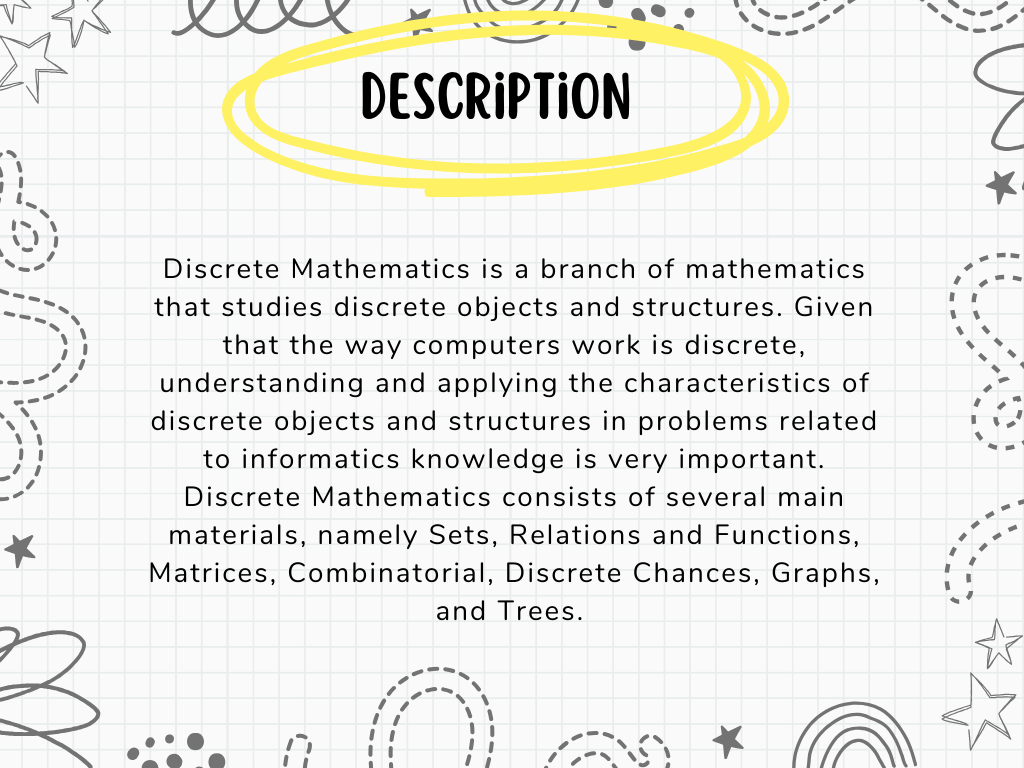
Discrete Mathematics is the branch of mathematics that studies discrete structures, i.e. objects that can be counted or have discrete rather than continuous values. The field includes concepts such as set theory, logic, combinatorics, relations, graphs, and algorithms. Discrete Mathematics is very important in computer science and information technology as many of its basic concepts are used in programming, algorithm design, data analysis, and computer network development. By studying Discrete Mathematics, we can understand and solve problems involving discrete structures in various technological and scientific applications.
-
-
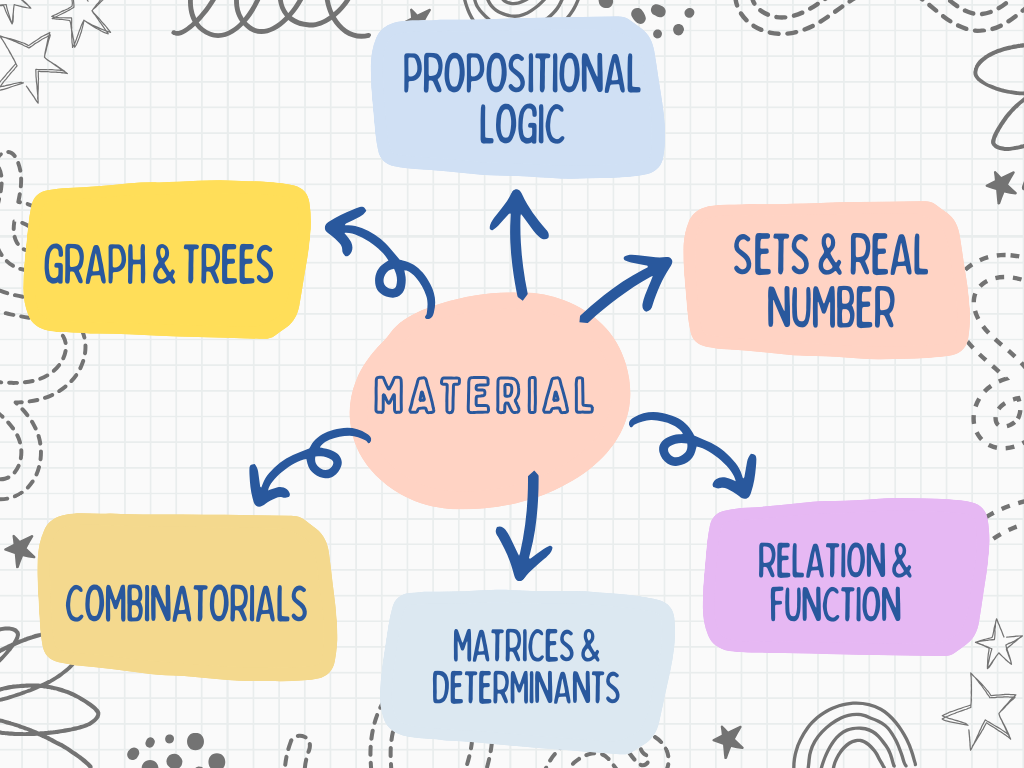
Propositional Logic is a branch of logic that studies the relationship between propositions or statements that can be true or false. In propositional logic, these statements are represented with symbols, such as p, q, or r, and can be combined using logical operators such as AND (∧), OR (∨), NOT (¬), IMPLICATION (→), and BIIMPLICATION (↔). The purpose of propositional logic is to determine the truth of a complex statement based on the truth of its component statements. Propositional logic forms the basis for understanding more complex logical concepts and is often used in mathematics, computer science, and philosophy.
-
-
This material introduces the basic concepts of propositional logic, particularly compound statements and inference. Compound statements are formed from single propositions that are combined using logical operators such as ΓÇ£andΓÇ¥, ΓÇ£orΓÇ¥, and ΓÇ£implicationΓÇ¥. Understanding how compound statements work is essential in determining the truth value of an argument.
-
-
What is the main difference between a single proposition and a proThis ΓÇ£Introduction to Sets and Real NumbersΓÇ¥ material is designed to provide a basic understanding of the fundamental concepts in mathematics that form the foundation for various advanced topics. Set is one of the core concepts used to group and classify objects in various mathematical contexts. An understanding of sets is essential as these concepts will often be used in theory, analysis, and modeling. In addition, real numbers are an important part of the number system that includes all numbers that can be represented on the number line, including rational and irrational numbers. An introduction to real numbers helps us understand more complex numerical properties and forms the basis for further studies in mathematical analysis.
-
-
In mathematics, the concepts of sets and real numbers are fundamental building blocks for understanding various mathematical structures and operations. A set is simply a collection of distinct objects, which can be anything from numbers to geometric shapes, or even abstract concepts. The study of sets provides the foundation for much of modern mathematics, including logic, algebra, and calculus. Meanwhile, real numbers form an essential part of number theory and analysis. They include all the numbers that can be represented on the number line, such as integers, fractions, and irrational numbers. The real numbers are crucial for describing continuous quantities and are used extensively in fields ranging from physics to economics. In this section, we will explore the basic properties of sets and real numbers, discuss how they relate to each other, and understand their importance in the broader context of mathematics.
-
-
In mathematics, the concepts of relations and functions are essential for understanding how elements within sets can be connected or mapped to one another. A relation is a relationship between elements of two sets, where each element of one set is associated with one or more elements of another set. Relations help describe various connections and interactions between objects, and they form the basis for many mathematical structures such as equivalence relations and orderings. On the other hand, a function is a specific type of relation that assigns exactly one element from the second set to each element from the first set. Functions are fundamental in mathematics, serving as the primary way to describe and analyze relationships between variables in areas such as algebra, calculus, and computer science. In this section, we will explore the definitions, properties, and examples of relations and functions, highlighting their role in mathematical reasoning and problem-solving.
-
-
In mathematics, composite functions and inverse functions are key concepts that expand our understanding of how functions interact with each other. A composite function is formed by combining two functions, where the output of one function becomes the input of another. This process allows for the creation of more complex relationships and is widely used in various branches of mathematics to simplify expressions and solve problems. On the other hand, an inverse function is a function that reverses the effect of the original function. If a function maps an element from one set to another, its inverse will map the second set back to the first. Inverse functions are important for solving equations and understanding the reversibility of operations. In this section, we will examine the definitions, properties, and methods for finding composite and inverse functions, and explore their applications in mathematical analysis and real-world problem-solving.
-
-
The midterm exam is an important assessment that serves as a checkpoint in the academic term, allowing both students and instructors to evaluate the progress made in understanding the course material. It typically covers all topics studied up until that point, testing the depth of knowledge, comprehension, and application of key concepts. The midterm exam offers students an opportunity to demonstrate their grasp of the subject, identify areas of weakness, and improve their performance in the second half of the term. In this section, we will discuss the format, structure, and expectations for the midterm exam, providing tips and strategies for effective preparation. Understanding the scope and purpose of the midterm exam is crucial for achieving success and mastering the material for the remainder of the course.
-
Matrices are powerful mathematical tools used to organize and manipulate data, often appearing in various fields such as physics, economics, computer science, and engineering. A matrix is a rectangular array of numbers, symbols, or expressions arranged in rows and columns. Matrices allow for compact representation of linear systems, transformations, and relations between variables. They provide a structured way to perform operations like addition, multiplication, and inversion, which are essential for solving equations and modeling real-world phenomena. In this section, we will introduce the basic concepts of matrices, including their structure, types, and operations, and explore their significance in solving complex problems in mathematics and beyond. Understanding matrices is crucial for developing skills in linear algebra and applying them in various scientific and practical contexts.
-
-
The determinant of a matrix is a scalar value that can be computed from the elements of a square matrix. It provides important insights into the properties of the matrix, such as whether the matrix is invertible or singular. Determinants play a crucial role in various areas of mathematics, particularly in solving systems of linear equations, analyzing eigenvalues, and understanding matrix transformations. For example, if the determinant of a matrix is zero, it indicates that the matrix does not have an inverse and the system of equations it represents may not have a unique solution. In this section, we will explore how to compute the determinant of different types of matrices, the properties of determinants, and their applications in solving mathematical and real-world problems.
-
-
An inverse matrix is a matrix that, when multiplied by the original matrix, yields the identity matrix. In other words, the inverse of a matrix "reverses" the effect of the original matrix. Not all matrices have an inverse, and a matrix is invertible only if its determinant is non-zero. Inverse matrices are critical in solving systems of linear equations, especially when seeking solutions to matrix equations. They are also used in various applications, including computer graphics, optimization problems, and cryptography. In this section, we will introduce the concept of inverse matrices, explore methods for calculating the inverse, and examine their applications in both theoretical and practical contexts. Understanding how to work with inverse matrices is essential for solving complex problems in linear algebra and beyond.
-
-
In this material, we will learn the basics of combinatorial, which is a branch of discrete mathematics that focuses on how to calculate and analyze the various possibilities of arranging, selecting, and arranging objects in a set. Basic concepts such as permutation, combination, and the inclusion-exclusion principle will be an important foundation for understanding various problems in graph theory, probability, and applications in computer science and engineering.
-
Permutations and combinations are two important concepts in mathematics that are used to calculate the possible arrangements or choices of a number of elements in a set.
Permutations are concerned with ways to arrange or arrange elements in a particular order. In permutations, the order of the elements is very important. For example, if we have three letters, A, B, and C, we can arrange them in several different orders, such as AB, BA, AC, CA, BC, and CB. Here, the order of the letters gives different results, even though they involve the same elements. So, if the order of the elements is considered, then it is a permutation.
Combination, on the other hand, focuses on the selection of elements without regard to their order. That is, in combination, what counts is how many ways we can select a certain number of elements from a set, regardless of how the elements are ordered. For example, from the three letters A, B, and C, if we choose two letters, then the choices we can make are AB, AC, and BC. Here, the order doesn't matter-it's just the selection that counts. In short, the main difference between permutations and combinations is that permutations pay attention to order, while combinations do not. -
-
Graph theory is a branch of mathematics that studies the structure of relationships between objects referred to as graphs. Graphs are used to model various phenomena that involve relationships or connections between elements in a system. In the context of graph theory, the elements are referred to as nodes or vertices, while the relationships between them are referred to as edges.
Graph theory is widely used, ranging from the representation of social networks, transportation systems, to algorithms in computer science. For example, in a social network, vertices can represent individuals, and the edges connecting them represent the relationships between those individuals. In transportation systems, vertices can represent cities, and edges are the roads that connect the cities.
There are different types of graphs used in this theory, such as directed graphs (where edges have a specific direction) and undirected graphs (where edges have no direction). In addition, there are also weighted graphs where the edges have values or weights that describe how strong or expensive the relationship is.
One of the main goals of graph theory is to study various properties of graphs, such as the connectedness between vertices, the shortest path between two vertices, and ways to optimize or organize the graph. In addition, graph theory also includes algorithms used to solve problems such as finding shortest paths or finding connected components in a graph.
With its ability to model complex relationships, graph theory has become a very important tool in various fields, including computer science, engineering, biology, and more.
-
-
A tree is a data structure used to describe hierarchical relationships between elements, where each element is referred to as a node. In a tree, there is one node called the root which is the starting point of all other nodes, and each node can have multiple child nodes. This structure is similar to the branches of a tree, where the root is the center point and the branches spread downwards.
One of the most commonly used tree types is the binary tree. A binary tree is a type of tree where each vertex can only have two children, often referred to as a left child and a right child. Since each node only has two children, this structure makes it easier to search, insert, and delete data.
Binary trees have various variations, such as the binary search tree, where the value in the left child is smaller than the value of the parent node and the value in the right child is larger. This structure is very useful in searching and sorting data.
Overall, both trees and binary trees are used in various applications, such as data search, sorting, and representation of hierarchical structures in various fields of computer science.
-