Garis besar topik

    • ΓÇ£Trust yourself that you can do it and get it.ΓÇ¥ ΓÇô Baz Luhrmann.


    • Assalamualaikum wr. wb

      Welcome to my class, my beloved students. It is very nice to meet all of you in this semester. 
      Hoping you all are in good condition and always be happy. 

      Welcome to my subject of English 2, especially for the 2nd semester students of Technic Information Study Program. This subject consists of 2 SKS with 16 meetings include Mid Term and Final Exam. The method of our teaching process is using Hybrid system, which is some of you study in the class and the other students study use zoom application in the same time. Of course if you study in the class don't forget to pay attention to the Three Health Protocols, they are using mask, washing hands, maintaining the distance. For those who study using zoom please pay attention to the dicipline and attitude. I really hope that all of you always be active and enjoy studying English with me in this teaching learning process. 

      May Allah bless us until the end of our study. Enjoy your class and have a nice learning. 

      Best Regards
      Wassalamu'alaikum Wr. Wb
      Betty Magdalena


      my foto
    • PAY ATTENTION TO THE RULES AND THE INSTRUCTION OF OUR LEARNING

    • HERE IS THE LESSON PLAN OF ENGLISH 2

    • HERE IS THE MODULE OF ENGLISH 2. PLEASE TO DOWNLOAD AND PRINT OUT IT AS YOUR HAND OUT MODULE.  

    • HERE IS THE LIST OF STUDENT'S NAME AND STUDENT'S NUMBER AS THE PARTICIPANTS OF ENGLISH 2 SUBJECT.  

    • My profileTHIS IS THE PROFILE OF YOUR ENGLISH LECTURE FOR THIS SEMESTER

  • Assalamualaikum wr. wb.

    Good afternoon class. 

    Welcome to our first meeting with the topic of The using of Auxilary Verb in Daily.  I shared the material and the video of the using of auxilary verb. Please to study it first. Then you may do the discussion forum. You may use the module that I shared. Please to print it out as your hand out. Good luck guys... Thanks...

    • What are auxiliary verbs?

      Auxiliary verbs are so called because they help to form the various tensesmoods, and voices of other verbs. The principal ones are bedo, and have.

      Be is used with other verbs to form continuous tenses and the passive voice:

      She is reading a magazine.

      We were talking to them for ages.

      England were beaten by Germany in the final.

      Have is used to make perfect tenses:

      The judge had asked her to speak up.

      In two years, we will have established community gardens.

      Do is used:

      for emphasis:

       He did look tired.


      to make questions:

      Do you want a coffee?


      to form negative statements or questions:

      donΓÇÖt like meat.

      DidnΓÇÖt he know how to play football?


      Modal verbs

      There is a further set of auxiliary verbs known as modal verbs or modal auxiliary verbs. These combine with other verbs to express necessity, possibility, intention, or ability. The modal auxiliary verbs are must, shall, will, should, would, ought (to), can, could, may, and might. For example:

      You must act promptly.

      Can you speak Spanish?

      would go if I could afford it.

      He said he might reconsider his decision.

      ought to visit my family.

      We should get to London before midday.

      May I come in?


    • In a group that consists of 3 students. Open your module lesson 1 

      Do "Exercise on Auxiliary Verbs" part "Choose the correct Auxiliary - Exercise 2, Exercise 3, Exercise 4" 

      Write your answer in this forum discussion with the name of the group. 


    • Here is the PPT OF Lesson 1 as your guidance 

  • Assalamulaikum wr. wb

    Good afternoon everybody.

     How are you today? I hope all of you are fine wherever you are. It is very nice to meet you in our second meeting. My dear students... welcome back to our subject of English 2, with the topic "Descriptive Paragraph". Today, I shared in lms the explanation of Descriptive Paragraph. I also shared the video as your guidance to write about descriptive paragraph. There is a discussion forum that you must write a descriptive paragraph. Please be active guys.... Thanks

    Wassalamualaikum wr. wb


    • HERE IS THE MATERIAL OF LESSON 2
    • descriptive paragraphs

      A descriptive paragraph describes a thing, a person, or a place. Detailed information allows the reader to form an image in his or her imagination. The better the description, the clearer the image.

      When teaching my students how to write a descriptive paragraph, I usually have them consider the five senses of touch, smell, sound, taste, and sight. Before writing the paragraph, make five columns and list words or ideas for the subject of the paragraph based on these five senses. Like this:

      touchsmellsoundtastesight
           

      The sense of sight is the one that most writers consider first, but try to work on that one last. LetΓÇÖs take, for example, a description of a place. What do you feel when you go there? What do you feel on your skin. Is it hot or cold? Is it wet or dry? What do you smell? Is there food? Are the smells good or bad? What do the smells remind you of? What do you hear? Is it quiet or noisy? Are there cars moving about? Are people talking? What about the sounds of nature? Are they present? Even a soft wind makes a sound. Taste is a difficult sense to describe, and the degree to which you pay this any attention depends on the subject matter. Sight comes last. Here you can describe color, size, depth, height, width, etc.

      HereΓÇÖs an example. I want to write a paragraph that describes a lake:

      touchsmellsoundtastesight

      water

      sand

      heat

      air

      fish

      hot dogs

      food trucks

      sun block

      laughing

      splashing

      music

      volleyball

      sand

      lotion

      the sun

      sand

      children

      lifeguard

      toys

      boats

      canoes

       Lake Harriet is a great place to to swim and relax. In the summer, the water is warm and clean, and the beaches attract people seeking relief from a midsummer scorcher. In addition to swimming, visitors to the lake can go canoeing, sailing, windsurfing, or fishing. The blue water is a refreshing, tempting sight. The sweet scent of sun block wafts through the air from sunbathers lying on the beach. Children laugh and splash in the water, and nearby volleyball games stir passionate shouts in the heat of competition. Meanwhile lifeguards sit atop their towers and make sure everyone is safe. In the distance, sail boats catch the soft breezes that ripple Lake HarrietΓÇÖs surface, and canoeists glide quietly past. This is what summer is all about!

      In this simple description, the reader should get a good sense of what itΓÇÖs like to be in this place. The prewriting exercise of listing different aspects of the experience as it relates to the five senses is helpful when coming up with something to write.

    • PENGERJAAN SOAL WRITING

      1. Pilihlah satu topik yang disediakan.

      2. Tulislah SEBUAH PARAGRAPH deskriptif mengenai sala satu topik yang ada modul lesson 1  dalam + 200 kata.

      3. Ketiklah latihan (paragraph deskriptif) anda ke diskusi forum hari ini Senin sampai pukul 16.00.

      4. Tulis nama dan NPM


    • LINK ZOOM

  • Assalamulaikum wr. wb

    Good morning everybody. 

    How are you today? I hope you are always in good condition.  It is very nice to meet you again today. Welcome to our subject English 2, now we are the third meeting of our schedule. Our topic today is about Reading text of Lesson 2 from English Module. Related to Coordinating Conjunction I shared the material of conjunction and the video. Today, there is a task that you must answer of questions in Reading text of Lesson 2. Then, you must find the conjunction in the reading text. Submit them to assignment of LMS. There is the discussion forum that you must submit the summary of English Webinar which held by UK Bahasa of IIB Darmajaya on 3rd April 2021.   Please be active guys.... Thanks

    Wassalamualaikum wr. wb


      • Coordinating Conjunction: Definition & Examples

        Believe it or not, we need coordinating conjunctions. We need them to express more than a single thought, feeling, or action. We need coordinating conjunctions to say things like, 'Gordon will not go camping or hiking or swimming in the river' or 'Susan loves curry and chapati bread,' or 'Shelley stumbled and fell off the balcony, but was unhurt by the fall.' We need coordinating conjunctions to talk about more than a single idea or possibility. We need them to say things like 'My brother, Mike, doesn't like cats, and my sister, Karen, doesn't like dogs' or 'The cat is hiding under the couch, in the cupboard, or on top of the bookcase.' We need coordinating conjunctions to express the many complex ideas that make up our world.

        coordinating conjunction is a word that connects words, phrases, or sentences. When a coordinating conjunction joins together two sentences, the resulting sentence is called a compound sentence. There are seven coordinating conjunctions: for, and, nor, but, or, yet, and so.

        Examples

        1) A coordinating conjunction can be used to connect words. If two words are connected, there is no need for a comma. If, however, a coordinating conjunction is used to connect a series of words, they must be separated by a comma.

        • For example, in the sentence, 'Joey likes cookies and milk,' the coordinating conjunction 'and' connects the words 'cookies' and 'milk' and tells readers that Joey likes both cookies and milk, and no comma is necessary between the two items.
        • If, however, we add another item to the list, such as bananas, we get, 'Joey likes cookies, milk, and bananas.' The coordinating conjunction 'and' now connects three items, 'cookies,' 'milk,' and 'bananas,' and a comma is necessary to separate them in order to clearly tell readers that Joey likes all three items.

        2) A coordinating conjunction can be used to connect phrases. If two phrases are connected there is no need for a comma. If, however, a coordinating conjunction is used to connect a series of phrases, they must be separated by a comma.

        • For example, in the sentence, 'The bird is hiding in the roses or in the chrysanthemums,' the coordinating conjunction 'or' connects the phrases, 'The bird is hiding in the roses' and 'in the chrysanthemums.' This tells readers that the bird is hiding in one or the other of the two places, 'in the roses' or 'in the chrysanthemums,' and does not require a comma to separate the two phrases

        • If, however, we add another possible hiding place such as 'in the oak tree,' we get 'The bird is hiding in the roses, in the chrysanthemums, or in the oak tree.' The coordinating conjunction, 'or,' now connects three phrases, 'in the roses, in the chrysanthemums,' and 'in the oak tree,' and requires a commas to separate them and clearly tell readers that the bird may be hiding in any one of those three places.

        Examples of Coordinating Conjunctions

        In the following examples, the coordinating conjunctions have been italicized for easy identification.

        1. You can eat your cake with a spoon or fork.
        2. My dog enjoys being bathed but hates getting his nails trimmed.
        3. Bill refuses to eat peas, nor will he touch carrots.
        4. I hate to waste a drop of gas, for it is very expensive these days. 
        Coordinating Conjunctions Exercises

        The following exercises will help you gain greater understanding about how coordinating conjunctions work. Choose the best answer to complete each sentence.

        1. Would you rather have cheese _____ bologna on your sandwich?
          1. For
          2. Nor
          3. Or
          4. So

          Answer: 3. Would you rather have cheese or bologna on your sandwich?

        2. His two favorite sports are football ______ tennis.
          1. Or
          2. And
          3. Nor
          4. For

          Answer: 2. His two favorite sports are football and tennis.

        3. I wanted to go to the beach, _______ Mary refused.
          1. But
          2. Or
          3. So
          4. For

          Answer: 1. I wanted to go to the beach, but Mary refused.

        4. I am allergic to cats, ­­­­______ I have three of them.
          1. Or
          2. For
          3. Yet
          4. So

          Answer: 3. I am allergic to cats, yet I have three of them.

        5. I am a vegetarian, ­­­­_______ I don’t eat any meat.
          1. So
          2. Yet
          3. Nor
          4. But

          Answer: 1. I am a vegetarian, so I donΓÇÖt eat any meat.

        Coordinating Conjunctions List

        Remember, there are only seven coordinating conjunctions. This list contains all of them.

        • For
        • And
        • Nor
        • But
        • Or
        • Yet
        • So
        Coordinating Conjunctions Exercises

        1. Thomas will be late to work, _____ he has a dental appointment.
        A. but
        B. or
        C. for
        D. nor

        2. Jennifer does not like to swim, ____ does she enjoy cycling.
        A. and
        B. or
        C. but
        D. nor

        3. Jackson wanted to eat another piece of cake, ____ he was on a diet.
        A. for
        B. but
        C. yet
        D. so


    • Read the text carefully.  Open your module of English 2. Lesson 2 (Global Positioning System)

    • The Instruction :  

      You may open your English Modul of Lesson 2.  Reading Text : Global Positioning System 

      Type and submit your answer in pdf to assignment. lms. darmajaya. Date : 9th April 2021 until 16.00 pm 

      (a) Answer these questions briefly.

      1. What is the best title of the passage?

      2. What does GPS function?

      3. What are the obstacles that worsen the GPS signals?

      4. When was GPS project firstly initiated?

      5. What does GPS function?

      6. Mention other types of navigation satellite system like GPS developed by some countries in the world.

       (b) Match the words in column A with their definition in column B


      COLUMN A


      COLUMN B

      1. global

      a) that can be reached, entered, used, seen, etc.

      2. provides

      b) experienced something unpleasant, such as injury, defeat or loss

      3. obstacle

      c) covering or affecting the whole world

      4. to transmit

      d) the fact that something is possible to get, buy or find

      5. accessible

      e) to send an electronic signal, radio or television broadcast, etc.

      6. to degrade

      f) gives something to somebody or make it available for them to

      use

      7. suffered

      g) to increase or further improve the good quality, value or status

      of somebody/something

      8. to enhance

      h) to stop holding something or stop it from being held so that it

      can move, fly, fall, etc. freely

      9. availability

      i) to make something become worse, especially in quality

      10. to release

      j) a situation, an event, etc. that makes it difficult for you to do or

      achieve something


      (c) Complete the sentences using the words in column A above.

      1. So far, we have managed to overcome all the that have been placed in our path.

      2. WeΓÇÖd better wait for the of cheap flights

      3. The ceremony was live by satellite to over fifty countries.

      4. The remote desert area is only by helicopter.

      5. This is an opportunity to the reputation of the company.

      6. This year the economy will grow by about 4 per cent.

      7. The company huge losses in the last financial year.

      8. Important natural habitats have been _ by development.

      9. The chemical reaction energy in the form of light.

      10. The exhibition an opportunity for local artists to show their work.


    • Mention your summary about an English Webinar that was held by UKM Bahasa IIB Darmajaya.  The webinar's theme is Dare to Speak By Increasing Your Public Speaking Skill.  

    • Assalamulaikum wr.wb. 

    • Good afternoon everyone. How are you today?  Welcome back to my subject English 2.  Well... Today we are going to discuss about how to write a good paragraph.  In this part I will show you the explanation how to write a good paragraph that relate this one to the narrative paragraph. I will share the video about Narrative Paragraph. For the exercise you may see in our second lesson of our English module. Keep on studying and enjoy the lesson..

    • Thank you,... Wassalamualaikum wr.wb

      • narrative paragraphs


        A narrative paragraph tells a story. Something happens first, second, third, etc. Of course, narrative paragraphs are used in fiction as a writer describes the unfolding of events, but they are also found when describing any actual sequence of activity.

        Because narrative paragraphs resemble fiction (an untrue story), you have a little more freedom to write the story in the style you prefer. This is known as artistic freedom or artistic license. You can use the first person narrative style and include words that clearly refer to you (I, me, my, mine, etc.), or you can try to tell the story from a purely objective point of view that is not personal, but gives a straight-forward, factual account of what happened.

        If your teacher asks you to write about a personal experience, try to tell it by using the first person. This is the easiest style in which to write something. You might choose something that you remember well, or something that changed you life. Teachers who work with a large number of foreign-born students often ask them to write about the time they first arrived in the United States. ThatΓÇÖs a good assignment because it allows you to write in the first person and the details in this kind of paragraph are likely to be very vivid. HereΓÇÖs an example:

         I remember when I first arrived in the United States. Even before the plane landed, the little windows in the airplane revealed snow and ice-covered houses and buildings. As I walked off the plane, cold air crept though the corrugated ramp that led to the airport terminal. Some people inside the airport were wearing big coats and hats, which I had seen on television, but never up close. I felt a little dizzy and needed to sit down, and then my cell phone rang. It was my Aunt Sophia. She was waiting for me outside in the passenger pick-up area, so I walked quickly to the exit, forgetting all about my luggage. When the sliding glass door opened to the outside, there was my auntΓÇôa woman I hadnΓÇÖt seen in over ten yearsΓÇôwearing a parka and waving her arms frantically in my direction.

        The topic sentence in this paragraph is the first sentence, I remember when I first arrived in the United States. The supporting sentences that follow should be about this experience and how it is still remembered. The concluding sentence in this kind of a paragraph would lead to the action in the next paragraphΓÇôif there is one.

        The sequence of activity can be implied or reassembled by the reader as demonstrated in this paragraph:

         Those of us who found out early that our teacher would be Mr. Fine shuddered to think of having to spend an entire year in his classroom, trapped and subjected to months of unending terror. WeΓÇÖd heard stories. We knew. Then a month before school was to begin, a list mysteriously surfaced showing the names of all the sixth grade students at Fairmont Elementary, their teachers, and their classrooms. Normally such information wasnΓÇÖt known until the first week of classes, but John PatrickΓÇÖs mother was a secretary at the school, and somehow this list appeared. It didnΓÇÖt matter how it was found, or who exactly leaked the information. It was that cold list of names that would cause a couple dozen eleven-year olds to panic. But as it turns out, we were all wrong about Mr. Fine.

        Or the activity can be clearly sequenced so that thereΓÇÖs no mistake about what happens first, second, third, and so on:

         TheoΓÇÖs day began with a shock. As soon as he arrived at the office that morning, he learned that his best friend was dead. WasnΓÇÖt it just twelve hours ago that they were eating chicken wings and tipping back beer in front of a baseball game at the CooperΓÇÖs Bar and Grill? After a long day of crunching numbers at the office, they stopped at a bar for a Thursday afternoon happy hour. They saw a few coworkers there, and before they knew it, it was closing time. Bill got in a car with someone he met just that evening and that was the last time Theo saw him.

        When you do the prewriting for a narrative paragraph, list the sequence of activity. When you are ready to write, you can use this information in plotting out the events. It is not necessary to always go directly in order. An event that happens last can appear first in the paragraph. In fact, this is a good way to arouse interest in the reader. As long as the paragraph seems fairly logical, you have a lot of creative freedom in writing this kind of a paragraph.

        You could also just start writing the paragraph in a stream-of-consciousness sort of way and let the ideas and action flow freely from your mind as you remember.


    • LESSON 3 CREDIT CARD

      A. READING

      (a) Read the reading passage carefully and then answer the following questions.


      Ask people wheter credit cars are a necessity or a luxury and most would probably term them a necessity these days. Credit cards are considered a boon for the ready convenience they confer on the user ΓÇô you donΓÇÖt have to worry about carrying enough cash when you go shopping or to a restaurant. Just flash your card, sign and walk out. But there are many who criticise credit cards for the ΓÇÿeasy moneyΓÇÖ syndrome they generate. It is youΓÇÖre careful with your expenses, they can be a handy thing to have around. Hence, you need to consider the term ΓÇÿresponsible usageΓÇÖ and understand the actual significance of living on credit.

      Remember that using a credit card does not mean ΓÇÿfreeΓÇÖ credit. In effect, what you are doing is merely postponing payment. While it looks realy good to have to pay only one or two thousand a moth on your card, remeber that youΓÇÖre paying interest on the amound that you ΓÇÿresolveΓÇÖ from one billing cycle to the next. But thereΓÇÖs on precaution we

      should add. Always settle a credit car bill in full for two good reasons. First and foremost, if you are not able to pay up now, you should not have spent it in the first place. Second, credit charges tend to be extremely high , ranging from 2 per cent to 3 per cent per month.

      There is no shortage of cards on offer. Almost every bank has launched a a card so the biggest hurdle you face is in trying to choose from amongst them.

      So, how does one choose among the various on offer? ΓÇ£The factors for choosing a card to resolve around certain differentiating features that one card may offer and the others donΓÇÖt, like acceptability, eligibility, fees, other charges, credit period, cas advance, etc.ΓÇ¥

      Cards which carry the Master or Visa affiliation are more widely accepted across the country compared to diners and American Express cards. Similarly, global credit cards are valid even outside India. If you travel regularly within or outside India, thses cards would probably suit you the best, due to their accptability across outlets.

      If your credit card is more of a functional accessory while you shop or entertain in you own town, you will want a higher credit limit. Here, foreign and private banks will give you a higher limit. But if you are a value-for-money person who likes the convenience offered by a card, but will alternate between paying by cash and card, you could consider credit cards offered by the public sector banks. Their entry fees are typically lower. Moreover, if need them, you get longer credit periods and lower credit charges. But you may not get a very high credit limit. Many of us nowadays carry more than one card, and under the circumstances, you could use them to segregate your expenses. For example, if your employer reimburse you for certain travel and entertainment expenses to the other card. This will help you account for your official expenses easily.

      ItΓÇÖs all very well to be a member of the plastic age. Like all good things in life, a credit card privilege has to be enjoyed.


      (source: https://edumantra.net/learn-english/class-9-10-reading-passage-no-242-credit-card-550-words-objective- solved/)

      (b) Answer these questions briefly.

      1. What is the best title of the passage?

      2. What does the sentence ΓÇÿ using a credit card does not mean ΓÇÿfreeΓÇÖ creditΓÇÖ in paragraph 2 mean?

      3. What does the phrase ΓÇ£easy moneyΓÇ¥ in paragraph mean?

      4. Why do we have to settle a credit car bill in full?

      5. What happens to the credit cards users when there is no shortage of cards on offer?


    • Phrasal Verbs

      What are Phrasal Verbs?

      A phrasal verb is a verb like pick upturn on or get on with. These verbs consists of a basic verb + another word or words. The two or three words that make up a phrasal verb form a short "phrase" - which is why we call them "phrasal verbs". But a phrasal verb is still a verb. Look is a verb. Look up is also a verb - a different verb. They do not have the same meaning, and they behave differently grammatically. You should treat each phrasal verb as a separate verb, and learn it like any other verb. Look at these examples. You can see that there are three types of phrasal verb formed from a single-word verb:

       verbdefinitionexample
      single-word verblookdirect your eyes in a certain directionYou must look before you leap.
      phrasal verbverb + adverblook upsearch for and find information in a reference bookYou can look up the word in a dictionary.
      verb + prepositionlook aftertake care ofWho is looking after the baby?
      verb + adverb + prepositionlook forward toanticipate with pleasurelook forward to meeting you.

      Phrasal Verb: VERB + ADVERB

      The structure of this type of phrasal verb is:

      verb+adverb

      These phrasal verbs can be:

      • transitive (direct object)
      • intransitive (no direct object)

      Look at these examples of transitive and intransitive::

        meaningexample sentence
       direct object
      transitiveput offpostponeWe will have to put offthe meeting.
      turn downrefuseThey turned downmy offer.
      intransitiveget uprise from bedI don't like to get up. 
      break downstop workingHe was late because his car broke down. 

      Separable

      When this type of phrasal verb has a direct object, we can usually separate the two parts. For example, "turn down" is separable. We can say: "turn down my offer" or "turn my offer down". Look at these example sentences:

      They turned down my offer.

      When this type of phrasal verb has a direct object, we can usually separate the two parts. For example, "turn down" is separable. We can say: "turn down my offer" or "turn my offer down". Look at these example sentences:

      tickThey turned down my offer.
      tickThey turned my offer down.

      However, if the direct object is a pronoun, we have no choice. We must separate the two parts of the verb and insert the pronoun. Look at these examples with the verb "switch on". Note that the last one is impossible:

      tickJohn switched on the radio.
      tickJohn switched the radio on.
      tickJohn switched it on.
      crossJohn switched on it.
      Separable or inseparable?
      Many dictionaries tell you when a phrasal verb is separable. If a dictionary writes "look (something) up", you know that the phrasal verb "look up" is separable, and you can say "look something up" and "look up something". It's a good idea to write "sthg/sby" as appropriate in your vocabulary book when you learn a new phrasal verb, like this:
      • get up
      • break down
      • break sthg off
      • turn sthg/sby down

      This tells you if the verb needs a direct object (and where to place it).

      Phrasal Verbs reference: hundreds of phrasal verbs with definitions, example sentences, quizzes and answers

      Phrasal Verb: VERB + PREPOSITION

      This type of phrasal verb is also called a "prepositional verb". The structure of a prepositional verb is:

      verb+preposition

      Because a preposition always has an object, all prepositional verbs have direct objects (ie they are transitive).

      Look at these examples of prepositional verbs:

      prepositional verbmeaningexample sentence
       direct object
      believe inhave faith in the existence ofbelieve inGod.
      look aftertake care ofHe is looking afterthe dog.
      talk aboutdiscussDid you talk aboutme?
      wait forawaitJohn is waiting forMary.

      Prepositional verbs cannot be separated. That means that we cannot put the direct object between the two parts. For example, we must say "look after the baby". We cannot say "look the baby after":

      tickWho is looking after the baby?
      crossWho is looking the baby after?
      It is a good idea to write "something/somebody" in your vocabulary book when you learn a new prepositional verb, like this:
      • believe in something/somebody
      • look after sthg/sby
      This reminds you that the verb needs a direct object (and where to place it).

      Phrasal Verb: VERB + ADVERB + PREPOSITION

      This type of phrasal verb is also called a "phrasal-prepositional verb". The structure of a phrasal-prepositional verb is:

      verb+adverb+preposition

      Look at these examples of phrasal-prepositional verbs:

      phrasal-prepositional verbmeaningexample sentence
       direct object
      get on withhave a friendly relationship withHe doesn't get on withhis wife.
      put up withtolerateI won't put up withyour attitude.
      look forward toanticipate with pleasurelook forward toseeing you.
      run out ofuse up, exhaustWe have run out ofeggs.

      Because phrasal-prepositional verbs end with a preposition, there is always a direct object. And, like prepositional verbs, phrasal-prepositional verbs cannot be separated. Look at these examples:

      tickWe ran out of gas.
      tickWe ran out of it.
      crossWe ran gas out of.
      crossWe ran out gas of.
      It is a good idea to write "something/somebody" in your vocabulary book when you learn a new phrasal-prepositional verb, like this:
      • get on with somebody
      • put up with sthg/sby
      • run out of something
      This reminds you that the verb needs a direct object (and where to place it).


    • PLEASE FINDING THE PHRASAL VERB IN THE READING TEXT (LESSON 3) WITH THE TITLE : CREDIT CARD. PLEASE WRITE YOUR ANSWER IN THIS FORUM DISCUSSION

    • Betty Magdalena is inviting you to a scheduled Zoom meeting.

      Join Zoom Meeting
      https://us04web.zoom.us/j/7933379420?pwd=MWdlRkNrMTJmVEdDcTZYZVBCcE01QT09

      Meeting ID: 793 337 9420
      Passcode: 9PzTki

  • Assalamulaikum wr. wb

    Good afternoon everybody. 

    How are you, class. I hope that all of you are fine and in a good condition. Welcome back to our subject of English 2. Today we are in the sixth meetings. We are going to discuss about writing lesson with the topic of Comparison and Contrast Paragraph.  Let's start studying.  You may open your English module of Lesson 3. There is the explanation of using the comparison and Contrast Paragraph. In lms I have already shared the explanation of Comparison and Contrast Paragraph too. Please to comprehend those one. I also shared the video using Comparison and Contrast Paragraph.  Please to watch it and comprehend too. Today there is a forum discussion, you must choose one of some topics then you must write the similarity and the contrast of both of the things.  Thanks for your attention Please be active guys....

    Wassalamualaikum wr. wb


    • Compare and Contrast Structure Words

      Compare and contrast structure words are transition signals which show the similarities or differences. Below are some common examples.

      Compare
      • Similarly
      • Likewise
      • also
      • both... and...
      • not only... but also...
      • neither... nor...
      • just like (+ noun)
      • similar to (+ noun)
      • to be similar (to)
      • to be the same as
      • to be alike
      • to compare (to/with)
      Examples
      • Computers can be used to communicate easily, for example via email. Similarly/Likewise, the mobile phone is a convenient tool for communication.
      • Both computers and mobile phones can be used to communicate easily with other people.
      • Just like the computer, the mobile phone can be used to communicate easily with other people.
      • The computer is similar to the mobile phone in the way it can be used for easy communication.
      Contrast
      • However
      • In contrast
      • In comparison
      • By comparison
      • On the other hand
      • while
      • whereas
      • but
      • to differ from
      • to be different (from)
      • to be dissimilar to
      • to be unlike

      Examples
      • Computers, although increasingly small, are not always easy to carry from one place to another. However, the mobile phone can be carried with ease.
      • Computers are generally not very portable, whereas the mobile phone is.
      • Computers differ from mobile phones in their lack of portability.
      • Computers are unlike mobile phones in their lack of portability.

      Criteria for comparison/contrast

      When making comparisons or contrasts, it is important to be clear what criteria you are using. Study the following example, which contrasts two people. Here the criteria are unclear.

      • Aaron is tall and strong. In contrast, Bruce is handsome and very intelligent.

      Although this sentence has a contrast transition, the criteria for contrasting are not the same. The criteria used for Aaron are height (tall) and strength (strong). We would expect similar criteria to be used for Bruce (maybe he is short and weak), but instead we have new criteria, namely appearance (handsome) and intelligence (intelligent). This is a common mistake for students when writing this type of paragraph or essay. Compare the following, which has much clearer criteria (contrast structure words shown in bold).

      • Aaron and Bruce differ in four ways. The first difference is height. Aaron is tall, while Bruce is short. A second difference is strength. Aaron is strong. In contrast, Bruce is weak. A third difference is appearance. Aaron, who is average looking, differs from Bruce, who is handsome. The final difference is intelligence. Aaron is of average intelligence. Bruce, on the other hand, is very intelligent.
      In a compare and contrast paragraph, you write about the similarities and differences between two or more people, places, things, or ideas.

      Example:
      Write a paragraph comparing the weather in Vancouver and Halifax.

      The following words can help you to write a good compare and contrast paragraph:

      SimilaritiesExample
        
      is similar toSpring weather in Vancouver is similar to spring weather in Halifax.
      bothBoth Vancouver and Halifax have rain in the spring.
      alsoHalifax also has a rainy spring season.
      tooHalifax has a rainy spring season, too.
      as wellAs well, Halifax has rainy spring season.


      DifferencesExample
        
      on the other handOn the other hand, winter is much colder in Halifax.
      howeverHowever, winter is much colder in Halifax.
      butVancouver has a mild winter, but Halifax has a cold one.
      in contrast toIn contrast to Vancouver, Halifax has a cold winter.
      differs fromHalifax differs from Vancouver by having a cold winter.
      whileWhile Vancouver has a mild winter, Halifax has a cold winter.
      unlikeUnlike Halifax, Vancouver doesn't get much snow


    •  WRITING: COMPARISON-CONTRAST PARAGRAPH

       comparison-contrast paragraph compares two things. The differences can be large or small, depending on the goals of the writer. A compare and/or contrast paragraph is required if you are asked to examine similarities and/or differences. Compare focuses on similarities. Contrast focuses on differences.

       Below are useful transitional words and phrases used for comparison and contrast.

       For comparisonsimilar to, similarly, in the same way, like, equally, again, also, too, each of, just as so

       For contrastin contrast, on the other hand, different from, whereas, while, unlike, however, but, although, however, conversely, yet, unlike

       A comparison or contrast paragraph should be tightly focused on a meaningful difference or similarity between two things, people, places or ideas. You should use specific details and

      examples to explain why the difference or similarity matters. Because this is likely to be a paragraph within a larger essay that discusses three or more differences or similarities, you should focus on just one difference or similarity. Comparison or contrast essays often explain the writer's preference for one thing over the other.

      ┬╖ Focus Your Ideas

      Brainstorm about the similarities or differences in your topics. Choose a focus from your list that gives new and worthwhile information about the topic. Rather than the obvious paragraph about the differences in color between red and green apples, for instance, you might explain how bakers would use each differently based on their different flavors. For example, green apples have a more tart flavor and so would be more appropriate for a pie than sweeter red apples, which would be a better choice for stand-alone baked apples.

       ┬╖ Write a Topic Sentence

      Create a topic sentence to explain the comparison or contrast and its importance for your overall point as explained in your thesis. As the first sentence in your paragraph, it establishes your purpose, giving the reader an idea of your content and the reason it matters. For example, a comparison paragraph in an essay about choosing an appropriate pet might use the topic sentence, "Housebreaking procedures for dogs and cats differ greatly." The reader understands from this statement that the paragraph will analyze the differences between the two types of training, a difference important for readers unfamiliar with each to learn. The housebreaking focus could be one point in a three-point thesis that also includes the differences in time investment and compatibility with children.

       ┬╖ Develop with Support

      Develop the paragraph with specific information to illustrate the comparison or contrast and how it supports your overall point. Include examples, detailed explanation, definitions and whatever other kind of support that makes your thinking clear. For example, to support a topic sentence about a similarity between bottled water and tap water, details might focus on the fact that both types of water have to meet similar safety and purity requirements. Tap water is regulated by the Environmental Protection Agency, and bottled water is regulated by the Food and Drug Administration, but the purity standards are similar. Include a minimum of five sentences of support for good development of your comparison or contrast.

        Conclude and Tie Together

      Create a concluding sentence to sum up the similarities or differences and why they matter. For example, a paragraph contrasting community colleges and universities to argue one makes a better choice might end, "These differences in price clearly show that community colleges offer excellent education without the temendous debt many universities impose on students." The paragraph on price could be one point in a thesis that also notes that community colleges offer smaller class sizes and more vocational programs. Include transitions within the body to help tie ideas together as well, using phrases like "on the other hand" or for a contrast paragraph and "in the same way" for a comparison.


    • Exercise:

      Choose one of these topics and then write a compare and contrast paragraph based on the topic you have chosen.

      a. Online shopping and offline shopping.

      b. Night Time and Day Time: Advantages Each Period Has.

      c. What Makes People Completely Different from Animals.

      d. Living in Poverty and Being Rich.

      e. Coffee and Tea: The Effects of Both.

      f. Living in Big City or Staying in Village.

      g. Feeling Sad against Feeling Lonely. 

  • Assalamulaikum wr. wb. Good afternoon Guys, How are you? I hope you are all in good condition. Welcome back to our subject, English 2 subject. Today you are in the 7th meetings. The material is about Reading text of lesson 4. Please to read and comprehend the passage. You are also learning about structure with the topic is Gerund and Infinitive. In this time I shared the material of Gerund and Infinitive. There are the explanations and the exercises for Gerund and Infinitive. I also shared the video to add more your knowledge about this topic. Please pay attention and read first about the explanation after that we will discuss about this topic in discussion forum. Good Luck guys. Thank you Wassalamualaikum wr. wb
      • Gerunds and Infinitives

        Gerunds and infinitives are sometimes referred to as verb complements. They may function as subjects or objects in a sentence

        What are Gerunds?
        gerund is a verb in its ing (present participle) form that functions as a noun that names an activity rather than a person or thing. Any action verb can be made into a gerund.

        Spelling Tip

        Verbing (Present Participle)

        • Add ing to most verbs. Ex. play > playing, cry > crying, bark > barking
        • For verbs that end in e, remove the e and add ing. Ex: slide > sliding, ride > riding
        • For verbs that end in ie, change the ie to y and add ing. Ex: die > dying, tie > tying
        • For a verb whose last syllable is written with a consonant-vowel-consonant and is stressed, double the last letter before adding ing. Ex: beg > begging, begin > beginningHowever: enter > entering (last syllable is not stressed)

        Gerund Examples

        Gerunds can appear at the beginning of a sentence when used as a subject:

        1. Jogging is a hobby of mine.

        Gerunds can act as an object following the verb:

        1. Daniel quit smoking a year ago.

        Gerunds can serve as an object after a preposition:

        1. I look forward to helping you paint the house.

        Note: The same spelling rules that apply to the progressive tenses also apply to gerunds.

        Some verbs and verb phrases are directly followed a gerund:

        1. Paul avoids using chemicals on the vegetables he grows.

        Some verbs can be followed by a gerund or an infinitive without causing a change in meaning:

        1. Some people prefer getting up early in the morning.
        2. Some people prefer to get up early in the morning

        Some verbs can be followed by a gerund or infinitive but with a change in meaning:

        1. He remembered sending the fax. (He remembered the act of send the fax)
        2. He remembered to send the fax. (He remembered the fax and sent it.)

        What are Infinitives?

        An infinitive is a verb form that acts as other parts of speech in a sentence. It is formed with to + base form of the verb. Ex: to buy, to work.

        Infinitive Examples

        Infinitives can be used as:

        an object following the verb:

        1. Jim always forgets to eat

        a subject at the beginning of a sentence:

        1. To travel around the world requires a lot of time and money.

        an adverb modifying a verb:

        1. You promised to buy me a diamond ring.

        an adjective modifying a noun:

        1. Tara has the ability to succeed.

        Some verbs are directly followed by an infinitive:

        1. Do you want to call your family now?

        Some verbs are directly followed by a noun or pronoun and then by an infinitive:

        1. I convinced Catherine to become vegetarian.
        2. He advised me to sell all my shares of stock.

        Some verbs can be followed by an infinitive or a gerund without causing a change in meaning:

        1. Will you continue working after you give birth?
        2. Will you continue to work after you give birth?

        Some verbs can be followed by an infinitive or a gerund but with a change in meaning:

        1. He stopped drinking coffee. (He never drank coffee again.)
        2. He stopped to drink coffee. (He stopped what he was doing and drank some coffee.)

        Exercises ΓÇô Gerunds and Infinitives
        Choose the correct gerund or infinitive from the parenthesis at the end of the sentence.
        1. She likes to get up early in the morning. (likes / dislikes)
        1. 1. Alan canΓÇÖt stand _________ on trains. (riding/ to ride)
        1. Mr. Harris enjoys _________ people out to dinner. (inviting / to invite)
        1. In the old days, gentlemen challenged their rivals _______. (fighting / to fight)
        1. As the famous saying goes, thereΓÇÖs no use ______ over spilt milk. (crying / to cry)
        1. Jim stopped _________ his shoelace. Wait for him. (tying / to tie)
        1. My wife always volunteers ___________ cakes PTA meetings. (baking / to bake)
        1. DonΓÇÖt waste my time ___________ about your salary. (complaining/ to complain)
        1. Eva is having trouble _________ on the exam. (concentrating / to concentrate)
        1. Please allow me ____________ your Facebook page. (joining / to join)
        1. You wonΓÇÖt forget _________milk on your way home, will you? (picking up /to pick up)
        Answers:
        1. riding
        1. inviting
        1. to fight
        1. crying
        1. to tie
        1. to bake
        1. complaining
        1. concentrating
        1. to join
        1. to pick up
        Reference Lists ΓÇô Gerunds and Infinitives
        Common verbs and phrases that are followed by a gerund
        • admit
        • advise
        • avoid
        • be used to
        • canΓÇÖt help
        • canΓÇÖt stand
        • consider
        • deny
        • discuss
        • dislike
        • end up
        • enjoy
        • feel like
        • finish
        • forget
        • get used to
        • give up
        • go on
        • have difficulty
        • have problems
        • have trouble
        • imagine
        • itΓÇÖs no use
        • itΓÇÖs worthwhile
        • keep
        • look forward to
        • mention
        • mind
        • miss
        • recommend
        • remember
        • quit
        • spend time
        • stop
        • suggest
        • understand
        • waste time
        • work at
        Common verbs that can be followed by either a gerund or an infinitive without causing a change in meaning
        • begin
        • continue
        • hate
        • intend
        • like
        • love
        • prefer
        • start
        Common verbs that can be followed by a gerund or infinitive but with a change in meaning
        • forget
        • remember
        • stop
        Common verbs that are followed by an infinitive
        • afford
        • agree
        • appear
        • arrange
        • ask
        • care
        • decide
        • demand
        • expect
        • fail
        • forget
        • hope
        • learn
        • manage
        • mean
        • offer
        • plan
        • prepare
        • pretend
        • promise
        • refuse
        • remember
        • seem
        • stop
        • volunteer
        • wait
        • want
        • wish
        Common verbs that are directly followed by a noun or pronoun and then by an infinitive
        • advise
        • allow
        • ask
        • cause
        • challenge
        • command
        • convince
        • expect
        • forbid
        • force
        • hire
        • instruct
        • invite
        • order
        • pay
        • permit
        • program
        • remind
        • teach
        • tell
        • urge
        • want
        • warn


    • please comprehend the reading text about Social Media

    • Instruction :

      1. what is the topic sentence based on the reading text of Lesson 4 . (social Media)

      2. What are the supporting sentence on the text

      3. What is the concluding sentence in the text?

      4. Write the sentences based on the text that related to Gerund.

      5. Write the sentences based on the text that relate to Infinitive 

      Note : Type your answer in pdf. Submit to assignment of lms.  The time limit : Wednesday, 13.00 -16.10 pm.


    • PERHATIKAN KETENTUAN UTS :

      1. Jangan lupa menulis Nama, NPM dan kelas di lembar jawaban anda.

      2. Berdoalah sebelum mengerjakan soal.

      3. Baca soal baik-baik dan kerjakan seluruh pertanyaan soal UTS tersebut

      4. Ketik jawaban soal UTS dan harus submit ke lms.darmajaya @ac.id dalam bentuk pdf.

      5. Batas waktu pengumpulan jawaban UTS adalah hari Rabu, tanggal 2 Juni 2021, Pukul 13.00 sd 18.00 wib

      6.  Dilarang mencontek atau memindahkan jawaban dari teman atau dari google, jawaban anda tidak adak di koreksi.

      Terima kasih. Selamat Bekerja Semoga Sukses


  • Assalamulaikum wr. wb. 

    TABIIK.....PUN 

    Good afternoon Guys, How are you? I hope you are all in good condition. Welcome back to our subject, English 2 subject. Today you are in the 9th meetings. The material is about Writing about Cause Effect of lesson 4. There is the explanation how to make a paragraph that the topic is Cause Effect.  I also shared the video to add more your knowledge about this topic. Please pay attention and read first about the explanation after that we will discuss about this topic  There is a discussion forum that you must upload your paragraph. Good Luck guys. Thank you 

    Wassalamualaikum wr. wb

    • Cause and Effect


      Cause and effect is a common way to organize information in a text. Paragraphs structured as cause and effect explain reasons why something happened or the effects of something. These paragraphs can be ordered as causes and effects or as effects and then causes. The cause and effect text structure is generally used in expository and persuasive writing modes.

      To put it another way: when an author gives reasons why something happened, he or she is explaining what caused an effect (reasons are causes and the thing that happens is the effect). Also, when a writer explains the results of an action, he or she is explaining the effects of a cause (results are effects and the thing that occurs is the cause). The cause and effect text structure is used so commonly that you have probably written a paragraph using it and not noticed.

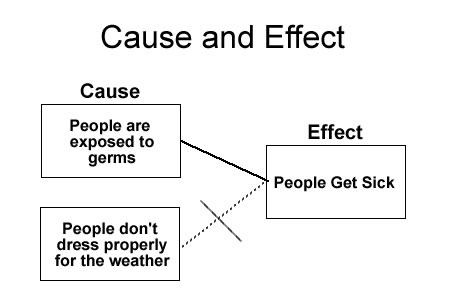
      Cause and Effect Text Structure Graphic Organizer

      Illnesses are caused by germs not temperature.

      Example: Many people think that they can get sick by going into cold weather improperly dressed; however, illnesses are not caused by temperature- they are caused by germs. So while shivering outside in the cold probably wonΓÇÖt strengthen your immune system, youΓÇÖre more likely to contract an illness indoors because you will have a greater exposure to germs.

      In the above example, the paragraph explains how germs cause illnesses. The germs are the cause in the paragraph and the illness is the effect.

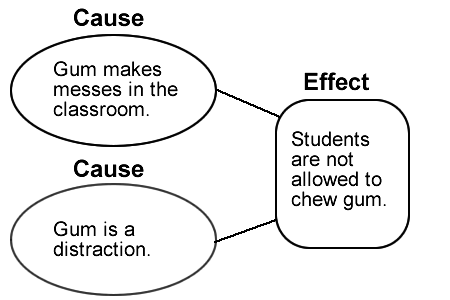
      Here is another example of a paragraph that is written using the cause and effect text structure:

      This is a graphic organizer representing the cause and effect text structure.

      Reasons why you can't chew gum in class

      Another Example: Students are not allowed to chew gum in my class. While some students think that I am just being mean, there are many good reasons for this rule. First, some irresponsible students make messes with their gum. They may leave it on the bottoms of desks, drop it on the floor, or put it on other peopleΓÇÖs property. Another reason why I donΓÇÖt allow students to chew gum is because it is a distraction. When they are allowed to chew gum, students are more worried about having it, popping it, chewing it, and snapping it then they are in listening, writing, reading, and learning. This is why I donΓÇÖt allow students to chew gum in my class.

      Identifying a text written using the cause and effect pattern of organization can be tricky. In most stories, events in the plot occur for various reasons, This can be mistaken for the cause and effect text structure; however, stories are organized chronologically, and the information in each passage is more likely to be organized by the time in which each event occurred. Contrarily, cause and effect passages usually focus on explaining the reason why something occurs or occurred, and time will usually not pass in these paragraphs.

      Here are some signal words that may indicate that information in a paragraph is organized as cause and effect: because, as a result, resulted, caused, affected, since, due to, effect


  • Assalamualaikum wr. wb. 

    Taaabik punn..

    Good afternoon everyone? How are you today? I hope that you are fine and in good condition It is very nice to meet you again with me in our tenth meeting. Welcome to our subject talking about Structure and the topic is Question Tags. In this meeting I shared the explanation about Question Tags. You can add more by reading the using of Question Tags in your module lesson 5. I also shared the video. Would you like to pay attention to the things that I shared. After that you may join in the discussion forum. Well guys, I am waiting for you in this lms and join with me actively. Thank you.. 


    • Tag Questions
      You speak English, don't you?

      A tag question is a special construction in English. It is a statement followed by a mini-question. We use tag questions to ask for confirmation. They mean something like: "Is that right?" or "Do you agree?" They are very common in English.

      The basic structure of a tag question is:

      positive statementnegative tag
      Snow is white,isn't it?
      negative statementpositive tag
      You don't like me,do you?

      Notice that the tag repeats the auxiliary verb (or main verb when be) from the statement and changes it to negative or positive.

      Positive Statement Tag Questions

      Look at these examples with positive statements. You will see that most of the time, the auxiliary verb from the positive statement is repeated in the tag and changed to negative.

      (+) positive statement(-) negative tag
      subjectauxiliarymain verb auxiliarynotpersonal pronoun same as subject
      Youarecoming, aren'tyou?
      Wehavefinished, haven'twe?
      Youdolikecoffee,don'tyou?
      You likecoffee,don'tyou?
      Theywillhelp, won'tthey?
      Icancome, can'tI?
      Wemustgo, mustn'twe?
      Heshouldtryharder,shouldn'the?
      You areEnglish,aren'tyou?
      John wasthere,wasn'the?
      Notice:
      • the use of do in the two coffee questions. Remember that in Present Simple, do is optional in positive statements (You like coffee/You do like coffee). But the do must appear in the tag. The same applies to Past Simple did.
      • in last two questions, no auxiliary for main verb be in Present Simple and Past Simple. The tag repeats the main verb.
      Negative Statement Tag Questions

      Look at these examples with negative statements. Notice that the negative verb in the original statement is changed to positive in the tag.

      (-) negative statement(+) positive tag
      subjectauxiliary main verb  auxiliarypersonal pronoun same as subject
      Itisn'training,  isit?
      Wehaveneverseen that,havewe?
      Youdon'tlike coffee,doyou?
      Theywillnothelp,  willthey?
      Theywon'treport us,willthey?
      Icanneverdo it right,canI?
      Wemustn'ttell her,mustwe?
      Heshouldn'tdrive so fast,shouldhe?
      Youwon'tbe late,willyou?
      You  aren'tEnglish,areyou?
      John  wasnotthere,washe?
      Notice:
      • won't is the contracted form of will not
      • the tag repeats the auxiliary verb, not the main verb. Except, of course, for the verb be in Present Simple and Past Simple.

      Answering Tag Questions

      How do we answer a tag question? Often, we just say Yes or No. Sometimes we may repeat the tag and reverse it (They don't live here, do they? Yes, they do). Be very careful about answering tag questions. In some languages, an opposite system of answering is used, and non-native English speakers sometimes answer in the wrong way. This can lead to a lot of confusion!

      Answer a tag question according to the truth of the situation. Your answer reflects the real facts, not (necessarily) the question.

      For example, everyone knows that snow is white. Look at these questions, and the correct answers:

      tag questioncorrect answernotes
      Snow is white, isn't it?Yes (it is).Answer is same in both cases - because snow is white!But notice change of stress when answerer does not agree with questioner.
      Snow isn't white, is it?Yes it is!
      Snow is black, isn't it?No it isn't!Answer is same in both cases - because snow is not black!
      Snow isn't black, is it?No (it isn't).

      In some languages, people answer a question like "Snow isn't black, is it?" with "Yes" (meaning "Yes, I agree with you"). This is the wrong answer in English!

      Here are some more examples, with correct answers:

      • The moon goes round the earth, doesn't it? Yes, it does.
      • The earth is bigger than the moon, isn't it? Yes.
      • The earth is bigger than the sun, isn't it? No, it isn't!
      • Asian people don't like rice, do they? Yes, they do!
      • Elephants live in Europe, don't they? No, they don't!
      • Men don't have babies, do they? No.
      • The English alphabet doesn't have 40 letters, does it? No, it doesn't.
      Tag Question Special Cases

      Negative adverbs

      The adverbs neverrarelyseldomhardlybarely and scarcely have a negative sense. Even though they may be in a positive statement, the feeling of the statement is negative. We treat statements with these words like negative statements, so the question tag is normally positive. Look at these examples:

      positive statement
      treated as negative statement
      positive tag
      He never came again,did he?
      She can rarely come these days,can she?
      You hardly ever came late,did you?
      barely know you,do I?
      You would scarcely expect her to know that,would you?

      Intonation

      We can change the meaning of a tag question with the musical pitch of our voice. With rising intonation, it sounds like a real question. But if our intonation falls, it sounds more like a statement that doesn't require a real answer:

       intonation 
      You don't know where my wallet is,do you?/ risingreal question
      It's a beautiful view,isn't it?\ fallingnot a real question

      Imperatives

      Sometimes we use question tags with imperatives (invitations, orders), but the sentence remains an imperative and does not require a direct answer. We use won't for invitations. We use can, can't, will, would for orders.

      imperative + question tagnotes
      Take a seat, won't you?polite invitation
      Help me, can you?quite friendly
      Help me, can't you?quite friendly (some irritation?)
      Close the door, would you?quite polite
      Do it now, will you.less polite
      Don't forget, will you.with negative imperatives only will is possible

      Same-way tag questions

      Although the basic structure of tag questions is positive-negative or negative-positive, it is sometimes possible to use a positive-positive or negative-negative structure. We use same-way tag questions to express interest, surprise, anger etc, and not to make real questions.

      Look at these positive-positive tag questions:

      • So you're having a baby, are you? That's wonderful!
      • She wants to marry him, does she? Some chance!
      • So you think that's funny, do you? Think again.

      Negative-negative tag questions usually sound rather hostile:

      • So you don't like my looks, don't you? (British English)

      Asking for information or help

      Notice that we often use tag questions to ask for information or help, starting with a negative statement. This is quite a friendly/polite way of making a request. For example, instead of saying "Where is the police station?" (not very polite), or "Do you know where the police station is?" (slightly more polite), we could say: "You wouldn't know where the police station is, would you?" Here are some more examples:

      • You don't know of any good jobs, do you?
      • You couldn't help me with my homework, could you?
      • You haven't got $10 to lend me, have you?

      Some more special cases

      examplenotes
      am right, aren't I?aren't I (not amn't I)
      You have to go, don't you?you (do) have to go...
      have been answering, haven't I?use first auxiliary
      Nothing came in the post, did it?treat statements with nothing, nobody etc like negative statements
      Let's go, shall we?let's = let us
      He'd better do it, hadn't he?he had better (no auxiliary)
      Mixed Examples of Tag Questions

      Here is a list of examples of tag questions in different contexts. Notice that some are "normal" and others seem to break all the rules:

      • But you don't really love her, do you?
      • This'll work, won't it?
      • Oh you think so, do you?
      • Well, I couldn't help it, could I?
      • But you'll tell me if she calls, won't you?
      • We'd never have known, would we?
      • Oh you do, do you?
      • The weather's bad, isn't it?
      • You won't be late, will you?
      • Nobody knows, do they?
      • You never come on time, do you?
      • You couldn't help me, could you?
      • You think you're clever, do you?
      • So you don't think I can do it, don't you? (British English)
      • Shut up, will you!
      • She can hardly love him after all that, can she?
      • Nothing will happen, will it?

    • 1.  Doing the Question Tags exercise part (a) and (b) page 38 of lesson 5 of English module.

      2. Submit those tasks into the assignment lms darmajaya, using pdf . The time limit will be at 18 pm


  • Assalamualaikum wr. wb

    Tabik pun..

    How are you, guys. Welcome back to our subject today still in online teaching learning process.

    I hope it will not reduce your spirit to study our lesson which is talking about Persuasive 

    paragraph. In this topic we will discuss about how to write Persuasive Paragraph

    You can see the way to write the paragraph in the 5th lesson that I shared with

    the examples. I shared the explanation from other resources. I also shared the video to support and 

    help you make and write paragraph easily.

    Pay attention with the explanation after that you may do the exercise from the module of lesson 5.

    Thank you....


    • Tips on Writing a Persuasive Essay

      Tips for Writing a Persuasive Essay

      Parents, does your student need assistance with writing a persuasive essay? Our teachers can help. Sign up for either our Middle School Essay Writing or High School Essay Writing course for 1-to-1 guidance.


      Writing a persuasive essay is like being a lawyer arguing a case before a jury. The writer takes a stand on an issueΓÇöeither ΓÇ£forΓÇ¥ or ΓÇ£againstΓÇ¥ΓÇöand builds the strongest possible argument to win over the reader.

      In a persuasive essay, itΓÇÖs the writerΓÇÖs job to convince the reader to accept a particular point of view or take a specific action. Persuasive essays require good research, awareness of the readerΓÇÖs biases, and a solid understanding of both sides of the issue. A good persuasive essay demonstrates not only why the writerΓÇÖs opinion is correct, but also why the opposing view is incorrect.

      Persuasive writing is a fixture of modern lifeΓÇöfound in advertising, newspaper editorials, blogs, and political speeches. Often persuasive writing assignments and test prompts concern contemporary issues, for example: ΓÇ£The school board is debating on whether or not to ban cell phone use in school. Write an essay convincing the board to adopt your position.ΓÇ¥ As shown in this persuasive writing prompt, the main purpose is not to inform, but to ΓÇ£persuadeΓÇ¥ or ΓÇ£convinceΓÇ¥ an audience (the school board) to think or act a certain way.

      The Five-Step Writing Process for Persuasive Essays

      At Time4Writing, we believe the five-step writing process is the best approach to learning how to write a persuasive essay. Here are persuasive essay tips for each phase of the writing process.

      1. Prewriting for the Persuasive Essay

      The prewriting phase of writing a persuasive essay is extremely important. During this phase, students should plan every aspect of the essay:

      • Choose a position. Students should think about the issue and pick the side they wish to advocate.
      • Understand the audience. In order to write an effective persuasive essay, the writer must understand the readerΓÇÖs perspective. Is the reader undecided or inclined to favor one side or the other?
      • Do the research. A persuasive essay depends upon solid, convincing evidence. DonΓÇÖt rely on a single source. Pull information from multiple websites and reference materials. Speak with community experts and teachers. Read and take notes. There is no substitute for knowledge of both sides of the issue.
      • Identify the most convincing evidence, as well as the key points for the opposing view.

      Organizing the Persuasive Essay: Outline and Structure

      Next, create an outline. Organize the evidence to build the strongest possible argument. If the teacher has specified an essay structure, incorporate it into the outline. Typically, the persuasive essay comprises five or six paragraphs:

      Persuasive Essay Outline

      Introductory Paragraph

      • Grab the readerΓÇÖs attention by using a ΓÇ£hook.ΓÇ¥
      • Give an overview of the argument.
      • Close with a thesis statement that reveals the position to be argued.

      Body Paragraphs

      • Each body paragraph should focus on one piece of evidence.
      • Within each paragraph, provide sufficient supporting detail.

      Opposing View Paragraph

      • Describe and then refute the key points of the opposing view.

      Concluding Paragraph

      • Restate and reinforce the thesis and supporting evidence.

      2. Drafting the Persuasive Essay

      When writing the initial draft of a persuasive essay, consider the following suggestions:

      • The introductory paragraph should have a strong ΓÇ£hookΓÇ¥ that grabs the readerΓÇÖs attention. Open with an unusual fact or statistic, a question or quotation, or an emphatic statement. For example: ΓÇ£Driving while talking on a cell phone, even hands-free, is the equivalent of driving drunk.ΓÇ¥
      • The thesis statement should leave no doubts about the writerΓÇÖs position.
      • Each body paragraph should cover a separate point, and the sentences of each paragraph should offer strong evidence in the form of facts, statistics, quotes from experts, and real-life examples.

      The Secret to Good Paragraph Writing

      • Consider various ways to make the argument, including using an analogy, drawing comparisons, or illustrating with hypothetical situation (e.g., what if, suppose thatΓǪ).
      • DonΓÇÖt assume the audience has in-depth knowledge of the issue. Define terms and give background information.
      • The concluding paragraph should summarize the most important evidence and encourage the reader to adopt the position or take action. The closing sentence can be a dramatic plea, a prediction that implies urgent action is needed, a question that provokes readers to think seriously about the issue, or a recommendation that gives readers specific ideas on what they can do.

      3. Revising the Persuasive Essay

      In the revision phase, students review, modify, and reorganize their work with the goal of making it the best it can be. Keep these considerations in mind:

      • Does the essay present a firm position on the issue, supported by relevant facts, statistics, quotes, and examples?
      • Does the essay open with an effective ΓÇ£hookΓÇ¥ that intrigues readers and keeps them reading?
      • Does each paragraph offer compelling evidence focused on a single supporting point?
      • Is the opposing point of view presented and convincingly refuted?
      • Is the sentence structure varied? Is the word choice precise? Do the transitions between sentences and paragraphs help the readerΓÇÖs understanding?
      • Does the concluding paragraph convey the value of the writerΓÇÖs position and urge the reader to think and act?

      If the essay is still missing the mark, take another look the thesis. Does it present the strongest argument? Test it by writing a thesis statement for the opposing viewpoint. In comparison, does the original thesis need strengthening? Once the thesis presents a well-built argument with a clear adversarial viewpoint, the rest of the essay should fall into place more easily.

      4. Editing the Persuasive Essay

      Next, proofread and correct errors in grammar and mechanics, and edit to improve style and clarity. Having a friend read the essay helps writers edit with a fresh perspective.

      5. Publishing the Persuasive Essay

      Sharing a persuasive essay with the rest of the class or with family and friends can be both exciting and intimidating. Learn from the experience and use the feedback to make the next essay even better.


    • PAY ATTENTION TO THE EXPLANATION OF PERSUASIVE  PARAGRAPH IN THIS LESSON

    • Exercise:

      Choose one of these topics and then write a cause and effect paragraph based on the topic you have chosen.

      a) Teachers should pass professional tests as students pass their school & college exams

      b) Schools have to reduce the amount of homework they assign to students

      c) Computer science is one of the most valuable academic subjects nowadays

      d) Reasons why mobile phones are not 100% safe

      e) Pros & cons of online education (e-learning)

      f) Do hobbies help people with their careers?  

  • Assalamulaikum wr. wb.

    taabik pun...

    Good afternoon Guys, How are you? I hope you are all in good condition. Welcome back to our subject, English 2 subject. Today you are in the 13th meetings and  we are going to study and discuss about structure with the topic is Conditional Sentence. In this time I shared the material of Conditional sentence type 1, 2 and 3. There are the explanations and the exercises for each of Conditional Sentence. I also shared the video to add more your knowledge about this topic. Please pay attention and read first about the explanation after that we will discuss about this topic in discussion forum

    Thank you 


  • Assalamualikum wr. wb

    Tabik pun..

    How are you, guys. Welcome back to our subject today still in online teaching learning process.

    I hope it will not reduce your spirit to study our lesson which is talking about process paragraph..

    In this topic we will discuss about how to make the process or procedure to make something. The procedure includes all about the steps from the beginning until finishing. You can see the way to make paragraph in the 6th lesson that I shared with the examples. I shared the explanation from other resources. I also shared the video to support and help you make and write paragraph easily. 

    Pay attention with the explanation after that you may do the exercise from the module of lesson 6.

    Thank you....


    • Steps in Writing a Process Paragraph

      1. Planning and Prewriting
      Skimp on the first two steps

      Writers often skimp on the first two steps in writing a process paragraph, but these steps provide the foundation for a successful essay. Planning can be done formally, as an outline, or informally. Decide what process the paragraph will explain and determine your audience; you will use different terminology in writing for beginners and for experts. Prewriting takes different forms; your instructor may have a preferred method. Common methods include brainstorming, list-making and journalistsΓÇÖ questions. You may move between planning and prewriting as you refine the topic. Think of prewriting as the inspiration part of the process, and planning as structuring that inspiration toward a workable paragraph.

      A process paragraph tells how to do something or explains how something happened. For example, it might instruct readers how to sell an item on Ebay, or it might explain how coral atolls form. You must break the process into separate, specific steps and order them logically. A reader should be able to use a correctly written process paragraph to fully understand and, if applicable, recreate the process.

      Topic Sentence

      Is writing a topic sentence

      The third step is writing a topic sentence, which is usually the first sentence of a paragraph. The topic sentence names the process in terms your readers will understand. Perhaps more importantly, the topic sentence should make it clear why this process is important or interesting; in other words, why your readers should care about how atolls form, or why they would benefit from learning how to sell items on Ebay.

      A process paragraph tells how to do something or explains how something happened. For example, it might instruct readers how to sell an item on Ebay, or it might explain how coral atolls form. You must break the process into separate, specific steps and order them logically. A reader should be able to use a correctly written process paragraph to fully understand and, if applicable, recreate the process.

      Process Steps

      Follows a series

      Any process paragraph follows a series of stages, and the fourth and fifth steps of writing one require you to divide the process into parts and then to order them appropriately. Each step must be simple enough for your readers to follow. Most process paragraphs show these steps in the order in which the reader should do them. Think of the steps as a recipe that readers can follow. The sixth step in writing a process paragraph is to develop each of these points with enough explanation or examples to make them clear to readers. A recipe, for instance, might instruct readers to cream butter and sugar together until the mixture is pale yellow; this specific detail tells readers what they need to know to successfully accomplish the process.

      A process paragraph tells how to do something or explains how something happened. For example, it might instruct readers how to sell an item on Ebay, or it might explain how coral atolls form. You must break the process into separate, specific steps and order them logically. A reader should be able to use a correctly written process paragraph to fully understand and, if applicable, recreate the process.

      Revision and Editing

      Writing a process paragraph

      The final two steps in writing a process paragraph are easy to overlook, but they can make the difference between a successful paper and a failed one. When you revise the paragraph, examine the content for any illogical breaks in the process, insufficiently explained details or unclear descriptions. Test your work; try to perform the process yourself, following the steps as written, or have a friend do so. When you are confident the content is clear and accurate, then you should edit the paragraph. Read it over carefully, looking for mistakes of style, grammar and punctuation; some writers benefit from reading out loud or having a friend read it out. Fix any errors that you find for a more polished paragraph.


    • WRITING: PROCESS PARAGRAPH (1) 

      A process paragraph is a series of steps that explain how something happens. Or it explains how to make something. It can explain anything from the growth of a malignancy to parallel parking to baking sourdough bread. It gives tips for conquering insomnia or for removing nose hair. Because such explanations must be clear, the process paragraph must be written in chronological order, and it must include a topic sentence that clearly states the paragraphΓÇÖs purpose. It must also include transition words and phrasesΓÇöΓÇ£first,ΓÇ¥ ΓÇ£next,ΓÇ¥ ΓÇ£finally,ΓÇ¥ for exampleΓÇöthat connect each of the steps. 

      There are two kinds of process paragraphs: a process explanation and a set of instructions. A process explanation explains a process without assuming that the reader will afterwards know how to carry out that process. A set of instructions gives the reader step-by-step guidance. 


       The following is an example of a process explanation paragraph: 

      How I Deal With My NephewΓÇÖs Obsessions. 

      Some years ago, my nephew was diagnosed with obsessive-compulsive disorder (OCD), meaning he often becomes fixated on making something happen that is impractical or impossible. Over the years I have learned, through trial and error, that by taking the following steps I can calm him when he gets into one of his OCD jags. First, I calm myself. I have to stay calm because at first sign of troubleΓÇöthat, for instance, he has become stuck on buying a cat we have seen in an animal shelterΓÇöI become irritated, even enraged. So I tell myself, This is not the end of the world. I tell myself, His fixation might go on for an hour, but no longer. After I am calm, I listen with a sympathetic ear to the problem. I ask him to tell me what he wants, and I let him talk as long as he wants. I also make a mental note to give the conversation at least ten minutes, even checking my watch to make sure that I do not interrupt (unless asked) until a full ten minutes has passed. Ten minutes might not seem like a long time, but when I anticipate ten hours devoted to one, apparently-trivial problem, ten hours that could be devoted to his sisterΓÇÖs needs (I sometimes baby-sit both of them), I am bound to be impatient. Sometimes, ten to fifteen minutes of active listening will solve the problem. And while he talks, I make sure to maintain eye contact, which reinforces the idea that my listening is sincere. If this doesnΓÇÖt work, I try to distract him by changing the subject. ΓÇ£Before I forget,ΓÇ¥ I might say, ΓÇ£did you hear the Mets are thinking of trading Reyes?ΓÇ¥ Sometimes this works; sometimes it doesnΓÇÖt. If it doesnΓÇÖt, and he is about to suffer an atomic meltdown, I have one more weapon: candy. 

      (Source:https://professortashman.wordpress.com/2007/10/01/process-paragraphs/) 

      Exercise 1: 

      Answer these questions briefly! 

      1. In the above paragraph, what is the topic sentence? 

      2. Is this an explanation paragraph or a set of instructions or a combination of both? 

      3. Below, list each of the steps in the process: 

      a. _________________________________________ 

      b. _________________________________________ 

      c. _________________________________________ 

      d. _________________________________________ 

      c. _________________________________________ 

      Exercise 2: 

      Choose one of these topics and then write a process  paragraph based on the topic you have chosen. 

      a) How to start your own business.  

      b) How to upgrade your smartphone.  

      c) How to be hired for the job of your dreams.  

      d) How to write an e-email.  


      e) How to achieve straight A grades.  

      f) How to start making a movie.  

      g) How to impress employers in a job interview


  • Assalamualaikum wr. wb. 

    Taaabik punn..

    Good afternoon everyone? How are you today? I hope that you are fine and in good condition It is very nice to meet you again with me in our foutheen meeting. Welcome to our subject talking about Structure and the topic is Passive Voice. In this meeting I shared the explanation about Passive Voice You can add more by reading the using of Passive Voice in your module lesson 7. I also shared the video. Would you like to pay attention to the things that I shared. After that you may join in the discussion forum. Well guys, I am waiting for you in this lms and join with me actively. Thank you.. 


    wassalamualaikum wr. wb

    • Passive voice

      Functions of the passive voice

      The passive voice is used to show interest in the person or object that experiences an action rather than the person or object that performs the action. In other words, the most important thing or person becomes the subject of the sentence.

      Examples
      • The passive voice is used frequently. (= we are interested in the passive voice, not in who uses it.)
      • The house was built in 1654. (= we are interested in the house, not in who built it.)
      • The road is being repaired. (= we are interested in the road, not in the people who are doing the repairs.)

      Sometimes we use the passive voice because we don't know or do not want to express who performed the action.

      Examples
      • I noticed that a window had been left open.
      • Every year thousands of people are killed on our roads.
      • All the cookies have been eaten.
      • My car has been stolen!

      The passive voice is often used in formal texts. Switching to the active voice will make your writing clearer and easier to read.

      PassiveActive
      A great deal of meaning is conveyed by a few well-chosen words.A few well-chosen words convey a great deal of meaning.
      Our planet is wrapped in a mass of gases.A mass of gases wrap around our planet.
      Waste materials are disposed of in a variety of ways.The city disposes of waste materials in a variety of ways.

      If we want to say who or what performs the action while using the passive voice, we use the preposition by. When we know who performed the action and are interested in him, it is always better to switch to the active voice instead.

      PassiveActive
      "A Hard Day's Night" was written by the Beatles.The Beatles wrote "A Hard Day's Night".
      The movie ET was directed by Spielberg.Spielberg directed the movie ET.
      This house was built by my father.My father built this house.

      Forming the passive voice

      The passive voice in English is composed of two elements:
      the appropriate form of the verb 'to be' + past participle

      AffirmativeNegativeInterrogativeNegative interrogative
      The house was built in 1899.The house wasn't built in 1899.Was the house built in 1899?Wasn't the house built in 1899?
      These houses were built in 1899.These houses weren't built in 1899.Were these houses built in 1899?Weren't these houses built in 1899?
      To clean, passive voice
      Subject+ to be (conjugated)+ past participle+ rest of sentence
      Simple present
      The houseiscleanedevery day.
      Present continuous
      The houseis beingcleanedat the moment.
      Simple past
      The housewascleanedyesterday.
      Past continuous
      The housewas beingcleanedlast week.
      Present perfect
      The househas beencleanedsince you left.
      Past perfect
      The househad beencleanedbefore they arrived.
      Future
      The housewill becleanednext week.
      Future continuous
      The housewill be beingcleanedtomorrow.
      Present conditional
      The housewould becleanedif they had visitors.
      Past conditional
      The housewould have beencleanedif it had been dirty.
      Inifinitive
      The housemust becleanedbefore we arrive.


    • Rewrite the sentences in passive voice.

      1. John collects money. - 
      2. Anna opened the window. - 
      3. We have done our homework. - 
      4. I will ask a question. - 
      5. He can cut out the picture. - 
      6. The sheep ate a lot. - 
      7. We do not clean our rooms. - 
      8. William will not repair the car. - 
      9. Did Sue draw this circle? - 
      10. Could you feed the dog? - 
      please do these exercises and write your answer in this forum.

  • Assalamualaikum wr. wb

    Tabik pun....

    Good morning guys? How are you today? I hope all of you are fine. Finally we are in the last meeting of our on line teaching learning process. You are going to have final exam of English 2 subject next Monday. I hope you can prepare all the materials that we have already discussed. The materials for Final exam are the materials after Mid Term topics. There will be reading textVocabulary, Structure and Writing. All right.. for today we are discussing about writing. The topic is still about a process paragraph. In this case, I share the explanation about a process paragraph. there is a discussion forum for you to share about what is a process paragraph.  Thank you. Good luck.

    Wassalamualikum wr. wb


    • OTHER EXPLANATION OF A PROCESS PARAGRAPH

      A process paragraph is a series of steps that explain how something happens. Or it explains how to make something. It can explain anything from the growth of a malignancy to parallel parking to baking sourdough bread. It gives tips for conquering insomnia or for removing nose hair. Because such explanations must be clear, the process paragraph must be written in chronological order, and it must include a topic sentence that clearly states the paragraphΓÇÖs purpose. It must also include transition words and phrasesΓÇöΓÇ£first,ΓÇ¥ ΓÇ£next,ΓÇ¥ ΓÇ£finally,ΓÇ¥ for exampleΓÇöthat connect each of the steps.

      There are two kinds of process paragraphs: a process explanation and a set of instructions. A process explanation explains a process without assuming that the reader will afterwards know how to carry out that process. A set of instructions gives the reader step-by-step guidance.

      The following is an example of a process explanation paragraph:

      How I Deal With My NephewΓÇÖs Obsessions.

      Some years ago, my nephew was diagnosed with obsessive-compulsive disorder (OCD), meaning he often becomes fixated on making something happen that is impractical or impossible. Over the years I have learned, through trial and error, that by taking the following steps I can calm him when he gets into one of his OCD jags. First, I calm myself. I have to stay calm because at first sign of troubleΓÇöthat, for instance, he has become stuck on buying a cat we have seen in an animal shelterΓÇöI become irritated, even enraged. So I tell myself, This is not the end of the world. I tell myself, His fixation might go on for an hour, but no longer. After I am calm, I listen with a sympathetic ear to the problem. I ask him to tell me what he wants, and I let him talk as long as he wants. I also make a mental note to give the conversation at least ten minutes, even checking my watch to make sure that I do not interrupt (unless asked) until a full ten minutes has passed. Ten minutes might not seem like a long time, but when I anticipate ten hours devoted to one, apparently-trivial problem, ten hours that could be devoted to his sisterΓÇÖs needs (I sometimes baby-sit both of them), I am bound to be impatient. Sometimes, ten to fifteen minutes of active listening will solve the problem. And while he talks, I make sure to maintain eye contact, which reinforces the idea that my listening is sincere. If this doesnΓÇÖt work, I try to distract him by changing the subject. ΓÇ£Before I forget,ΓÇ¥ I might say, ΓÇ£did you hear the Mets are thinking of trading Reyes?ΓÇ¥ Sometimes this works; sometimes it doesnΓÇÖt. If it doesnΓÇÖt, and he is about to suffer an atomic meltdown, I have one more weapon: candy.

      1. In the above paragraph, what is the topic sentence?

      2. Is this an explanation paragraph or a set of instructions or a combination of both?

      3. Below, list each of the steps in the process:
      a. _________________________________________

      b. _________________________________________

      c. _________________________________________

      d. _________________________________________

      c. _________________________________________

      Choose one of the following topics and write a process paragraph

      How to choose a gift for a new boyfriend or girlfriend
      How to use a word-processing program to insert footnotes
      How to develop a powerful tennis serve.
      How to clean a bathroom
      How to make friends
      How to find a boyfriend or a girlfriend
      How to make the perfect tunafish sandwich
      How to change an o-ring on a leaky faucet
      How to make turkey stuffing


    • PLEASE WRITE ABOUT YOUR A PROCESS PARAGRAPH 

  • UAS

    • PERHATIKAN KETENTUAN UAS :

      1. Jangan lupa menulis Nama, NPM dan kelas di lembar jawaban anda.

      2. Berdoalah sebelum mengerjakan soal.

      3. Baca soal baik-baik dan kerjakan seluruh pertanyaan soal UAS tersebut

      4. Ketik jawaban soal UAS dan harus submit ke lms.darmajaya @ac.id dalam bentuk pdf.

      5. Batas waktu pengumpulan jawaban UAS adalah hari Rabu, tanggal 28 JULI 2021, Pukul 13.00 sd 18.00 wib

      6.  Dilarang mencontek atau memindahkan jawaban dari teman atau dari google, jawaban anda tidak akan di koreksi.

      Terima kasih. Selamat Bekerja Semoga Sukses