Garis besar topik
-
-
Pengantar Perkuliahan
Assalamu'alaikum Wr. Wb
Tabik Pun...
Selamat bergabung rekan rekan Mahasiswa yang saya banggakan, semoga kita selalu dalam kondisi sehat walafiat dan dalam Lindungan Allah SWT.
Pada kesempatan ini, kita akan mempelajari Perkuliahan dengan materi Jarkom (SKO20417) online/daring SPADA (Sistem Pembelajaran Daring) Jurusan Sistem Komputer Fakultas Ilmu Komputer IIB Darmajaya. Mata kuliah Jarkom ini memiliki beban 4 SKS terdiri dari 2SKS teori dan 2 SKS praktek. Detail pembelajaran selama 1 semester dapat dilihat pada Rencana Pembelajaran Semester (RPS) yang dapat diunduh melalui http://rps.darmajaya.ac.id/.Pada era modern saat ini Jarkom memegang peran sangat penting, hampir semua aktivitas kita sehari hari tidak lepas dari fungsi Jarkom pada peralatan yang digunakan. Oleh sebab itu, perlunya kita mempelajari dan memahami secara sistematis dan terstruktur keilmuan di bidang tersebut.Selamat mengikuti perkuliahan ini dengan baik, Salam hangat dan tetap semangat !!!
Wassalamu'alaikum Wr. Wb
Rabbi zidnii ilman Warzuqnii fahmaa, Waj alni minash sholihin
Ya Allah, tambahkan ilmu ku dan berikan aku kemampuan untuk memahaminya, dan jadikanlah aku termasuk golongan orang yang sholeh.
-
Siswa harusTandai selesai
Deskripsi Matakuliah:
Matakuliah ini mempelajari sistem jaringan telekomunikasi yang memungkinkan antar device/komputer yang terhubung secara fisik maupun secara logic untuk saling berkomunikasi dengan memberikan layanan (service) untuk bertukar data atau informasi dan berbagi resource yang dimiliki.Capaian Pembelajaran Matakuliah:
Mampu membangun sistem Jarkom (pengetahuan), dan memilih dan menentukan perangkat yang digunakan untuk rancangan sistem (sikap), serta dapat menerapkannya melalui installasi, dan konfigurasi sistem pada Jarkom keterampilan).Struktur Pelaksanaan:
Struktur Pelaksanaan Perkuliahan mata kuliah ini, diharapkan seluruh peserta didik dapat menyelesaikan mata kuliah ini dalam kurun waktu satu semester Adapun struktur pelaksanannya adalah sebagai berikut:
- Peserta didik diwajibkan membaca setiap materi dan konten yang diberikan per pokok bahasan.
- Peserta didik wajib mengisi presensi kehadiran sesuai jadwal pada menu atttendace setiap kali melaksanakan perkuliahan online.
- Peserta didik secara aktif berpartisipasi dalam diskusi baik secara sinkron (zoom) maupun asinkron (diskusi di LMS).
- Peserta didik wajib mengerjakan tugas, kuis, maupun aktifitas lain yang telah disediakan.
- Setelah peserta didik mempelajari seluruh pokok bahasan pada pertemuan 1 sampai dengan 7, maka peserta didik dapat mengikuti UTS.
- Pada saat seluruh pokok bahasan telah dipahami dan dipelajari oleh peserta didik, maka yang bersangkutan dapat mengikuti UAS.
- Seluruh bentuk aktivitas selama perkuliahan online harus terdata di LMS ini.
Dosen Pengampu Mata Kuliah:
Nama : Bayu Nugroho, S.Kom., M.Eng NIK : 00200700 NIDN : 0218037701 Ruang : Ruang Dosen PRODI SK (Gedung F Lt 5) email : bayu@darmajaya.ac.id 
Panduan Penggunaan Tools Virtual dan Piranti Komunikasi
Mata kuliah ini menggunakan metode pembelajaran asinkronus dan sinkronus. Metode pembelajaran asinkronus menggunakan materi yang sudah diunggah pada modul LMS. Referensi utama telah disiapkan pada laman ini, namun mahasiswa dapat menggunakan berbagai macam sumber lain (buku, jurnal, sumber online) untuk menambah wawasan. Sedangkan metode pembelajaran sinkronus akan menggunakan aplikasi Zoom. Aplikasi lainnya yang digunakan adalah software simulator Packet Tracer. Berikut panduan penggunaan Zoom dan software simulator Packet Tracer untuk pembelajaran.Tools Virtrual (Aplikasi Zoom) tutorial:Tools Simulator SoftwareBuku Ajar
Materi buku ajar:
Jarkom
-
Siswa harusTandai selesai
Presensi eLearning
Matakuliah : JARKOMKelas : 4SK=P1Pelaksanaan Perkuliahan:
Seluruh mahasiswa wajib menyelesaikan materi kuliah ini dalam kurun waktu satu semester.
-
-
Attemp1 Pretest
Pretest ini merupakan uji pengetahuan tentang sejauh mana materi yang telah didapat sebelumnya yang akan dilanjutkan ke materi Programmable Logic Controller. Jawab berdasarkan pengetahuan anda apa adanya (tidak membuka buku ataupun searching di Google).-
-
-
Siswa harusTandai selesai
Data communications deals with the transmission of signals in a reliable and efficient manner. Topics covered include signal transmission, transmission media, signal encoding, interfacing, data link control, and multiplexing. Networking deals with the technology and architecture of the communications networks used to interconnect communicating devices. This field is generally divided into the topics of local area networks (LANs) and wide area networks (WANs).

-
Siswa harusTandai selesai
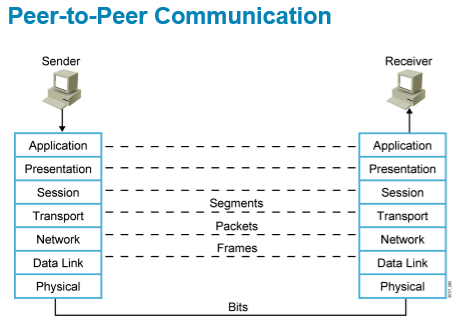
A protocol architecture is the layered structure of hardware and software that supports the exchange of data between systems and supports distributed applications, such as electronic mail and file transfer. At each layer of a protocol architecture, one or more common protocols are implemented in communicating systems. Each protocol provides a set of rules for the exchange of data between systems. The most widely used protocol architecture is the TCP/IP protocol suite, which consists of the following layers: physical, network access, internet, transport, and application. Another important protocol architecture is the seven-layer OSI model.

-
Siswa harusTandai selesai
-
-
-
DATA TRANSMISSION
The successful transmission of data depends principally on two factors: the quality of the signal being transmitted and the characteristics of the transmission medium. The objective of this chapter and the next is to provide the reader with an intuitive feeling for the nature of these two factors. The first section presents some concepts and terms from the field of electrical engineering.This should provide sufficient background to deal with the remainder of the chapter. Section 3.2 clarifies the use of the terms analog and digital. Either analog or digital data may be transmitted using either analog or digital signals. Furthermore, it is common for intermediate processing to be performed between source and destination,and this processing has either an analog or digital character.
-
Siswa harusTandai selesai
Data transmission occurs between transmitter and receiver over some transmission medium.Transmission media may be classified as guided or unguided. In both cases, communication is in the form of electromagnetic waves. With guided media, the waves are guided along a physical path; examples of guided media are twisted pair, coaxial cable, and optical fiber. Unguided media, also called wireless, provide a means for transmitting electromagnetic waves but do not guide them; examples are propagation through air, vacuum, and seawater.


-
Siswa harusTandai selesai
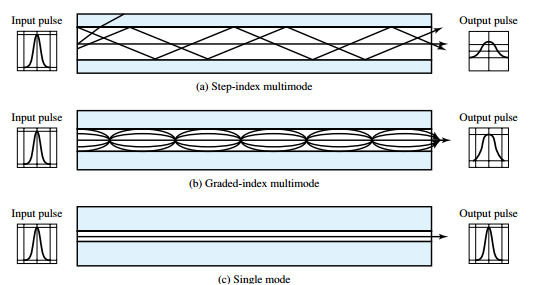
The transmission media that are used to convey information can be classified as guided or unguided. Guided media provide a physical path along which the signals are propagated; these include twisted pair, coaxial cable, and optical fiber. Unguided media employ an antenna for transmitting through air, vacuum, or water. Traditionally, twisted pair has been the workhorse for communications of all sorts. Higher data rates over longer distances can be achieved with coaxial cable, and so coaxial cable has often been used for highspeed local area network and for high-capacity long-distance trunk applications. However, the tremendous capacity of optical fiber has made that medium more attractive than coaxial cable, and thus optical fiber has taken over much of the market for high-speed LANs and for long-distance applications.

-
-
-
Siswa harusTandai selesai
Link Kuliah Daring/OnLine:
https://meet.google.com/rgb-ucfy-yve
-
Siswa harusTandai selesai
-
-
SIGNAL ENCODING TECHNIQUES
In This Chapter a distinction was made between analog and digital data and analog and digital signals. Figure 3.14 suggested that either form of data could be encoded into either form of signal. Figure 5.1 is another depiction that emphasizes the process involved. For digital signaling, a data source g(t), which may be either digital or analog, is encoded into a digital signal x(t).The actual form of x(t) depends on the encoding technique and is chosen to optimize use of the transmission medium. For example, the encoding may be chosen to conserve bandwidth or to minimize errors. The basis for analog signaling is a continuous constant-frequency signal known as the carrier signal. The frequency of the carrier signal is chosen to be compatible with the transmission medium being used. Data may be transmitted using a carrier signal by modulation.
-
Siswa harusTandai selesai
A digital signal is a sequence of discrete, discontinuous voltage pulses. Each pulse is a signal element. Binary data are transmitted by encoding each data bit into signal elements. In the simplest case, there is a one-to-one correspondence between bits and signal elements. An example is shown in Figure 3.16, in which binary 1 is represented by a lower voltage level and binary 0 by a higher voltage level. We show in this section that a variety of other encoding schemes are also used.


-
Siswa harusTandai selesai
The transmission of a stream of bits from one device to another across a transmission link involves a great deal of cooperation and agreement between the two sides. One of the most fundamental requirements is synchronization. The receiver must know the rate at which bits are being received so that it can sample the line at appropriate intervals to determine the value of each received bit.Two techniques are in common use for this purpose. In asynchronous transmission, each character of data is treated independently. Each character begins with a start bit that alerts the receiver that a character is arriving.The receiver samples each bit in the character and then looks for the beginning of the next character. This technique would not work well for long blocks of data because the receiverΓÇÖs clock might eventually drift out of synchronization with the transmitterΓÇÖs clock. However, sending data in large blocks is more efficient than sending data one character at a time. For large blocks, synchronous transmission is used. Each block of data is formatted as a frame that includes a starting and an ending flag. Some form of synchronization, such as the use of Manchester encoding, is employed.


-
-
-
Siswa harusTandai selesai
-
-
DATA LINK CONTROL PROTOCOLS
Because of the possibility of transmission errors, and because the receiver of data may need to regulate the rate at which data arrive, synchronization and interfacing techniques are insufficient by themselves. It is necessary to impose a layer of control in each communicating device that provides functions such as flow control, error detection, and error control.This layer of control is known as a data link control protocol.
-
Siswa harusTandai selesai
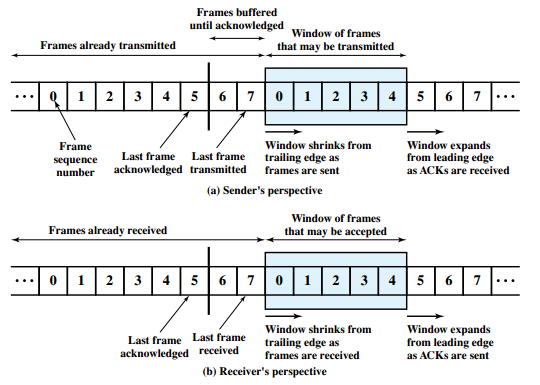
Flow control is a technique for assuring that a transmitting entity does not overwhelm a receiving entity with data. The receiving entity typically allocates a data buffer of some maximum length for a transfer. When data are received, the receiver must do a certain amount of processing before passing the data to the higher-level software. In the absence of flow control, the receiverΓÇÖs buffer may fill up and overflow while it is processing old data.

-
Siswa harusTandai selesai
To make efficient use of high-speed telecommunications lines, some form of multiplexing is used. Multiplexing allows several transmission sources to share a larger transmission capacity. The two common forms of multiplexing are frequency division multiplexing (FDM) and time division multiplexing (TDM).


-
Siswa harusTandai selesaiAddress Resolution Protocol merupakan sebuah protokol yang bertanggung jawab mencari tahu Mac Address atau alamat hardware dari suatu Host yang tergabung dalam sebuah jaringan LAN dengan memanfaatkan atau berdasarkan IP Address yang terkonfigurasi pada Host yang bersangkutan. Dalam OSI layer, protokol ini bekerja antara Layer 2 dan Layer 3.
-
Siswa harusTandai selesai
Packet tracer
Packet tracer adalah sebuah simulator protocol jaringan dapat mensimulasikan berbagai macam protocol yang digunakan pada jaringan baik secara realtime maupun dengan mode simulasi. Perangkat ini dkembangkan oleh CISCO Sytem, Inc.
-
-
-
Siswa harusTandai selesai
-
-
SPREAD SPECTRUM
Spread spectrum is an important form of encoding for wireless communications. The use of spread spectrum makes jamming and interception more difficult and provides improved reception. The basic idea of spread spectrum is to modulate the signal so as to increase significantly the bandwidth (spread the spectrum) of the signal to be transmitted.
-
Siswa harusTandai selesai
The spread spectrum technique was developed initially for military and intelligence requirements. The essential idea is to spread the information signal over a wider bandwidth to make jamming and interception more difficult. The first type of spread spectrum developed is known as frequency hopping.1 A more recent type of spread spectrum is direct sequence. Both of these techniques are used in various wireless communications standards and products.


-
Siswa harusTandai selesai
Circuit switching is used in public telephone networks and is the basis for private networks built on leased lines and using on-site circuit switches. Circuit switching was developed to handle voice traffic but can also handle digital data, although this latter use is often inefficient.


-
-
-
Siswa harusTandai selesai
-
-
ASYNCHRONOUS TRANSFER MODE
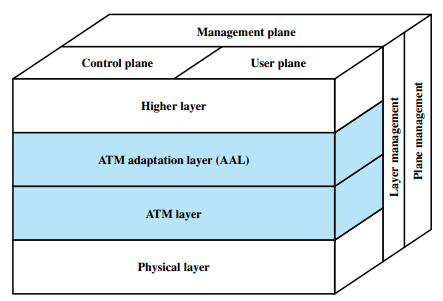
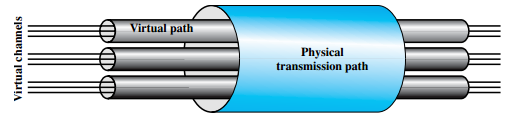
ATM is a streamlined packet transfer interface. ATM makes use of fixed-size packets, called cells. The use of a fixed size and fixed format results in an efficient scheme for transmission over high-speed networks. Some form of transmission structure must be used to transport ATM cells. One option is the use of a continuous stream of cells, with no multiplex frame structure imposed at the interface. Synchronization is on a cell-by-cell basis.The second option is to place the cells in a synchronous time-division multiplex envelope. In this case, the bit stream at the interface has an external frame based on the Synchronous Digital Hierarchy (SDH).
-
Siswa harusTandai selesai
Asynchronous transfer mode is in some ways similar to packet switching using X.25 and to frame relay. Like packet switching and frame relay,ATM involves the transfer of data in discrete chunks. Also, like packet switching and frame relay, ATM allows multiple logical connections to be multiplexed over a single physical interface. In thecase of ATM, the information flow on each logical connection is organized into fixedsize packets, called cells.
-
Siswa harusTandai selesai
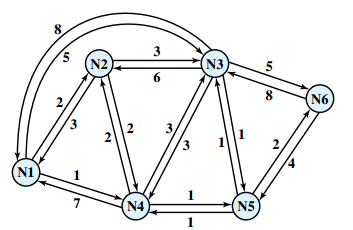
This chapter begins with a brief overview of issues involved in routing design. Next, we look at the routing function in packet-switching networks and then examine least-cost algorithms that are a central part of routing in switched networks. These topics cover issues that are relevant to routing in internets as well as packet-switching networks.

-
-
-
Siswa harusTandai selesai
-
-
CONGESTION CONTROL IN DATA NETWORKS
Congestion occurs when the number of packets being transmitted through a network begins to approach the packet-handling capacity of the network. The objective of congestion control is to maintain the number of packets within the network below the level at which performance falls off dramatically.
-
Siswa harusTandai selesai
Consider the queuing situation at a single packet switch or router, such as is illustrated in Figure 13.1. Any given node has a number of I/O ports3 attached to it: one or more to other nodes, and zero or more to end systems. On each port, packets arrive and depart. We can consider that there are two buffers, or queues, at each port, one to accept arriving packets, and one to hold packets that are waiting to depart. In practice, there might be two fixed-size buffers associated with each port, or there might be a pool of memory available for all buffering activities. In the latter case, we can think of each port having two variable-size buffers associated with it, subject to the constraint that the sum of all buffer sizes is a constant.


-
Siswa harusTandai selesai
The essence of a cellular network is the use of multiple low-power transmitters. The area to be covered is divided into cells in a hexagonal tile pattern that provide full coverage of the area. A major technical problem for cellular networks is fading, which refers to the time variation of received signal power caused by changes in the transmission medium or path(s).


-
-
-
Siswa harusTandai selesai
-
-
-
HIGH-SPEED LANS
Recent years have seen rapid changes in the technology, design, and commercial applications for local area networks (LANs).A major feature of this evolution is the introduction of a variety of new schemes for high-speed local networking.To keep pace with the changing local networking needs of business, a number of approaches to high speed LAN design have become commercial products. The most important of these are Fast Ethernet and Gigabit Ethernet, Fibre Channel, High-speed wireless LANs.
-
Siswa harusTandai selesai
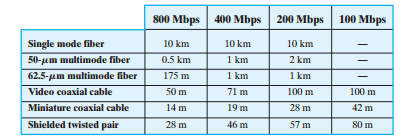
As the speed and memory capacity of personal computers, workstations, and servers have grown, and as applications have become ever more complex with greater reliance on graphics and video, the requirement for greater speed in delivering data to the processor has grown.This requirement affects two methods of data communications with the processor: I/O channel and network communications.

-
-
-
Siswa harusTandai selesai
-
-
Wireless LANs
In just the past few years, wireless LANs have come to occupy a significant niche in the local area network market. Increasingly, organizations are finding that wireless LANs are an indispensable adjunct to traditional wired LANs, to satisfy requirements for mobility, relocation, ad hoc networking, and coverage of locations difficult to wire. This chapter provides a survey of wireless LANs. We begin with an overview that looks at the motivations for using wireless LANs and summarize the various approaches in current use. The next section examines the three principal types of wireless LANs, classified according to transmission technology: infrared, spread spectrum, and narrowband microwave.
-
-
-
-
Siswa harusTandai selesai
-
-
INTERNET PROTOCOLS
The purpose of this chapter is to examine the Internet Protocol, which is the foundation on which all of the internet-based protocols and on which internetworking is based. First, it will be useful to review the basic functions of networking protocols. This review serves to summarize some of the material introduced previously and to set the stage for the study of internet-based protocols in Parts Five and Six. We then move to a discussion of internetworking. Next, the chapter focuses on the two standard internet protocols: IPv4 and IPv6. Finally, the topic of IP security is introduced.
-
-
-
-
Siswa harusTandai selesai
-
-
INTERNETWORK OPERATION
As the Internet and private internets grow in scale, a host of new demands march steadily into view. Low-volume TELNET conversations are leapfrogged by highvolume client/server applications. To this has been added more recently the tremendous volume of Web traffic, which is increasingly graphics intensive. Now real-time voice and video applications add to the burden.
-
-
-
-
Siswa harusTandai selesai
-
-
Transport Protocol
In a protocol architecture, the transport protocol sits above a network or internetwork layer, which provides network-related services, and just below application and other upper-layer protocols. The transport protocol provides services to transport service (TS) users, such as FTP, SMTP, and TELNET. The local transport entity communicates with some remote transport entity, using the services of some lower layer, such as the Internet Protocol. The general service provided by a transport protocol is the end-to-end transport of data in a way that shields the TS user from the details of the underlying communications systems.
-
-
-
Siswa harusTandai selesai
-
-
EIGRP Implementation
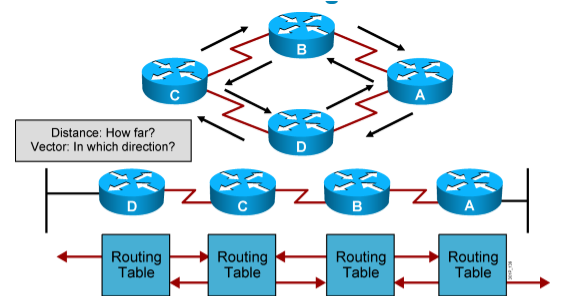
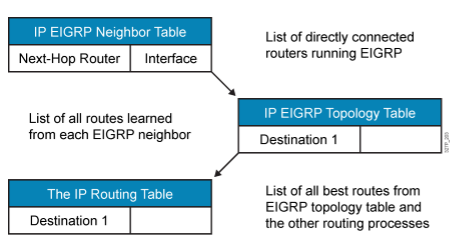
Enhanced Interior Gateway Routing Protocol (EIGRP) is an advanced ditance-vector routing protocol that is used on a computer network for automating routing decisions and configuration. The protocol was designed by Csco System as a proprietary protocol, available only on Cisco routers.
-
-
-
Siswa harusTandai selesai
-
-
TUGAS BESAR
-
Siswa harusTandai selesai
Rancang sebuah skema Jaringan menggunakan 2 router dengan komputer sebanyak 20 unit. Tuliskan komponen yang digunakan, fungsi dan cara kerjanya pada skema yang anda buat.
-